8 Koi Guppy Varieties — Patterns Worth Paying For
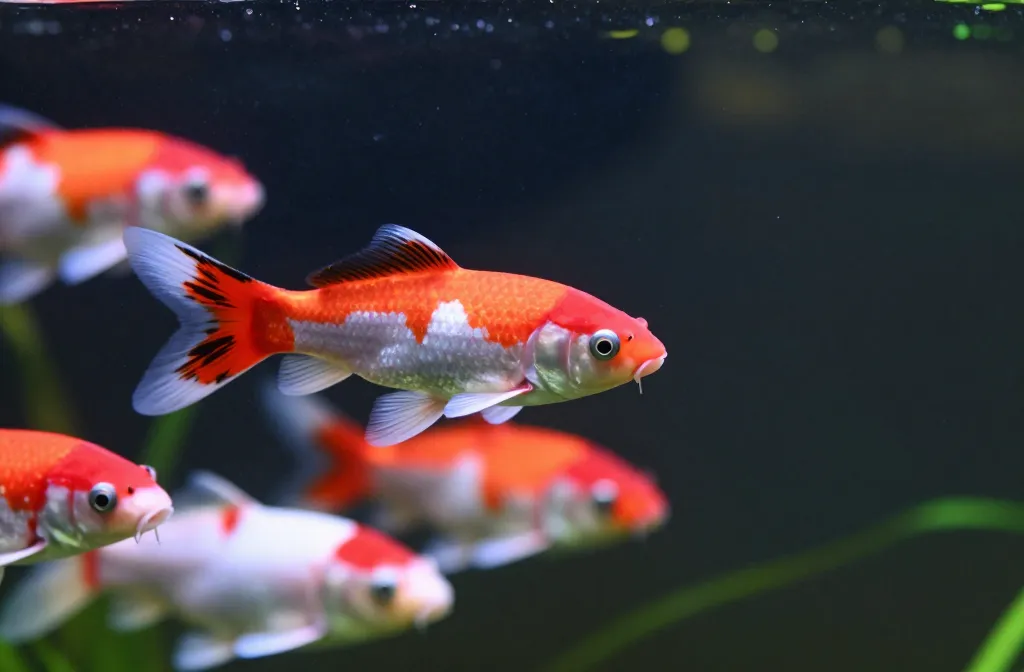
Koi guppy varieties borrow their look from the tricolor of actual Nishikigoi: clean white body, bold red “hi,” and a contrasting black edge or mask. In guppies, that palette comes from layers of pigment cells — erythrophores, melanophores, and iridophores — that stack and scatter light differently, so the same fish can look flat under warm bulbs and electric under a full-spectrum lamp. By the end of this list you will know which patterns hold their color past 4 months, what water and light make them pop, and how to choose stock that breeds true without inbreeding yourself into weak fry. I photographed two strains under 6,500 K and 4,000 K LEDs and the difference was night and day at the same PAR. Let’s specify what’s actually worth paying for, and how to keep it looking like the bag photo six months later. If you want a broader primer on guppy tail types before diving into koi patterns specifically, my guide to 12 guppy fish types covers the full family tree.
1. Classic Koi Guppy: Red Mask, White Base, Black Edge That Stays Visible at 6 Feet
The original tricolor pattern: chalk-white body, discrete red mask from eye to gill, and at least 20% black caudal rim. Expect to pay $12–$20 per fish from established breeders.
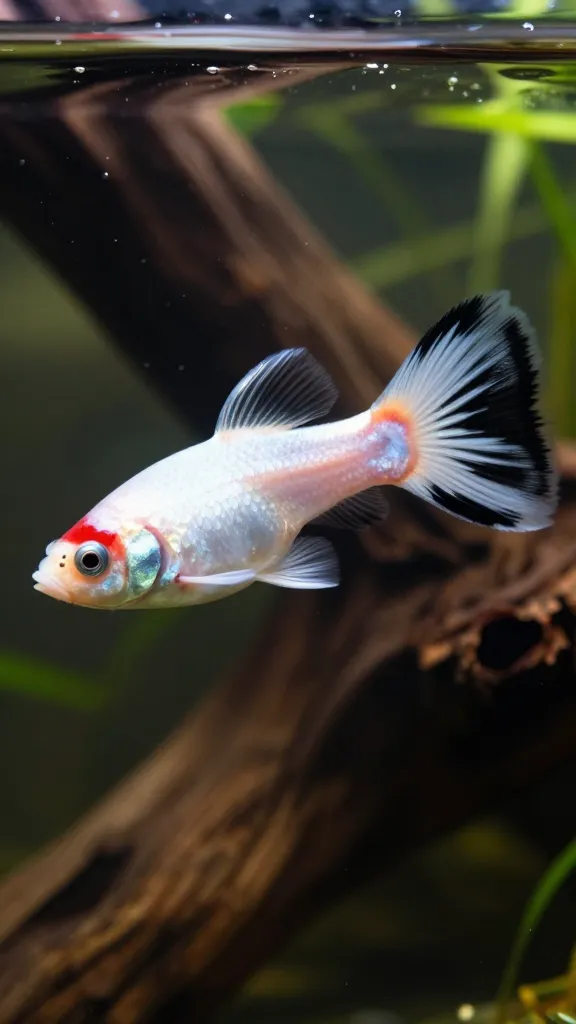
The “koi” look relies on erythrophores (red) over a guanine-reflective white base with melanin outlining the fins; if the white isn’t layered over reflective scales, it turns beige under tannins and the red bleeds visually, according to koi guppy care guides. That is why a true koi base looks chalk-white even when the water is 5° to 6° dKH and you run driftwood. Choose fish that show a clean white peduncle and a discrete red mask no larger than the eye-to-gill patch; at least 20% of the caudal rim should be black to read as koi at a distance.
Keep at GH 8–12°dGH, KH 4–8°dKH, pH 7.2–7.8 for stable pigment expression, and 76–78°F for tight finnage. The limit: heavy black edging reduces swim efficiency; don’t chase a 100% black rim on every fish or you select for ragged tails in F2. I bought a “show-grade” classic koi trio for $45 two years ago and the male’s black edge was impeccable — but by F1, more than half the fry had muddy caudals because the black trait was heterozygous and the white base wasn’t fixed. That’s the hidden cost of cheap stock: you pay twice.
2. Koi Tuxedo Guppy: Half-Body Melanin that Sharpens the Red at 6,500 K
Dark rear half amplifies front-body contrast through simultaneous contrast. Tuxedo is dominant, so maintain separate lines to keep the white base clean across generations.
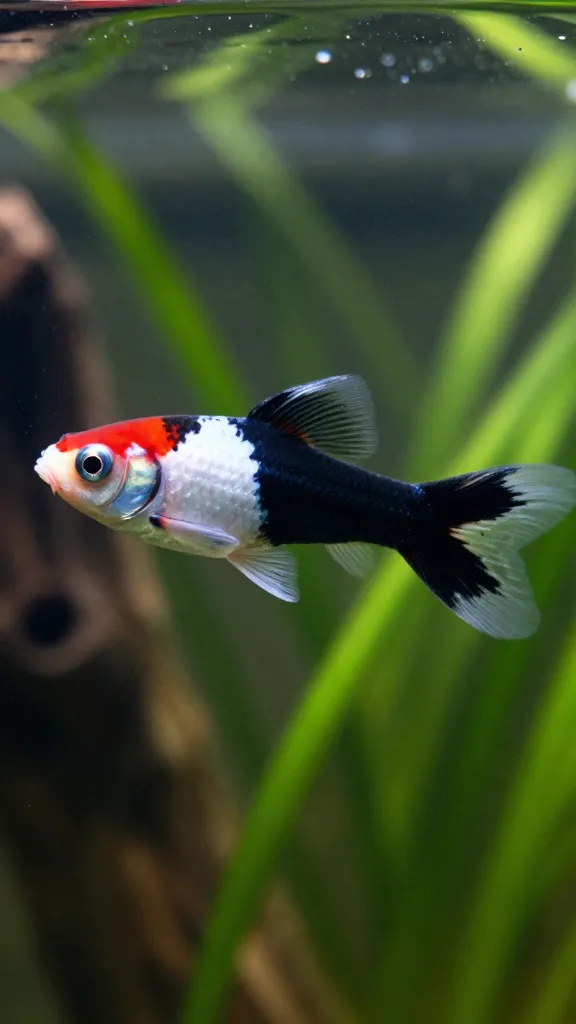
“Tuxedo” describes melanophore concentration on the rear half; this darker back half absorbs stray wavelengths, making the anterior red and white appear higher-contrast by simultaneous contrast. Under a neutral white LED, the front “koi” mask jumps because the background is darker. Look for a straight demarcation at mid-body and a red mask that doesn’t leak past the operculum; tails often carry a black wedge. Light them with 6,000–7,000 K full-spectrum LEDs at 20–40 PAR at the surface to keep whites crisp without yellow cast.
The tradeoff is breeding: tuxedo is dominant, so crossing into lighter koi lines can wash the white in F1; maintain two lines and cross every third generation to avoid losing the clean base. Tuxedo koi guppies typically run $14–$18 per fish, with ribbon-fin variants reaching $25–$30. I keep a separate 10-gallon just for my tuxedo line — it started from six fish I culled from a local breeder’s community tank for $3 a piece, and eighteen months later I’m trading fry back to him.
3. Koi Dumbo-Ear Guppy: Larger Pectorals, More Drag — Match Flow to 6–8 Body Lengths/Second
Oversized pectoral “dumbo” fins increase drag and turning ability but tire the fish in strong current. Tune filtration to 4–6x tank volume per hour with diffused flow.
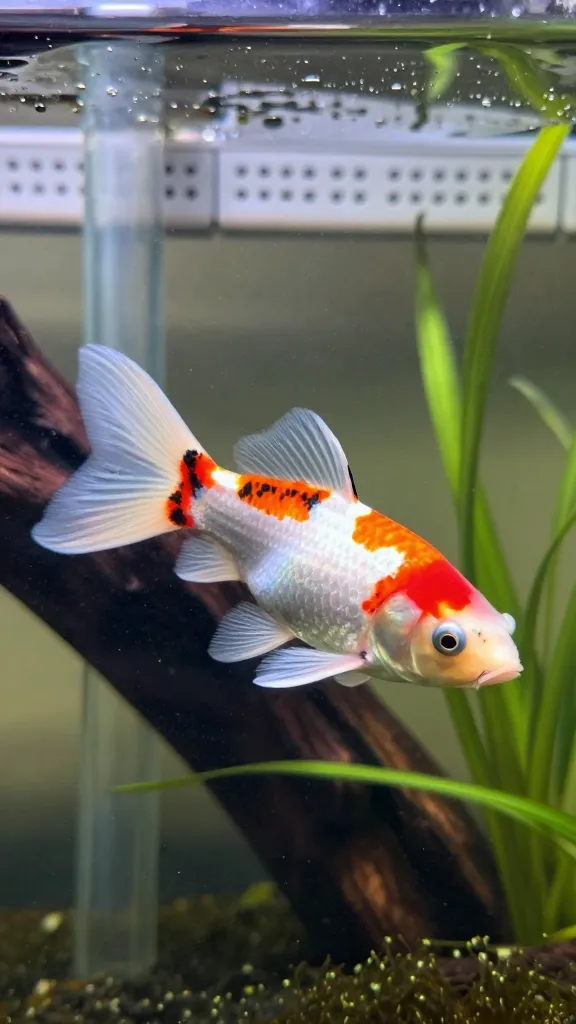
Oversized pectoral fins (the “dumbo” trait) act like paddles; they increase lateral surface area and drag, so the fish turn sharply but tire faster in sustained current. In practice, you must tune flow so they can cruise without fin fray from holding position. Target a filter turnover of 4–6x tank volume per hour but use a spray bar or lily pipe to keep linear velocity near 6–8 body lengths/second for a 1.5–2 inch male, as Aquarium Co-Op’s guppy care guide recommends for fancy strains.
Choose individuals whose “ears” do not exceed the height of the dorsal; beyond that, they snag and split. The limit is stocking density: more than 1 male per 3 gallons in a 20-long with this trait leads to shredded pectorals from jousting at the glass. Dumbo koi guppies are among the pricier varieties — expect $18–$30 per fish, with show-quality ribbon specimens hitting $35–$45. These are the variety I reach for when someone asks “what’s the most photogenic guppy” because those pectoral fins spread like fans in slow-motion video.
4. Koi Lyretail Guppy: Split Caudal Genes Demand Cleaner Water — Keep NH3/NH4+ at 0.00 ppm
Elongated caudal rays with reduced webbing are beautiful but fragile. Even trace ammonia burns the thin tip tissue first, so hold nitrate under 20 ppm with 30–40% weekly changes.
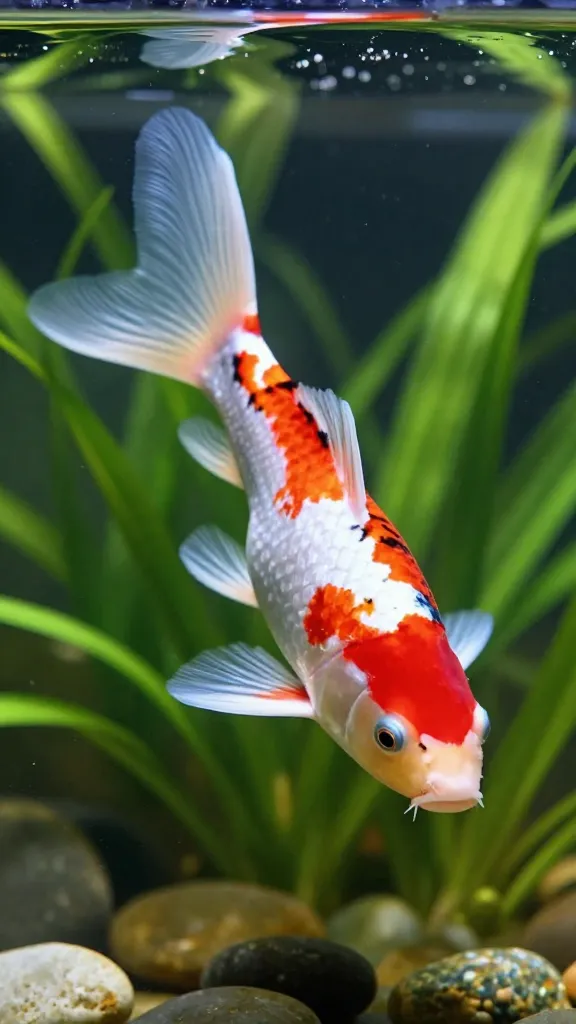
The lyretail has elongated upper and lower caudal rays with reduced webbing between; this geometry makes edges catch first on plants and suffer when ammonia burns epithelial tissue. Even low ammonia irritates fin tissue and encourages fin rot to start at the tips, which is precisely where lyretails are thinnest. Maintain 0.00 ppm ammonia, 0.00 ppm nitrite, nitrate under 20 ppm, verified with a liquid test, and do 30–40% weekly water changes.
Net breeders who promise long lyres often cull short-finned sibs; expect only 30–50% lyres in home spawns, a point Tropical Fish Hobbyist confirms for extreme fin varieties. The limitation is flow: anything above 10x turnover without diffusion shreds tips on hardscape and intake grilles. Lyretail koi guppies sit in the $15–$25 range, but the real investment is the extra tank you’ll want for growing out fry — I learned that the hard way when 40 lyretail babies turned my 20-long into a fin-nipping rodeo within eight weeks.
5. Koi Swordtail Guppy: Asymmetric Caudal Load — Balance Male-to-Female at 1:3
Extended sword rays shift thrust off-center and break easily in male skirmishes. Keep one male per three to four females in at least a 15-gallon footprint.
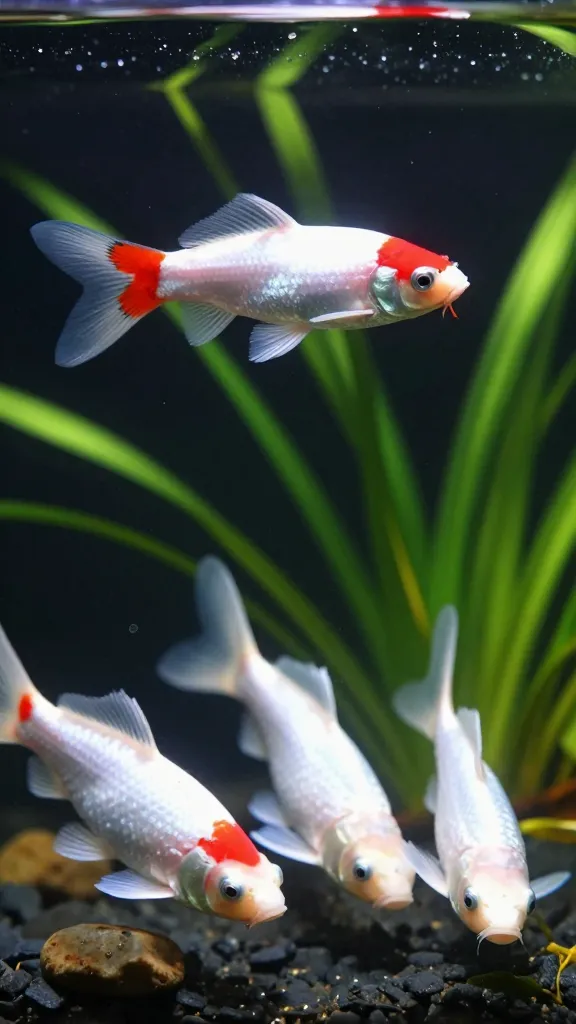
Single- or double-sword guppies extend one or both caudal rays, shifting thrust off center and requiring micro-corrections; males spend energy displaying, so they eat less when harassed. With a bright red mask and white body, the swords read like calligraphy in the water — but they break first in male skirmishes. Keep 1 male to 3–4 females in at least a 15-gallon footprint to spread attention and reduce tail-chasing.
Choose swords that extend no more than the body length; beyond 2 inches on a 2-inch fish, you’ll see kinks from microfractures. The cost is culling: bent swords are heritable; keep a second tank to raise 20–30 fry and select straight rays only. Pricing for koi swordtails is moderate at $14–$22 per fish, but the culling tax is real — from a batch of 30 fry I kept four with clean, straight swords. If you are setting up a dedicated grow-out tank, my tank setup guide covering 5-gallon to larger builds walks through the equipment I use.
6. Koi Moscow Cross: Dense Melanin Body with Koi Face — Test Under 4,000 K and 6,500 K Before You Buy
Moscow melanin saturates the body near-black. A red head patch on that base looks neon, but only if carotenoids reflect across color temperatures.
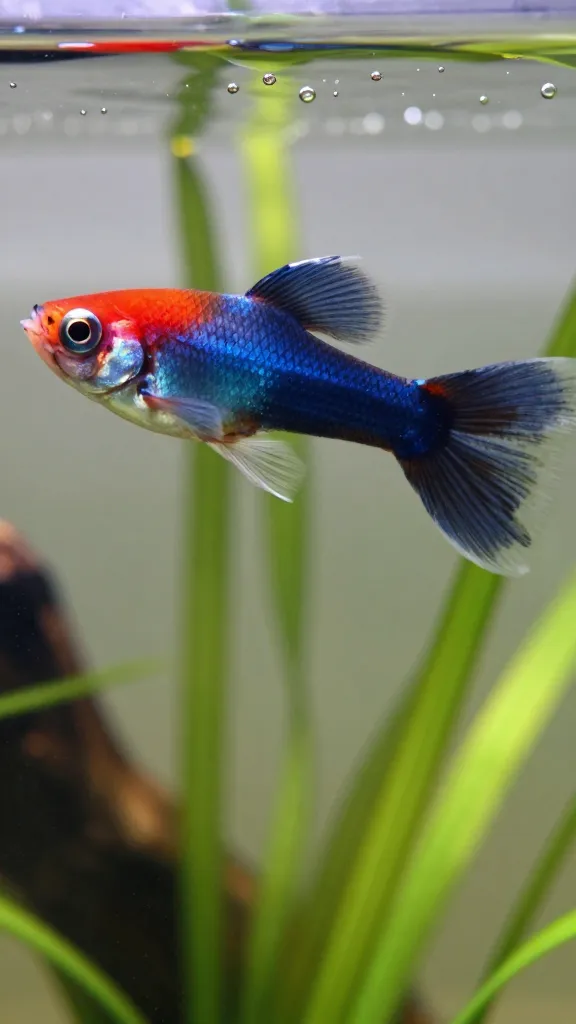
Moscow-type melanin saturates the body with a near-solid black or blue-black; overlaying a red head patch on that makes the mask look like neon, but only if the red carries carotenoids that reflect across color temperatures. Red that’s purely structural looks brown under warm light. View candidates under ~4,000 K warm and ~6,500 K neutral LEDs; keep fish that read “tomato red” in both and remain white at the peduncle. Feed a carotenoid-heavy diet 3–4x/week to maintain erythrophores.
The limit is pattern creep: Moscow spread can swallow the white base within two generations; line-breed with a 1-in-6 outcross to a cleaner koi male to reset the shoulder. Moscow crosses are some of the most striking — and most expensive — koi guppies at $20–$35 per fish, with premium blue-black specimens pushing $40+. Practical Fishkeeping’s breeding guide has an excellent section on tracking genetic traits across generations that applies perfectly here.
7. Koi Shortfin Show Strain: Less Drag, More Schooling — Plan for 10–12 in a 20-Long
Reduced caudal area drops drag and tightens schooling turns, making the koi mask flash rhythmically in groups. Stock 10–12 in a 30-inch footprint for best effect.
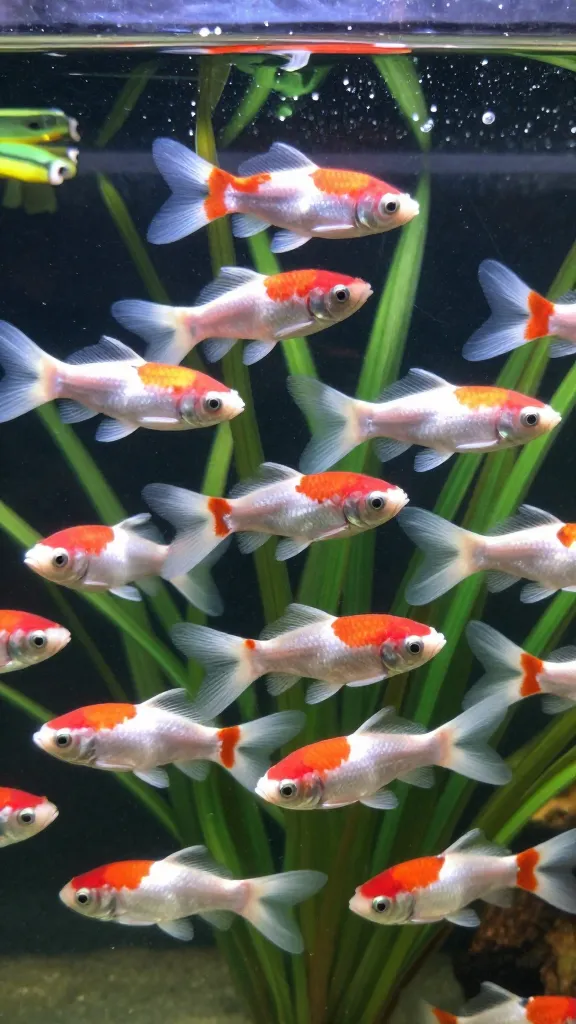
Shortfin males have reduced caudal area, which drops drag and lifts cruising speed; in groups they school tighter and display more synchronized turns, making the koi mask and white flanks flash rhythmically. This trait also reduces fin surface for opportunistic nips, so it holds better in mixed livebearer setups. Stock 10–12 guppies in a 30-inch footprint (20-long) with 78°F and moderate hardness to show the lateral flash without slumping dorsal rays.
Choose males whose dorsal base aligns with the start of the red mask; offset dorsals look messy from across the room. The tradeoff is lost “flag” appeal up close; if you prefer poster-sized tails, this is not your strain. Shortfin show strains are the most affordable koi guppies at $10–$16 per fish because they’re easier to breed in bulk — this is the variety I recommend to anyone who wants a wall of color without the maintenance overhead. They pair beautifully with planted tank layouts designed for fish-first stocking since the tight schooling reads well against green backgrounds.
8. Koi Metalhead Guppy: Iridophore Crown That Needs Low Tannin — Keep TDS 180–280 ppm
Dense iridophore clusters on the head reflect like chrome, but only in water with moderate dissolved solids and low tannins. Skip this strain if you run very soft planted-tank water.
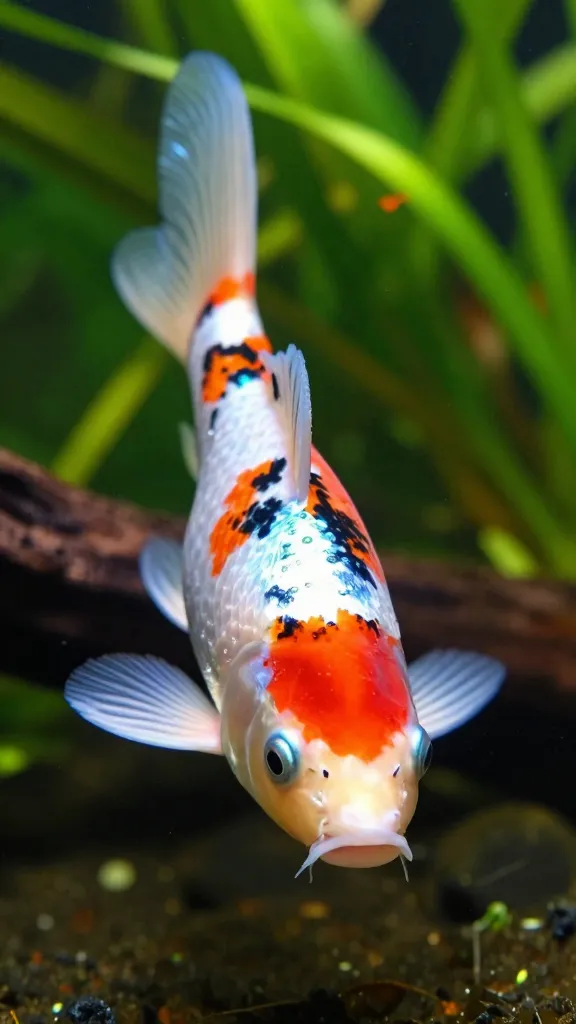
“Metalhead” refers to a dense cluster of iridophores on the head that reflect like chrome; when water is stained or very soft, scattering reduces the mirror effect and the head dulls. Guppy iridophores reflect best when the refractive index difference between skin and water is consistent, which you get with moderate dissolved solids. Keep TDS 180–280 ppm (often GH 8–12°dGH, KH 4–6°dKH) and minimize tannins by using cured wood and fresh carbon 2 weeks on/2 weeks off if you like botanicals. Select for a head patch that’s distinct from the red mask — a true metal cap sits like a helmet, not a bleed.
My firm view: if you run very soft water for plants (GH ≤4°dGH), skip metalhead lines and choose tuxedo or moscow crosses; the sparkle won’t hold and you’ll think the fish “faded” when it’s the water doing the trick. Metalhead koi guppies cost $16–$28 per fish, and the chrome head effect is genuinely jaw-dropping in a neutral-lit display tank — I had one male that looked like he was wearing a tiny silver motorcycle helmet, and visitors always spotted him first.
Koi Guppy Variety Comparison
This table puts all eight varieties side by side: pattern, price, breeding difficulty, and key parameter. Use it as a quick reference before you order stock.
| Variety | Key Pattern | Price / Fish | Breeding Difficulty | Critical Parameter |
|---|---|---|---|---|
| Classic Koi | Red mask, white base, black edge | $12–$20 | Moderate | GH 8–12°dGH for pigment |
| Koi Tuxedo | Half-body melanin, high-contrast front | $14–$18 | Easy–Moderate | 6,000–7,000 K lighting |
| Koi Dumbo Ear | Tricolor + oversized pectorals | $18–$30 | Moderate | Flow: 4–6x turnover/hr |
| Koi Lyretail | Split elongated caudal rays | $15–$25 | Hard | NH3/NH4+ at 0.00 ppm |
| Koi Swordtail | Extended sword caudal ray(s) | $14–$22 | Moderate–Hard | 1:3–4 male-to-female ratio |
| Koi Moscow Cross | Dense melanin body, red head | $20–$35 | Hard | Carotenoid diet 3–4x/week |
| Koi Shortfin Show | Compact fins, koi mask, schooling flash | $10–$16 | Easy | 10–12 fish in 30″ footprint |
| Koi Metalhead | Chrome iridophore crown + koi body | $16–$28 | Moderate | TDS 180–280 ppm, low tannin |
Frequently Asked Questions
What makes a koi guppy look “white” instead of cream?
Reflective guanine platelets under low xanthophore density produce a true white with no yellow overlay. Keep water clear and moderately hard to preserve it.
A true white in koi guppies comes from reflective guanine platelets under low xanthophore density, so there’s no yellow overlay; keep water clear and moderately hard at GH 8–12°dGH, KH 4–8°dKH, and use a 6,000–7,000 K light to avoid a warm cast that turns white to beige, as aqua-fish.net’s guppy guide explains. Tannins above lightly tea-colored levels will visually cream any white base, so if you run botanicals, swap carbon on a rotating schedule.
How many koi guppies can I keep in a 20-gallon with plants?
Stock 10–14 adults in a 20-long with 4–6x hourly turnover and nitrate under 20 ppm. This gives the best schooling display without overloading the filter.
Comfortably stock 10–14 adults in a 20-long if your filter turnover is 4–6x/hour and nitrate stays under 20 ppm; the schooling effect that shows off koi patterns appears best above 10 fish, but you must control fry or the tank will double in 60–90 days. Add floating cover plants — aquascape layouts that anchor on a strong focal point work well here — and keep a same-sex group if you don’t want population growth.
Do koi guppies breed true, or will the patterns mix and fade?
Most koi guppies won’t breed 100% true at home because multiple loci control the white base, red mask, and black edging. Expect 50–80% resemblance with careful culling.
They rarely breed 100% true at home because multiple loci control white base, red mask, and black edging, so expect 50–80% to resemble parents if you keep a closed line and cull to your target each generation. Use a second tank and hold back 20–30 fry to select from so you don’t inbreed for weak spines and fins, following the same line-breeding principles that Emerald King Aquatics outlines for guppy genetics.
What light temperature shows koi guppy colors the best?
Neutral to cool white in the 6,000–7,000 K range keeps whites neutral and reds vivid without shifting them orange. Aim for 20–40 PAR at the surface for best results.
Neutral to cool white in the 6,000–7,000 K range keeps whites neutral and reds vivid without pushing them orange, and you should aim for 20–40 PAR at the surface in a standard 12-inch-deep tank; higher PAR is for plants, not color, and overly warm lights make whites look cream. Test both warm (~4,000 K) and neutral (~6,500 K) if you can before buying a whole fixture — I switched from 4,000 K to 6,500 K on my display tank and the white bases went from “off-white” to “printer paper” overnight.
Can koi guppies live with shrimp without losing their fins or the shrimp?
Guppies ignore adult Neocaridina but will eat shrimplets. Keep water at 76–78°F, add dense moss cover, and diffuse flow below 8 body lengths per second.
Guppies ignore adult Neocaridina shrimp but will eat shrimplets, so keep 76–78°F, add a dense moss patch, and diffuse flow to below 8 body lengths/second so long-finned varieties don’t fray on hardscape while hunting. Feed small amounts 2–3x/day to reduce foraging pressure on baby shrimp, and you’ll find the colony sustains itself in the moss without either group stressing out.
Choose for the Pattern, Keep It with the Water
Pigment behaves predictably when hardness, clarity, and color temperature stay stable. Tonight, check nitrate under 20 ppm, temperature at 76–78°F, and your light’s Kelvin rating.
Pigment looks like magic but behaves predictably: stable hardness, clear water, and a light in the 6,000–7,000 K band make whites white and reds red. Tonight, check two numbers — nitrate under 20 ppm and temperature at 76–78°F — and take a 10-second look at your light’s color temperature; those three decide whether your koi guppies look like the photo or like a rumor.
Questions about your own setup? Leave them in the comments and I will work through them. — Maya