12 Guppy Fish Types — Tails, Patterns and How to Tell Them Apart
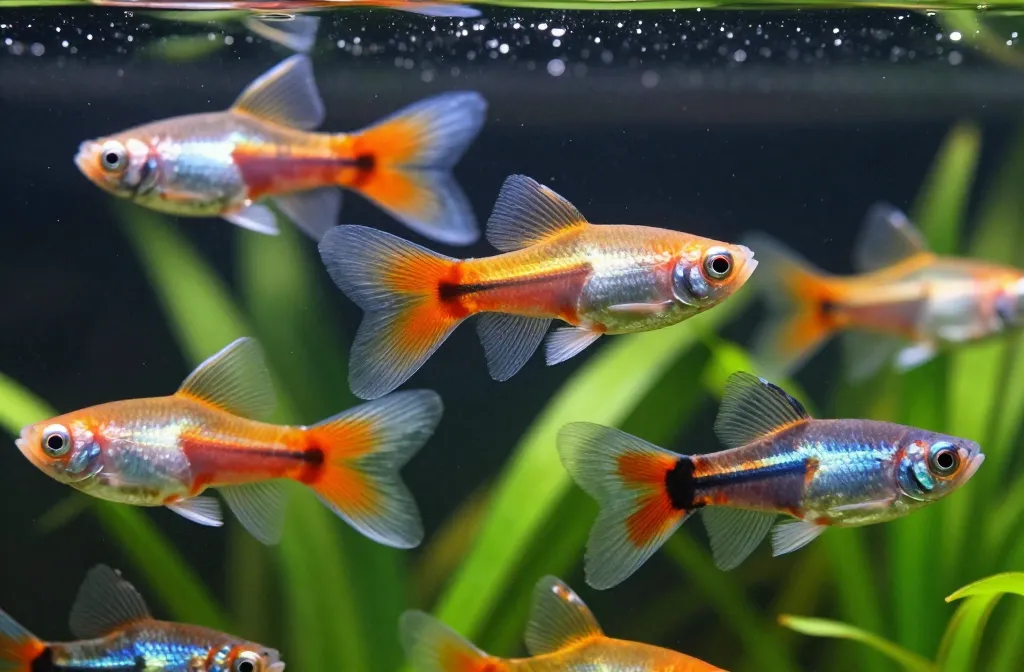
Most guppies (Poecilia reticulata) are labeled by tail shape and body pattern — but the visual comes from fin-ray structure and pigment layers that behave predictably under your lighting and water. Here is what the shapes and patterns actually mean, and the detail that lets you specify before you buy.
1. Delta Tail Guppy: The Broad Triangle
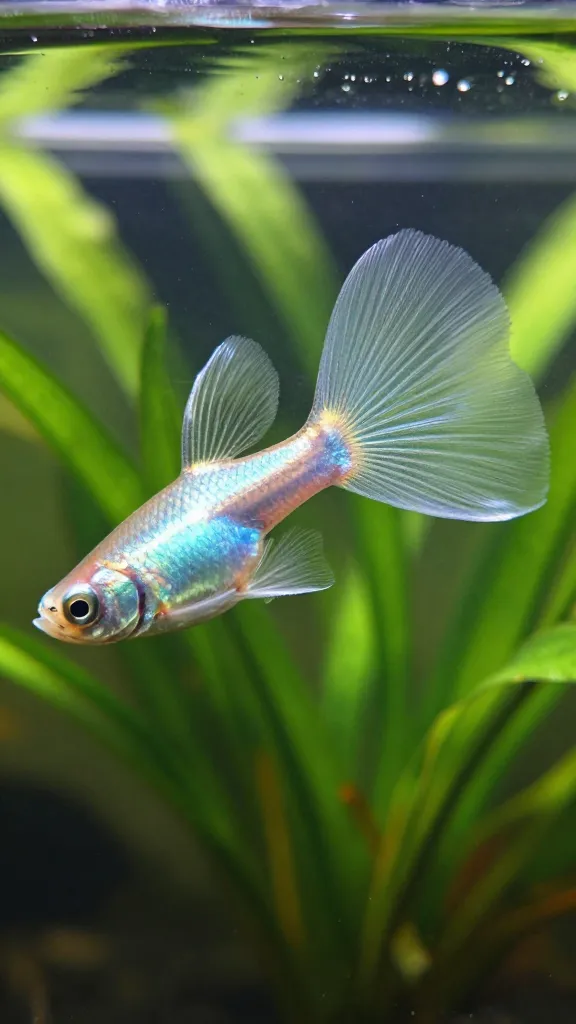
The delta tail is the most popular guppy tail form among competitive breeders worldwide. Its triangular outline comes from caudal fin rays that branch and extend, creating a wide membrane that boosts low-speed thrust at the cost of drag.
For identification, measure the tail height against body length: a classic delta shows tail height roughly equal to body length with a base-to-tip angle around 60–80°. Keep flow modest — turnover near 4× per hour prevents fraying on those broad edges. Push above 6× turnover in a 10–20 gallon and you will see nips and collapsed fin edges within two weeks. A good sponge filter rated for a 20-gallon runs about $12–18 and holds flow right where deltas need it.
2. Lyretail Guppy: Forked Filaments
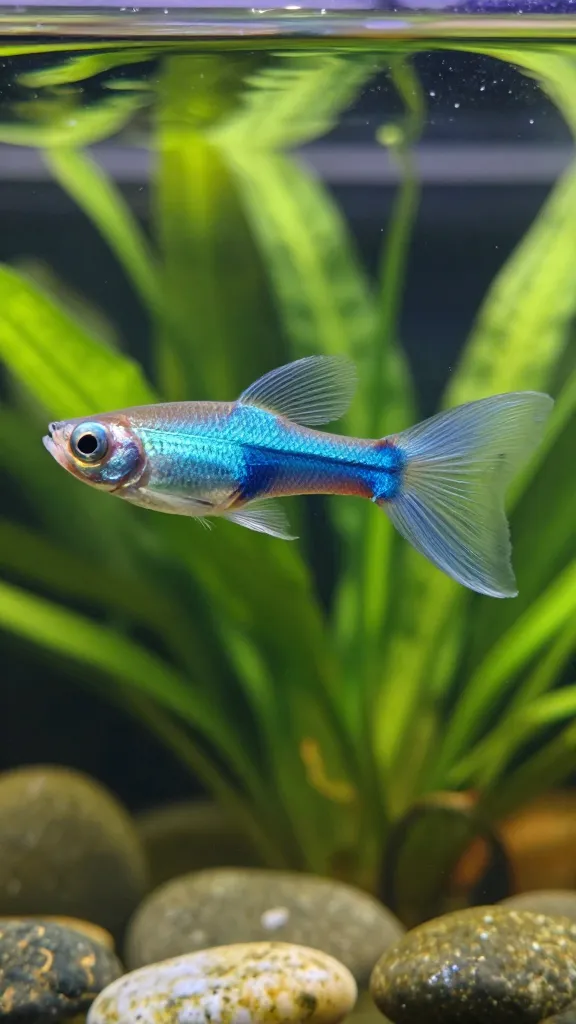
Lyretails extend the upper and lower caudal rays past the main membrane, creating a forked, filamented silhouette. The flow splits along filaments, making tight turns easier but straight-line swimming slower.
Look for two pointed extensions that are at least 15–25% of body length beyond the main tail fabric; both top and bottom should taper cleanly. Avoid sharp decor — anything with openings under 0.5 inches can catch those filaments. I lost the best lyretail male in my first breeding project to a tangle in java moss; torn filaments take 4–6 weeks to regrow in 78 °F water with protein-rich feed, and some never come back clean. Keep lyretails in tanks with smooth hardscape and you will avoid the heartbreak.
3. Fantail and Halfmoon Guppy: The 180° Arc
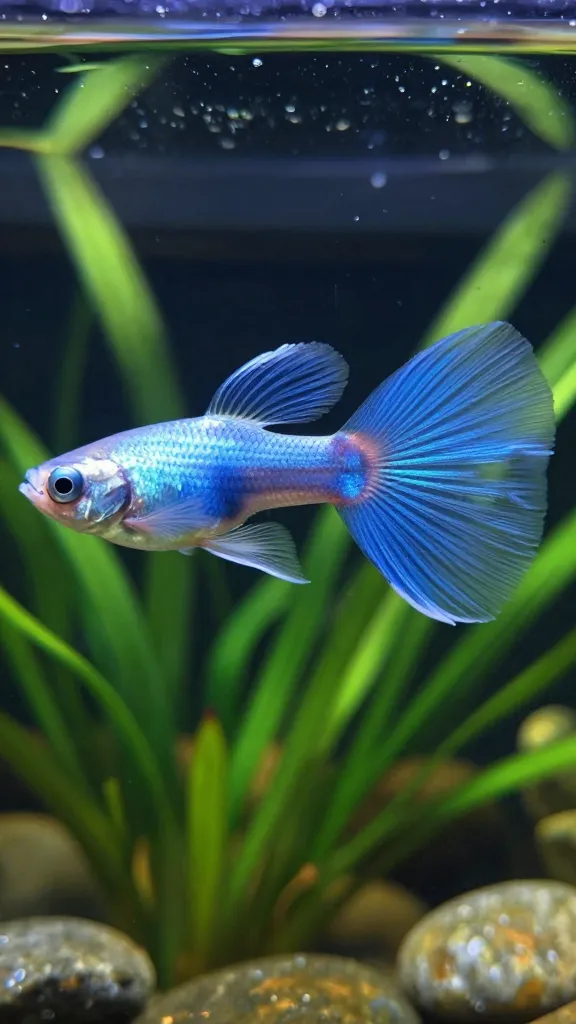
Halfmoons push caudal spread toward a near-180° semicircle with rays radiating like spokes. The fantail is a gentler version with softly curving edges and a concave rear edge.
Spot a halfmoon by the curvature — if you can inscribe a clean half-circle in a photo with the tail fully flared, you have it. These fish need gentle flow and higher oxygen; keep temperature at 76–78 °F and supplement surface agitation. I run halfmoons on a 3.5-watt air stone ($8 at the pet store) for extra O₂ because the broad fins collect detritus films. Plan on weekly 30–40% water changes to keep edges crisp — long fins bio-load faster than you would think.
4. Swordtail Guppy: The Single Lower Extension
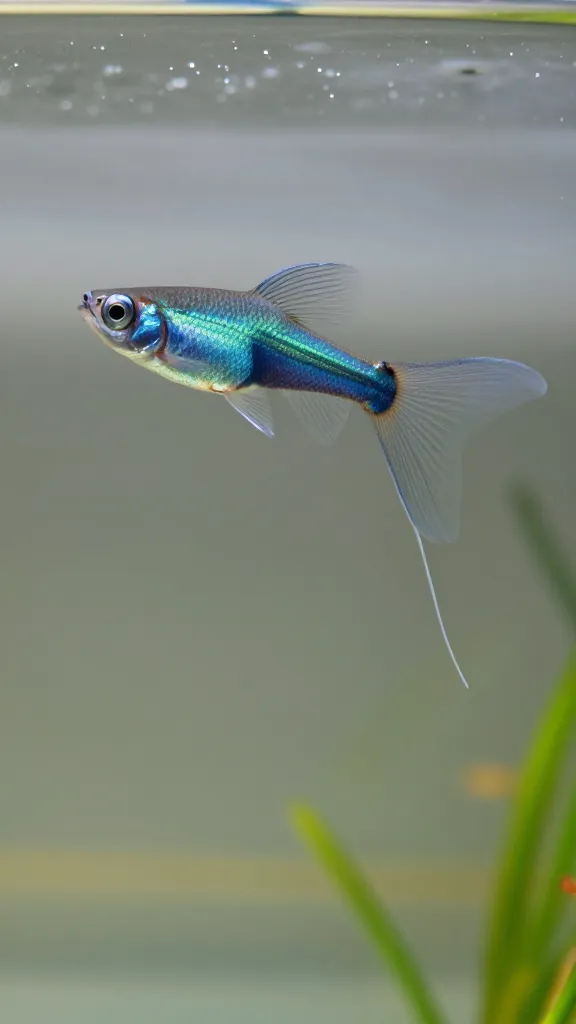
Swordtail guppies grow a single elongated lower caudal ray, creating a pendulum effect in turns and a distinct “flag” display during courting. The International Fancy Guppy Association recognizes both single and double sword variants.
Identification is simple: one lower filament at least 20–40% of body length longer than the trailing edge, with no matching top filament. Provide open water at least 18 inches long for full display — cramped tanks fold the sword and wear the tip. The sword edge abrades against moss tangles over 2–3 weeks, so keep hardscape open and smooth where swordtails display.
Tail Types at a Glance
Before we move to body patterns, here is a quick-reference chart I wish I had when I started. Each tail type changes how the fish swims, what flow rate it tolerates, and how much weekly maintenance the fins demand.
| Tail Type | Shape | Max Flow (turnover/hr) | Fin Repair Time | Key ID Feature |
|---|---|---|---|---|
| Delta | Broad triangle, straight edges | 4× | 2–3 weeks | 60–80° base angle; tail height ≈ body length |
| Lyretail | Forked, with filaments top and bottom | 4× | 4–6 weeks | Two pointed extensions ≥ 15% body length |
| Fantail | Gentle curves, widest at ¾ length | 4–5× | 2–3 weeks | Concave rear edge; 8/10 body-length caudal |
| Halfmoon | Semicircle, rays like spokes | 3–4× | 3–4 weeks | 180° spread; inscribe a half-circle in photos |
| Swordtail | Single lower extension | 4–5× | 3–4 weeks | One ventral filament 20–40% longer than body |
| Round Tail | Smooth oval, compact | 5–6× | 1–2 weeks | Closest to wild-type; no extensions or flare |
| Veiltail | Long, drooping, flowing | 3× | 3–5 weeks | Drapes downward; highest drag of all types |
5. Guppy Patterns 101: Base Layers Create the Look
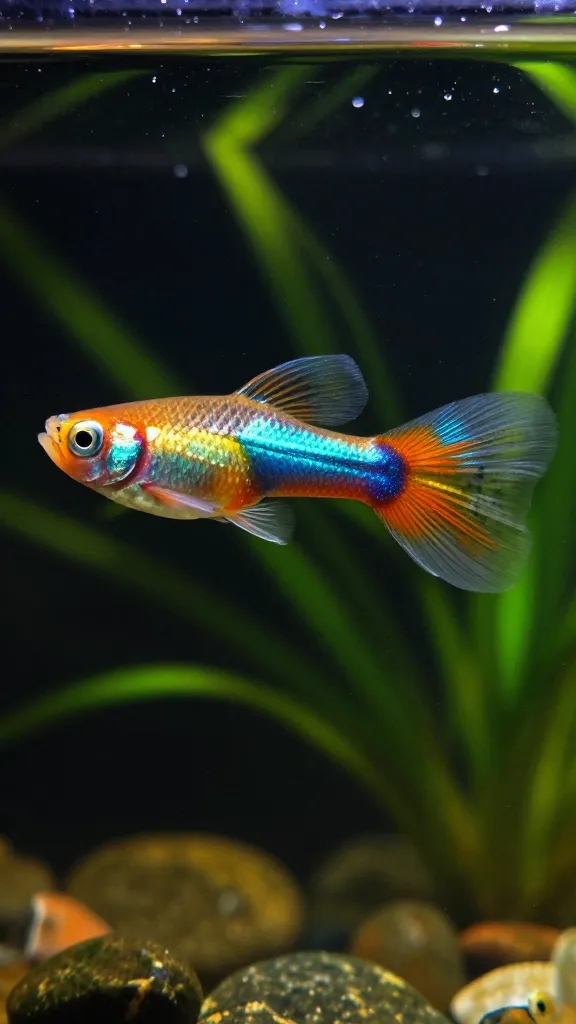
What you see on a guppy is pigment layered in three cell types: melanophores (black), xanthophores (yellow/orange), and iridophores (reflective shine). Under cool 6,500 K light, iridophores pop while reds can mute.
When you are identifying pattern, check the same fish under two lights: a warm 3,000–4,000 K and a cool 6,500–7,000 K. If the color vanishes in warm light, it is mainly iridophore shine, not true red pigment. The trap is buying for saturated phone photos — in tanks with low-CRI LEDs, reds lose 20–40% apparent depth compared to high-CRI fixtures (a good full-spectrum bar runs $25–40 for a 20-gallon and shows fish the way they actually look).
6. Cobra Pattern Guppy: Snake-Skin Reticulation
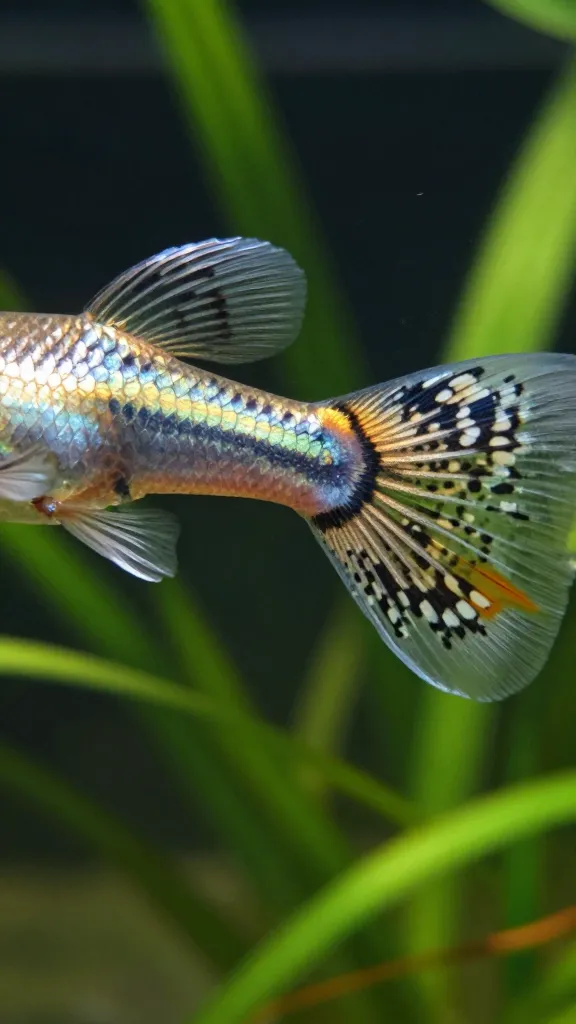
Cobra pattern creates snake-skin reticulation when dark melanophore edges frame lighter pigment along scale rows. Snakeskin shows a chain-link pattern; cobra shows finer parallel vermiculations (see the genetics guide).
Identify cobra by continuous reticulation from gill plate to caudal peduncle with 3–6 rows of netting and contrasting dots inside the “cells.” In breeding groups, cobra tends to pass as a dominant pattern — expect roughly 50–75% of sons to carry clear netting if the female is unpatterned. I bred a cobra male into a batch of plain red females and got 14 cobra-patterned sons out of 18 in the first fry round. The limit is muddiness: heavy black plus dark substrate makes the pattern disappear at viewing distances over 3 feet, so use light sand if you want the netting to read across the room. If you want to see how cobra stacks up against other show-worthy patterns, the koi guppy varieties guide covers what collectors pay a premium for.
7. Tuxedo Guppy: Two-Tone Pigment Split
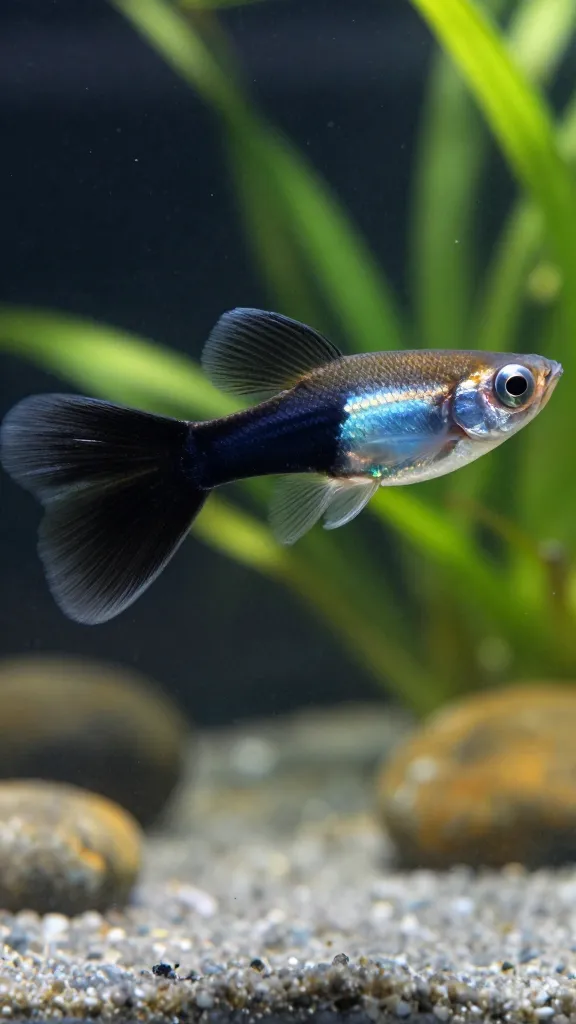
Tuxedo bodies split when melanin deposits heavily in the rear half, leaving the front lighter — a pigment boundary near the dorsal-fin origin. The boundary is crisp when skin-deep, soft when it rides only scale edges.
Look for a front-to-rear color break at about 45–55% of body length with the caudal peduncle solid and the chest pale. For display, use medium-gray sand — high-contrast black substrate makes the rear vanish and the front look washed. The weakness is females: tuxedo females often show only a faint rear shadow, so confirm males before buying if the look is important. I once bought six “tuxedo” females from a chain store and only two showed the pattern clearly — the rest looked like plain silvers until they paired with a tuxedo male and the rear darkened slightly with each batch of fry.
8. Mosaic and Lace Guppy: Interference Mesh
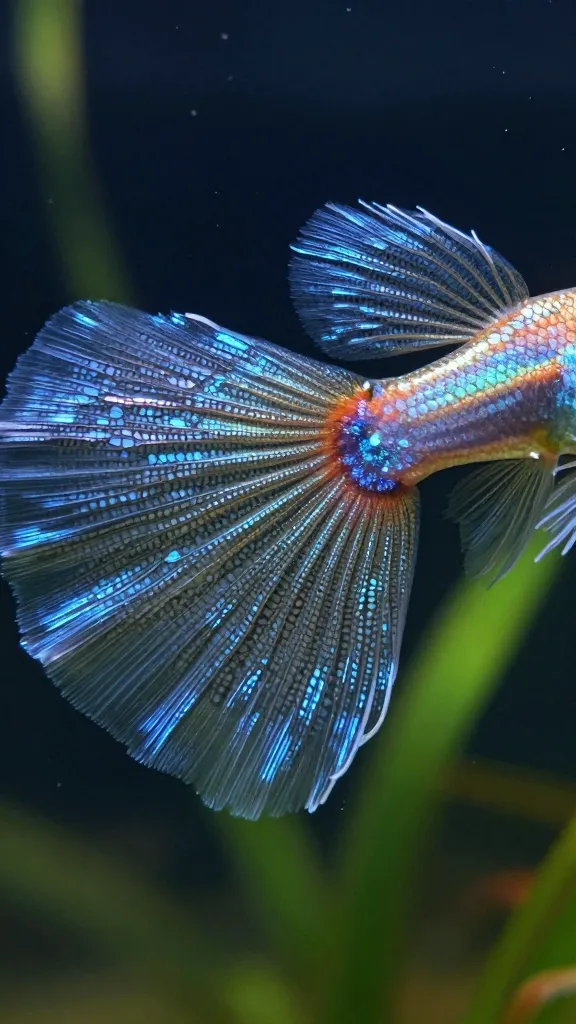
Mosaic and lace tails show repeating dark-and-light mesh from reflective iridophores and dark melanophore outlines in the fin membrane. Tropical Fish Keeping classifies mosaic as irregular chain patterns; lace is finer.
Identify it by more than 8–10 repeats of the smallest unit across the tail width; lace is the finer version, mosaic the coarser. These patterns read best under light with a strong blue peak around 450–470 nm. The limit is distance: fine lace looks gray beyond 4 feet — if your tank sits across the room, pick mosaic over lace. A 48-inch tank under a quality planted-aquascape LED ($35–60) will show both patterns faithfully.
9. Albino Guppy: Red Eyes Change the Color Math
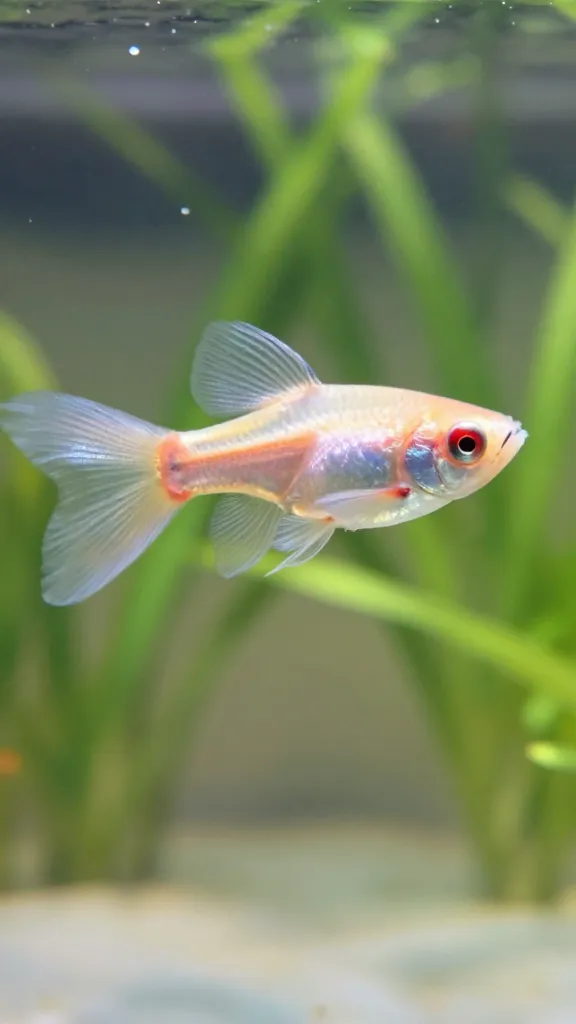
Albinos lack functional melanin entirely, so reds and yellows sit against pale skin with no black to deepen contrast. Without melanin, iridophore shine shifts the fish toward pastel rather than saturated.
To confirm albino, check for red pupils under ambient room light and the absence of black anywhere — the eye test is decisive. Keep them at the cooler end of guppy comfort, around 76–78 °F, because heat-stressed albinos show faster color fade. Strong light over 50 PAR at the surface makes them skittish; dimmer, even light shows them better. I keep a single 15-watt bar over my albino rack and the colors stay warmer than they did under the same fixture I used for my cobra colony.
10. Endler-Guppy Hybrids: Narrow Bodies, Bright Bars
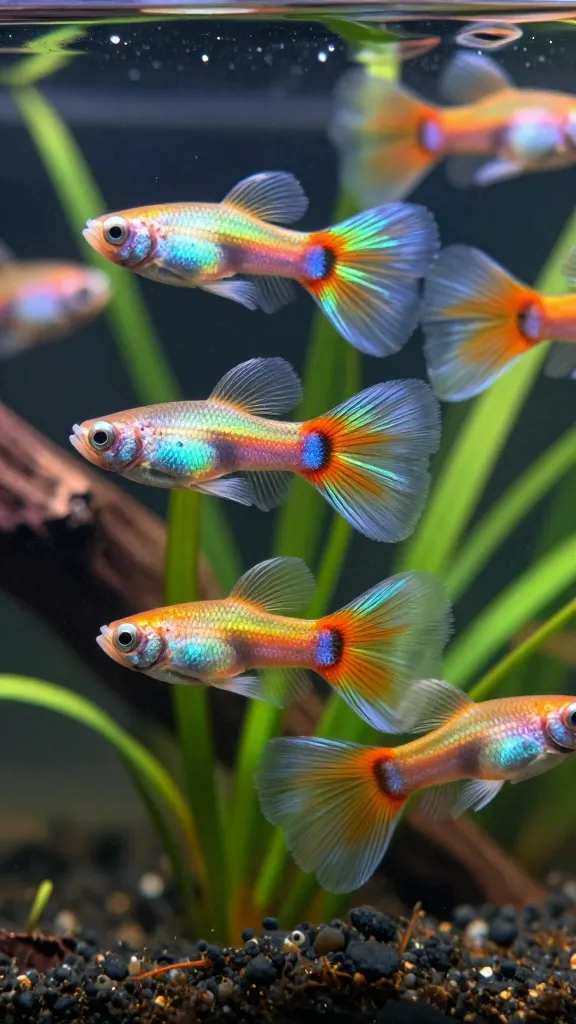
Endler’s livebearer (Poecilia wingei) crosses with common guppies (Poecilia reticulata) readily. Hybrids inherit a narrower body and shorter, stiffer caudal fins that beat at higher frequency, making metallic bars flash more in motion.
Identify hybrids by the slimmer body depth — typically 10–15% less than standard guppies of the same length — and the presence of neon bars in the shoulder. They handle slightly higher flow, up to 6× turnover, without fray, which makes them good candidates for planted tank setups where you want active, colorful fish that tolerate a bit more current. The limit is size: adult males top out near 1.2–1.6 inches, so mixing with large, fast barbs invites harassment. A 15-gallon planted tank with a school of six Endler hybrids costs roughly $40–60 in fish and $80–120 in basic planted-tank gear to set up.
11. Tail Size vs Flow: Fin Shear, Not “Biting”
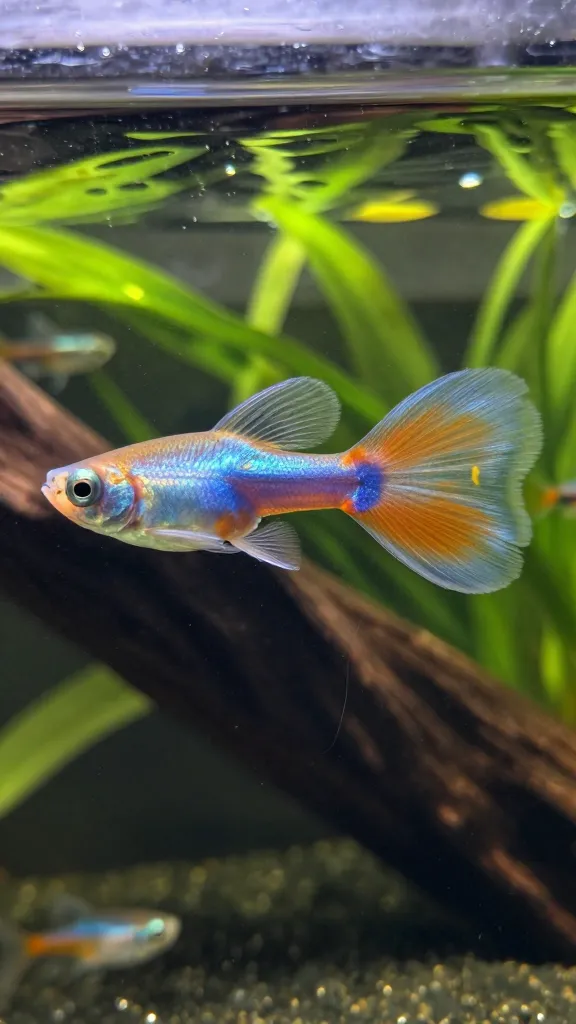
Frayed tails get blamed on tank mates, but broad fins shear where laminar flow turns turbulent at the edges. The wider the tail, the stronger this effect at the same current.
To protect deltas, halfmoons, and veiltails, set return flow to produce a visible surface ripple that travels across the tank in 1–2 seconds, not a rolling boil, and target total turnover near 4× per hour in 10–30 gallons. If you see V-shaped notches without missing chunks elsewhere, you are looking at shear, not nipping. The downside of lowering flow is reduced gas exchange; offset with a small air stone at 0.5–1.0 L/min — they cost under $10 and make a measurable difference on oxygen levels. If you are planning a community with sensitive-finned fish, these betta tank setups from 5 gallons up show how other long-finned species handle the same flow problem.
12. Guppy Color Stability: Temperature and Diet Lock It In
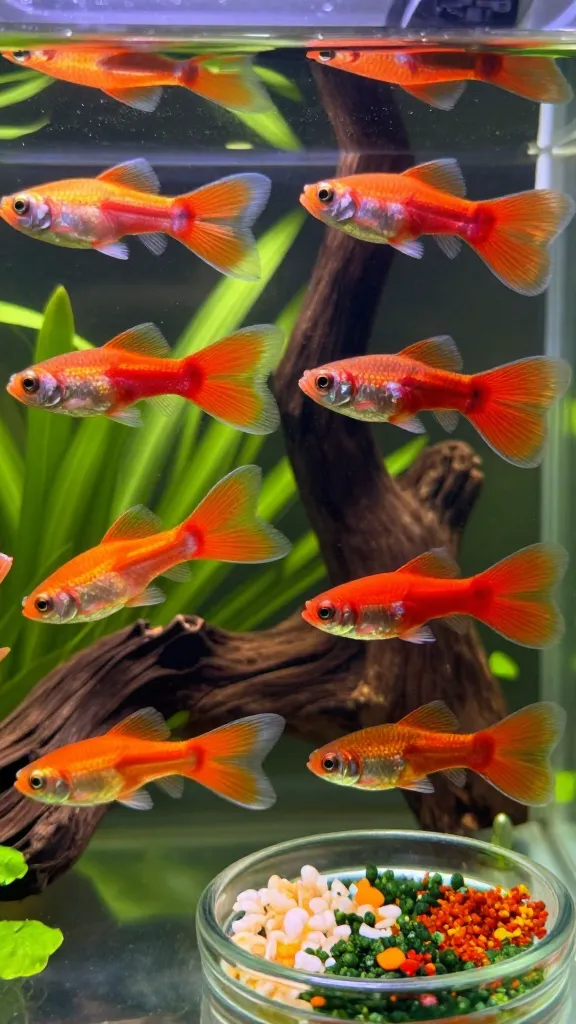
Color is metabolism plus pigment, and both drift with heat and nutrition — higher temperatures accelerate turnover of carotenoids and pteridines that make reds and oranges. If you run at 80–82 °F for breeding speed, expect paler oranges within a month unless diet supplies carotenoids daily.
For stable color, keep display tanks at 76–78 °F and feed at least 3× per week with a carotenoid-rich food — frozen bloodworms, spirulina flakes, or a dedicated color-enhancing pellet. A quality color food like Repashy or Northfin runs about $12–15 for a tub that lasts three months. Greens-only diets rinse color out in 2–4 weeks. My firm view: prioritize stable display at 76–78 °F over faster fry growth at 80–82 °F unless you are actively turning stock, because color holds better and fins last longer. I switched my display rack from 80 °F down to 77 °F and within six weeks every red in the tank deepened noticeably — the oranges went from tangerine to fire-engine.
Frequently Asked Questions
How can I tell delta tail guppies from halfmoons in the store?
Watch for the arc and the angle: deltas form a triangle with a 60–80° base angle and straight edges, while halfmoons curve into a near-180° semicircle when fully flared. Step back to 3 feet and look at the outline as the fish stops moving — deltas look pointy, halfmoons look rounded fans.
Do different guppy patterns need different lighting?
Iridescent-heavy patterns like mosaic and lace pop under 6,500–7,000 K light with strong blue at 450–470 nm, while red-and-yellow-heavy tuxedos look richer under a warmer spectrum around 3,000–4,000 K or a high-CRI 6,500 K fixture. If reds look dull, increase CRI or add a small warm supplemental strip rather than cranking brightness.
Will lyretail guppies tear in higher-flow filters?
They are more prone because the filaments catch turbulence, so keep total turnover near 4× per hour and avoid narrow gaps under 0.5 inches where tips can snag. If you must run 6× for heavy stocking, add pre-filter sponges and break up the current with dense planting.
Are Endler-guppy hybrids smaller than standard guppies?
Yes — males typically reach 1.2–1.6 inches versus 1.6–2.0 inches in most guppy strains, with bodies roughly 10–15% slimmer. That leaner shape handles 6× turnover comfortably but can get outcompeted at feeding time by larger livebearers.
Do albino guppies lose color faster at higher temperatures?
Without melanin, albinos rely on carotenoids and reflective platelets, which degrade faster at 80–82 °F. Keep them at 76–78 °F and feed carotenoid-rich foods at least 3× per week to hold saturation.
Stand Back and Read the Outline
Tail shape is physics and pattern is pigment layering — if you can name the outline and see where the color sits, you can identify any guppy in two passes. Tonight, step back 3 feet from your tank and photograph side-on under your regular light, then again under a desk lamp at 3,000–4,000 K — the change tells you which colors are pigment and which are shine.
Questions about your own fish? Leave them in the comments and I will work through them. — Maya