10 20-Gallon Fish Tank Ideas — Where a First Tank Stops Fighting You

My 20-gallon fish tank ideas came out of one shelf, one power strip, and a month where I kept testing and waiting because the cycle wasn’t done yet. A 20-gallon fish tank sits right in the sweet spot: big enough to be forgiving, small enough for one stand, and usually under $250 to get running with plants and hardy stock. By the end of this, you’ll have ten concrete builds you can actually do this month, with what to buy, what to skip, and honest cost bands. None of them need a sump, all of them need a cycle, and every one respects the animals first. I keep it simple because simple is what stays alive on a desk at 11 p.m. when you’re tired.
1. The 0 Planted Community That Forgives Your First Mistakes

A 20-gallon high with a small sponge filter, an adjustable heater at 76–78°F, and a clip-on light set to 6–8 hours grows a low-tech jungle you can see across the room. I run sand over a thin layer of root tabs, plus crypts (Cryptocoryne wendtii), water sprite (Ceratopteris thalictroides), and a big tangle of java fern (Microsorum pteropus). Expect $180–$240 to get the tank, filter, heater, light, substrate, plants, and test kit. Stock after 4–6 weeks of cycling with a small school of ember tetras (Hyphessobrycon amandae, adult size 0.8 inch) and a group of pygmy corydoras (Corydoras pygmaeus, adult size 1 inch). If you want carpet plants fast, this isn’t it without higher light and CO2.
2. The 20-Gallon Fish Tank for a Single Betta and a Peaceful Crew

This one centers a long-finned betta splendens with gentle tankmates that ignore him: a planted scape with tall stems (Ludwigia repens), floating Salvinia to break sightlines, and caves. Keep the heater at 78°F and flow soft: a sponge filter or baffled hang-on-back. Budget $200–$260 including the betta and a group of 8–10 chili rasboras (Boraras brigittae, adult 0.7 inch) plus 8–10 pygmy corydoras. I learned the hard way once in a smaller tank: nippy tankmates are a no; in 20 gallons, behavior is calmer but still watch the first 72 hours and be ready to rehome if he hunts the rasboras.
3. 0 Low-Tech Jungle with Just a Sponge Filter

If you like the hum of one air pump doing everything, run a double-sponge filter, a heater set to 77°F, and load the tank with undemanding plants: hornwort (Ceratophyllum demersum), hygros (Hygrophila polysperma), and anubias on wood. I kept mine under $150 by buying a used tank for $40 and plants from a local swap for $25; everything else was new. It ran stable for 18 months with weekly 30% changes and fed livebearer fry well thanks to the biofilm. It’s not silent: air pumps hum, and if that bugs you on a bedroom shelf, choose a quiet internal instead.
4. The Hillstream and Loach Flow Lane (Cool-Water, High Oxygen)
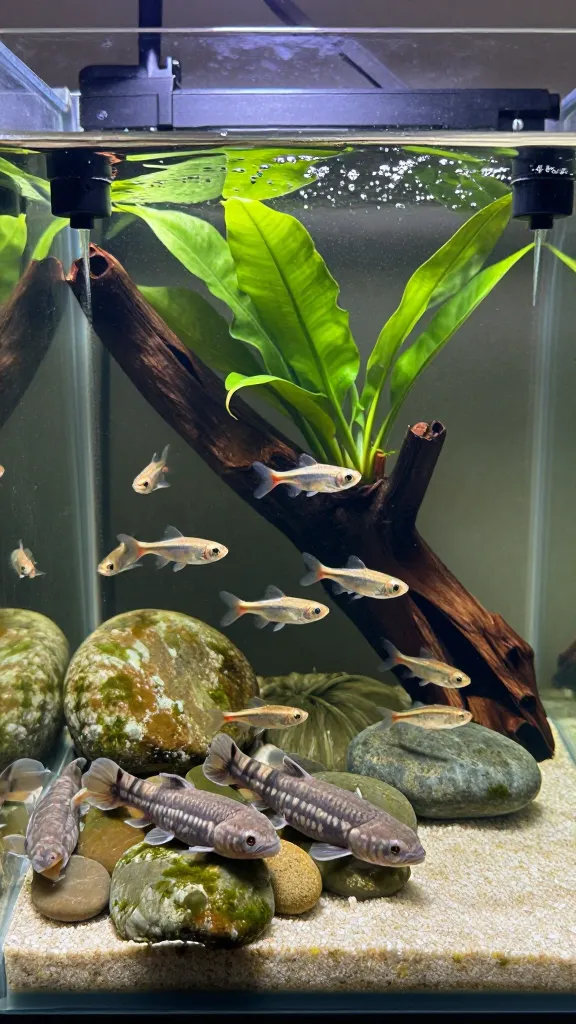
For cooler rooms, build current: two small internal filters pointed along the front glass, smooth river stones, and broad-leafed plants tied to wood. Keep it at 70–73°F for hillstream loaches (Sewellia lineolata, adult 2.5–3 inches) and white cloud mountain minnows (Tanichthys albonubes, adult 1.5 inches). Expect $220–$280 with extra powerheads and rock. Give the tank 6 weeks to mature algae films before adding loaches; they rasp surfaces constantly. Not for warm homes without AC — sustained >75°F and low oxygen is rough on these fish.
5. The 0 Shrimp and Snail Workbench That Teaches You Everything
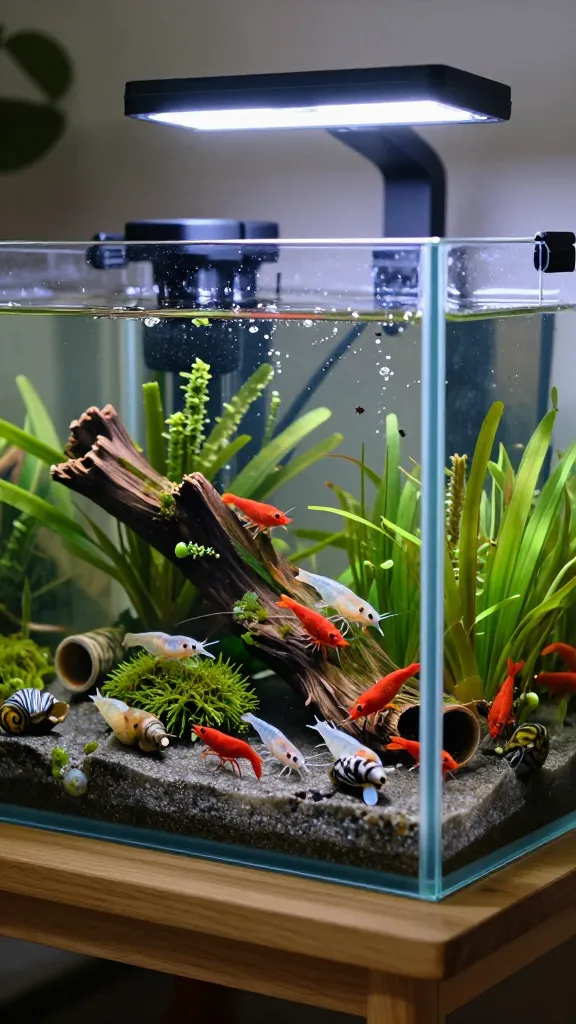
A 20-long with a sponge filter, no heater if your room stays 68–74°F, and dense plants becomes a breeding ground for colorful Neocaridina shrimp and a handful of nerite snails. I set one up for $120 by skipping fancy hardscape: sand, cholla wood, piles of subwassertang (Lomariopsis lineata), and a clip-on light at 6 hours the first month. Mine bloomed copepods around week three and the first shrimplets appeared in week eight. If your tap swings beyond KH 2–8 and GH 4–12, plan on remineralized water; unstable parameters are what stall colonies.
6. A Calm Schooling Show Tank: Rasboras, Corys, and Open Sand

Leave the center open: fine sand front to back, wood and plants framing the sides, and a dark background so colors pop. After a 5-week fishless cycle, add 12 harlequin rasboras (Trigonostigma heteromorpha, adult 2 inches) and 8 panda corydoras (Corydoras panda, adult 2 inches), with a heater at 76°F and a quiet internal filter rated around 150 gph. Plan on $210–$300 depending on plant load. This is the one that made me stop fiddling: when the rasboras started schooling across 24 inches, I noticed I was sitting down just to watch for 10 minutes most nights. If you want heavy wood stacks, reduce open swimming space or pick smaller species.
7. The Hardy Livebearer Nursery (And How to Not Get Overrun)
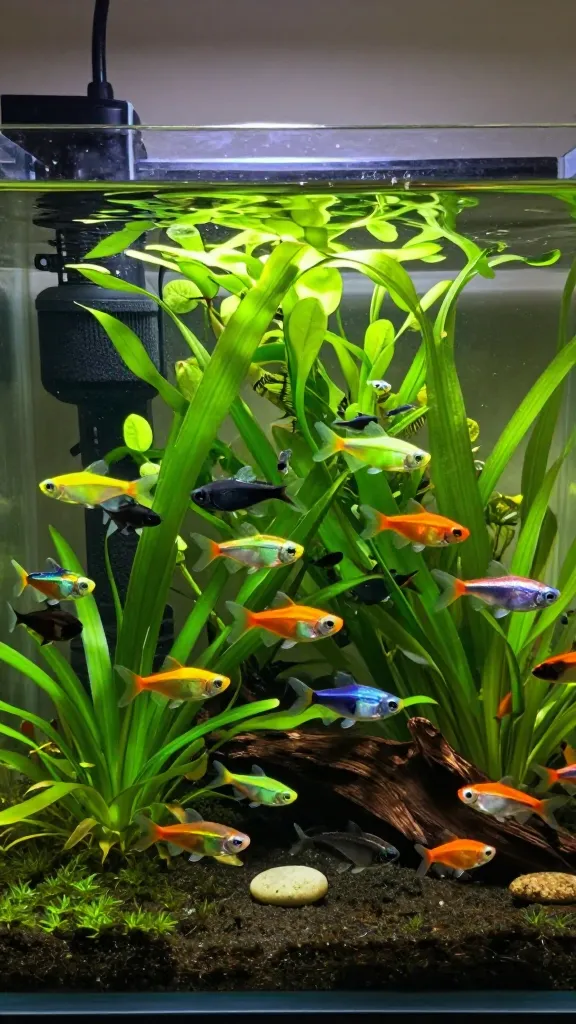
A planted 20 with floating hornwort, an internal filter with a prefilter sponge, and a heater at 76–77°F supports endlers (Poecilia wingei, adult 1 inch) or platies (Xiphophorus maculatus, adult 2.5–3 inches). Budget $170–$230 depending on how many plants you start with. You’ll see fry within 4–6 weeks of settling in if you keep nitrates under 20 ppm and feed small amounts twice daily. Here’s my one strong opinion: beginners do better with endlers than guppies in the first year; in my 20 the endlers stayed vigorous for 14 months without the tail rot drama that hit guppies when I missed a water change.
8. The Dirted Experiment Under 0 (Only If You Like Patience)

Cap 0.5 inch of organic, unfertilized potting soil with 1–1.5 inches of sand, plant heavy with fast stems, and run a simple shop-light style clip-on for 7 hours. I spent $95 all-in using a used tank for $30, a basic light for $25, and a sponge filter. The plant growth was wild by week 6, and I didn’t dose bottled fertilizer for the first 5 months. The caveat is discipline: no uprooting after livestock, go slow on initial water changes, and skip this if you want to rescape often — you’ll unleash mulm and ammonia spikes.
9. The Peaceful Dwarf Cichlid Pair with Leaf Litter

Create structure with wood, botanicals (Indian almond leaves), and caves, plus midground plants and a gentle filter. A pair of Apistogramma cacatuoides (adult 3 inches) with a top group of 10 pencilfish (Nannostomus beckfordi, adult 2 inches) works in a 20-long if you give territories and keep the heater at 78°F. Expect $220–$320 because the hardscape and botanicals add up. I waited a full 6 weeks post-cycle before adding the apistos so microfauna and biofilms settled; they grazed constantly. Not for hard, alkaline tap if you’re chasing breeding — that’s a deeper water chemistry project.
10. The Softly Lit Blackwater Look for Under 0
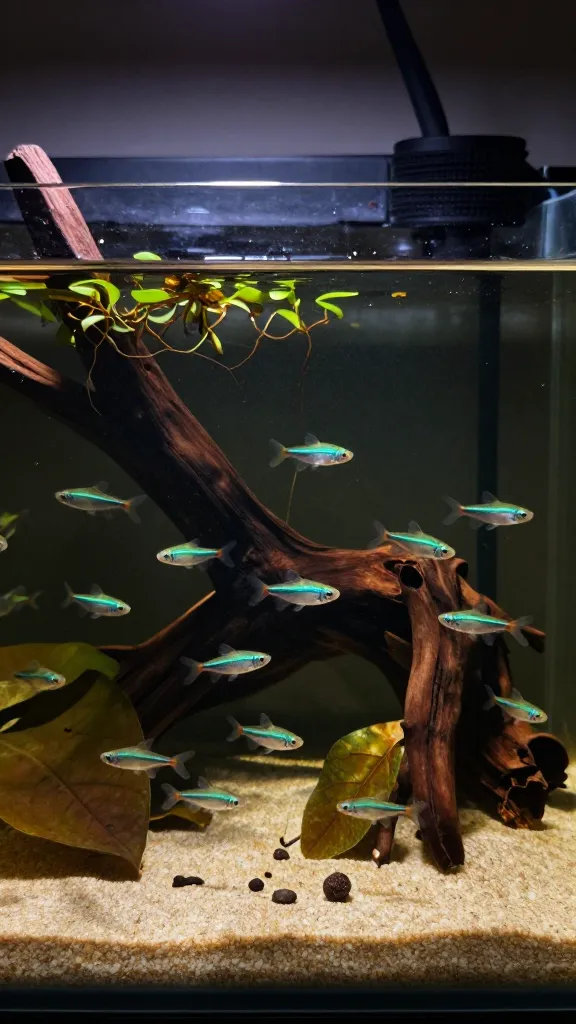
Use inert sand, wood, piles of leaves, and floaters like frogbit; run a sponge filter and keep light low so the water’s tea tint stays moody. Aim for 76°F with 12–15 green neon tetras (Paracheirodon simulans, adult 1 inch) after a 5–6 week cycle. I kept mine under $180 by foraging branchy wood locally and buying botanicals in bulk. Plants are slower here and algae control relies on restraint; without bright light, you won’t grow demanding stems, and that’s the point — it’s a drift-and-dim tank that asks you to underfeed.
Frequently Asked Questions
How much does a 20-gallon fish tank cost to set up?
Most complete 20-gallon builds land between $150–$300 depending on new vs. used glass, plant mass, and light. The big fixed pieces are the tank, heater, filter, and light; plants and hardscape flex the total. Plan another $20–$40 for a liquid test kit and dechlorinator. Livestock can be $30–$120 once the tank is cycled.
How long should I cycle a 20-gallon fish tank before adding fish?
Give it 4–6 weeks with an ammonia source and plants before any fish. You’re waiting for zero ammonia and nitrite on a liquid test and nitrates under about 20–30 ppm. Heavily planted tanks sometimes “silent cycle,” but still test for at least two weeks of stable numbers.
What fish are good for a first 20-gallon fish tank?
Peaceful small species that top out under 2–3 inches and like groups are ideal: rasboras, ember tetras, panda or pygmy corydoras, endlers, and a single betta with compatible tankmates. Keep schools at 8–12 and bottom groups at 6–10 for natural behavior. Always add fish in stages over 2–3 weeks to avoid ammonia spikes.
Do I need CO2 on a 20-gallon planted tank?
No, not for the plants listed here; low-tech species do fine on moderate light and root tabs. CO2 speeds growth and allows carpets, but it adds $80–$200 even for DIY-style rigs and raises the tuning load. If you’re new, master stable light and nutrients for 3 months first.
What maintenance does a 20-gallon need each week?
Plan 30–40 minutes: a 25–35% water change, glass wipe, light gravel vac over open sand, and filter sponge squeeze in tank water every 2–4 weeks. Keep nitrates < 30 ppm and temperatures steady within 2°F. Dose dechlorinator for the full tank volume, not just the bucket.
Pick One and Start Small
The only thing that matters is a stable, cycled 20 with animals that fit; the rest is style. If the cart feels heavy, buy the sponge filter, heater, and test kit this week, set the tank on its shelf, and plant three easy species — by week four, the water will tell you what comes next.
Questions about your own setup? Leave them in the comments — I answer all of them. — Maya