10 20-Gallon Aquascape Ideas — Where Composition Starts to Breathe

Most 20-gallon aquascape ideas fall apart at the same point: too many gestures in a space that wants one clear intent. A 20-gallon is where composition finally has room for negative space and a path for the eye, without becoming a maintenance project you resent. By the end of this list you will have chosen a layout, a hardscape material, and a plant palette you can build and live with for a year. You will also know what each idea looks like in 6 weeks, not just on planting day.
Across two decades I have learned that restraint does not read as empty; it reads as confidence. These ten builds are designed to thrive on ordinary tap water and steady attention rather than daily intervention.
1. Left-Weight Triangle: Mass to One Side, Water to the Other

Asymmetry calms the eye: one dominant mass balanced by open water creates a place to rest and a place to breathe. In a standard 24-inch 20-gallon high, stack Seiryu stone on the left to reach 2/3 of the tank height, sloped forward, and fade to sand on the right. Plant the mound with Cryptocoryne wendtii ‘Green’ around the base and Microsorum pteropus (Java fern) on the higher rocks; keep the right 1/3 as clean pool filter sand with sparse Eleocharis acicularis (dwarf hairgrass) runners to suggest a shoreline. Give it 6 weeks for crypts to root and hairgrass to tuft. When this goes wrong, it’s because the open side was filled in: if the sand bed is busy, the triangle vanishes.
2. The Mid-Valley: A Path that Narrows and Pulls You In
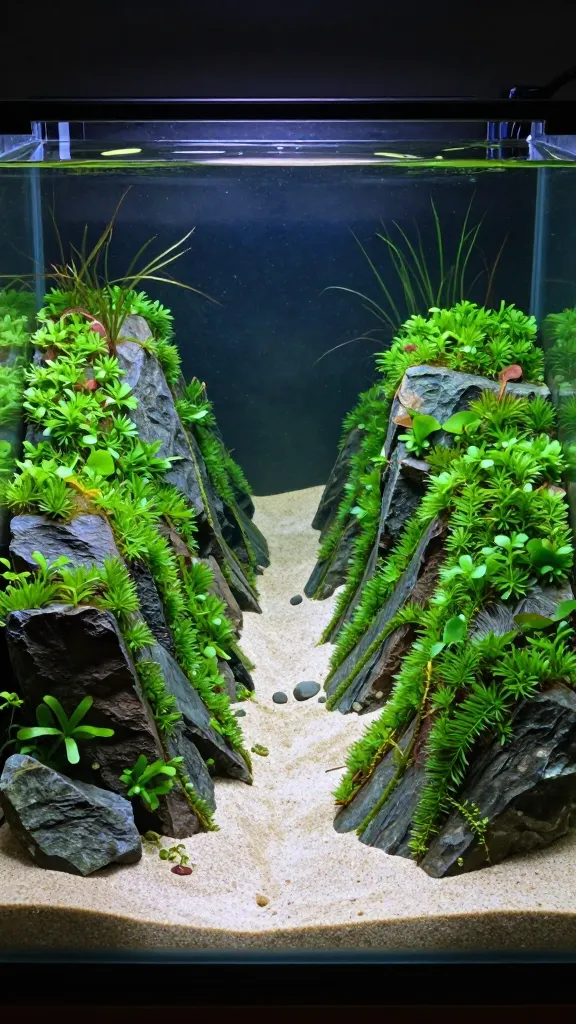
Depth is an illusion built by convergence; a path that starts wide and pinches toward the back tricks the eye into distance. In a 20-gallon long (30 inches), lay two low ridgelines of dragon stone (Ohko) from front corners toward a rear center point, leaving a 2-inch “river” at the front that shrinks to 1/2 inch at the back. Carpet the ridges with Micranthemum tweediei (Monte Carlo) if you run CO2, or Hydrocotyle tripartita ‘Japan’ trimmed low in low-tech; fill the river with fine sand and a sprinkle of Seiryu chips. Six weeks is enough for the carpet to link and the perspective to lock. Failure shows as parallel banks—if both sides run straight, the scene stalls flat.
3. Jungle Crescent: Framing the Center with Texture
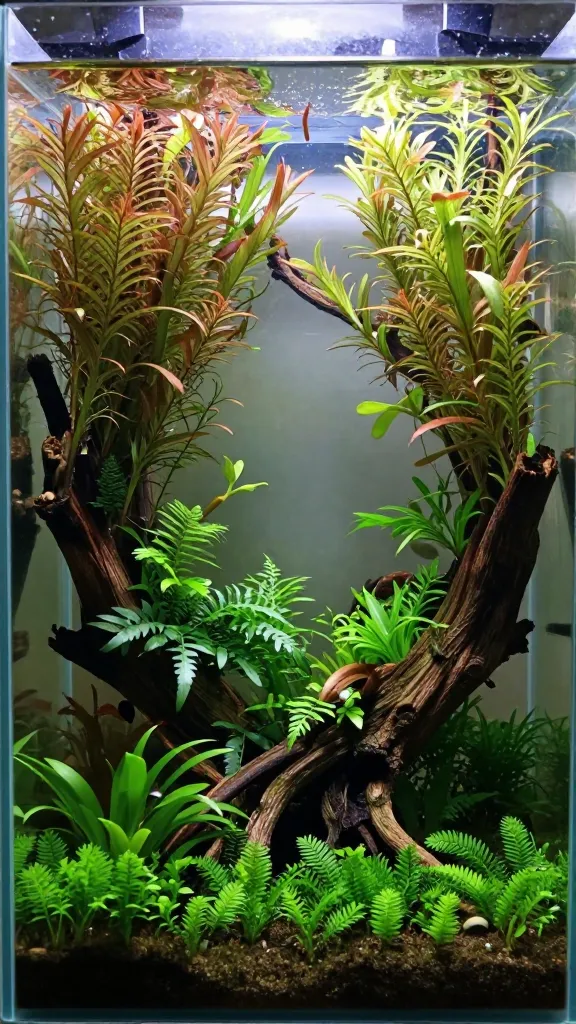
Enclosure with a deliberate gap invites the eye through, not around. Build a crescent from back-left to back-right in a 20-gallon high using tangled manzanita wood with 1/3 of the arc open in the middle. Plant tall, feathery Ludwigia repens and Hygrophila polysperma on the far arms, step down with Bolbitis heudelotii on wood mid-height, and finish the foreground with Cryptocoryne parva in a sparse 2-inch band. Let stems grow to the surface before the first cut at 6 weeks, then trim to a sloping canopy that peaks behind the wood ends. When this fails, it’s usually symmetric horns—mirror-image ends make a gate, not a crescent.
4. Iwagumi Discipline: Three Stones, One Focal, Nothing Extra

Clarity comes from a single focal point with subordinates in service, not competition. In a 20-gallon long, choose one Oyaishi of Seiryu stone tilted 10–15° and two supporting stones echoing its grain at 2/3 and 1/2 its size. Run a low, even carpet of Eleocharis acicularis ‘mini’ without other broadleaf interruptions; if low-tech, accept a slower close with Marsilea hirsuta over 8–12 weeks. Set the tallest stone 3/5 along the length, not dead center. The common failure is adding a fourth and fifth “helper” rock—clutter erases hierarchy faster than algae ever will.
5. Riverbank Woodscape: One Root Holding a Shoreline
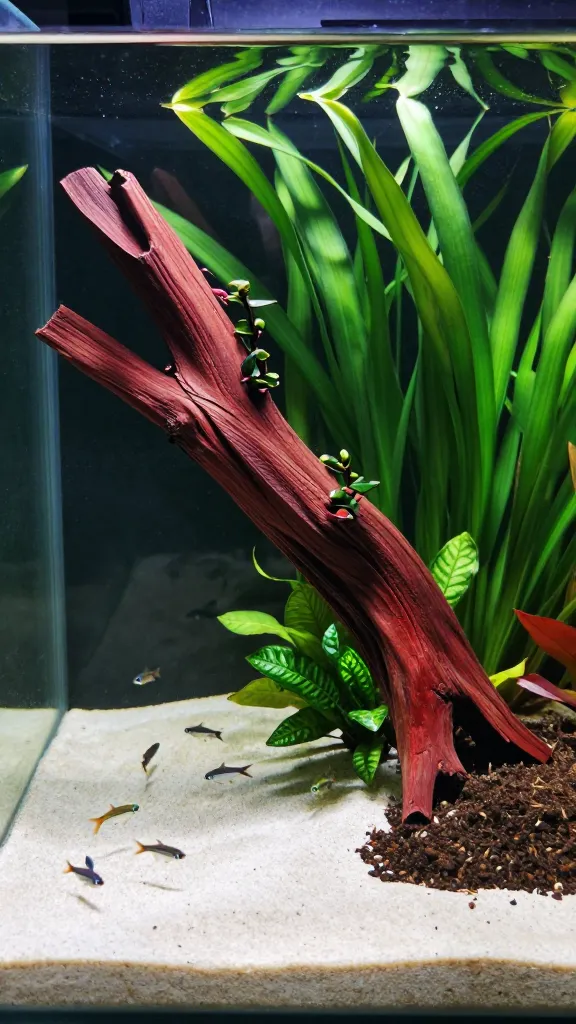
A single strong gesture does more than five minor ones. Anchor one large, branching piece of red moor wood so it leans from back-right to front-left in a 20-gallon high, base buried in a 1.5-inch ramp of soil that drops to clean sand covering 1/3 of the footprint. Tie Anubias barteri var. nana to the mid-branches, tuck Bucephalandra ‘Green Wavy’ at the base, and plant Vallisneria spiralis behind as a flowing screen. Leave the sand open for a shoal of small fish that enjoy the runway, and keep it vacuumed. When this build fails, the wood is centered and vertical—the sense of a bank disappears and the scape becomes a stick bouquet.
6. Island Mound: A Hill with Air Around It

Isolation defines form; an island reads as a whole when the water around it stays empty. In a 20-gallon long, create a 10–12-inch round mound of mixed lava rock and soil rising to 1/2 tank height, no contact with glass, and a 1–1.5-inch moat of sand all around. Plant the crown with Staurogyne repens and edge with Hemianthus micranthemoides (pearl weed) trimmed as a low hedge; hang small Microsorum pteropus ‘Trident’ on a few lava nubs for height texture. Give it 6 weeks for the pearl weed to knit and for melt to pass. The failure is drift—if the moat is invaded or the mound touches a pane, the “island” stops reading as one form.
7. Blackwater Grove: Color Temperature as Mood, Not Trick
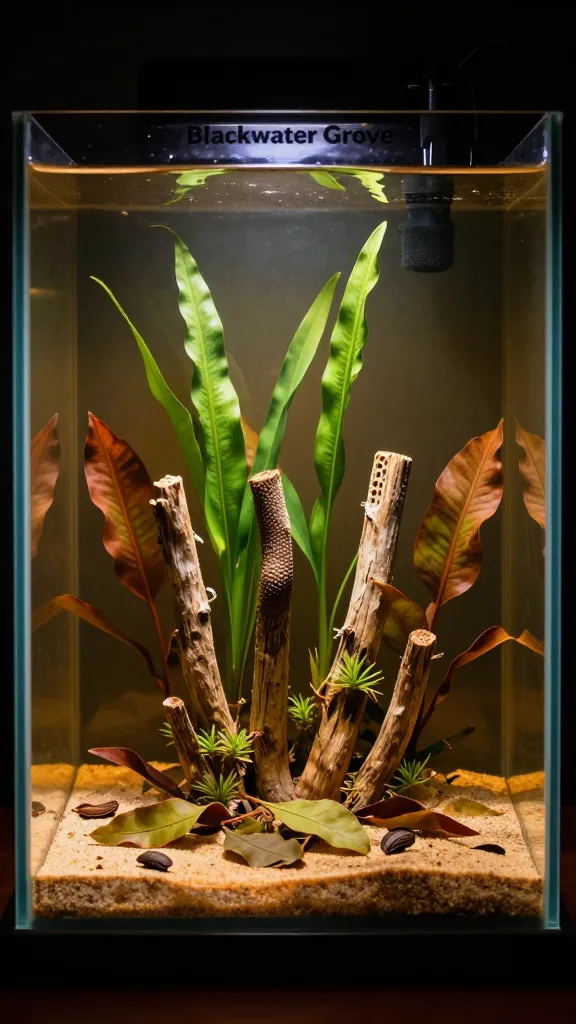
Color choice sets tempo; tea-stained water slows the scene and asks for bold leaf shapes. In a 20-gallon high, use cholla wood and leaf litter from clean, pesticide-free Catappa (Indian almond leaves) to create a sparse grove; plant Cryptocoryne usteriana and Barclaya longifolia for contrasting lanceolate and rounded forms. Skip bright carpets—use scattered Taxiphyllum barbieri (Java moss) on wood feet and let the foreground remain mostly leaf. Run gentle filtration with pre-soaked botanicals, and expect 6 weeks for tannins to mellow to a stable amber. When this misses, the keeper over-lights it—the mood breaks under harsh white LEDs and algae wins the story.
8. Two-Tier Terrace: Elevation Change that Reads from Across the Room

Height shift creates narrative: a terrace asks what grew first and what toppled into place later. In a 20-gallon long, retain a rear shelf 2 inches higher using stacked lava rock hidden by planting, leaving the front 2/3 at base level. Plant the upper deck with fine-leaved Rotala rotundifolia or Limnophila sessiliflora for a soft screen, and the lower with a mid-height band of Cryptocoryne wendtii ‘Bronze’ stepping to a foreground of Helanthium tenellum. The trim rhythm is 6 weeks: cut the background to 2/3 height and replant tops to thicken. Failure looks like a flat hedge—if the foreground and midground rise to the same line, the terrace collapses into a wall.
9. Moss and Stone Ravine: Texture Over Color
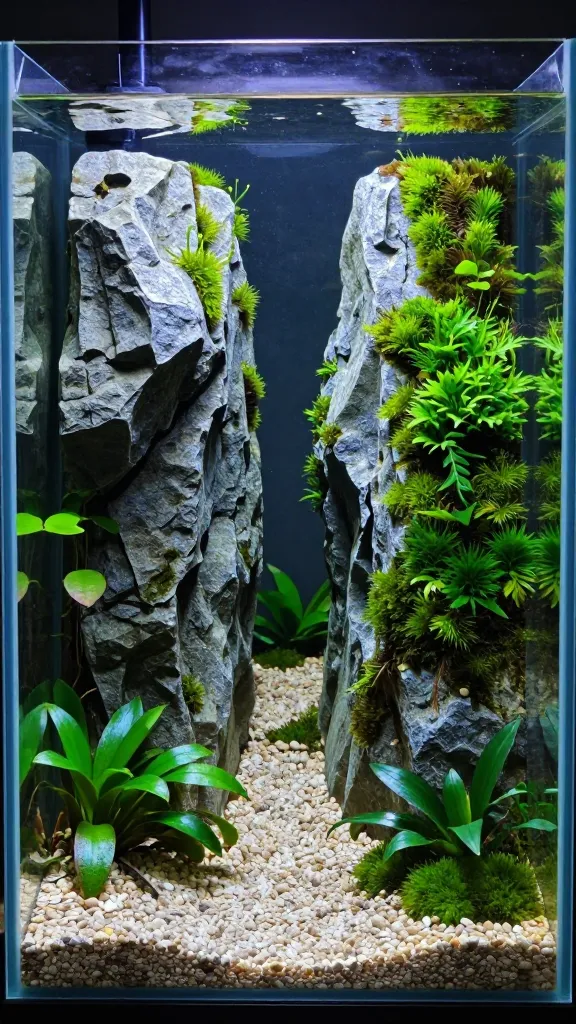
When contrast is all texture, time does the coloring for you. In a 20-gallon high, create two jagged faces of Ryuoh stone 3 inches apart, slanting inward slightly, with a winding floor of pea gravel between. Pack the crevices with Taxiphyllum ‘Flame’ and Vesicularia montagnei (Christmas moss), and dot the ravine mouth with a few Bucephalandra clumps for glossy leaves. Flow must be moderate, light moderated; the moss will knit in 6 weeks and thicken for months. This fails when the ravine becomes a gutter—if the faces are parallel and too close, the whole thing reads as a seam, not a passage.
10. Meadow and Thicket: Two Biomes, One Glass
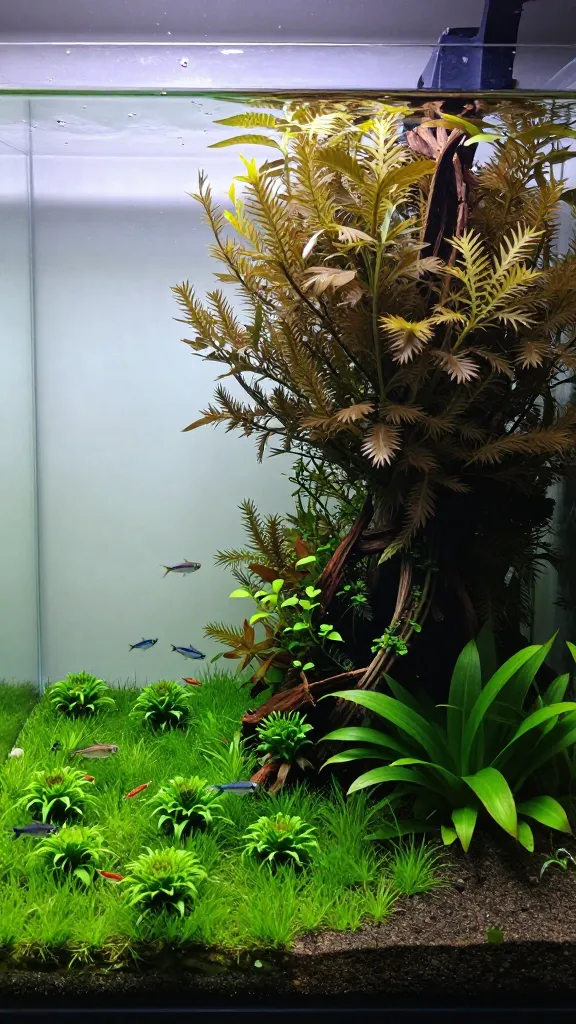
Contrast of density lets fish choose their comfort and your eye choose a route. Reserve the left half of a 20-gallon long for an open “meadow” of low Lilaeopsis brasiliensis dotted with five to seven Pogostemon helferi, and pack the right with a “thicket” of Hygrophila pinnatifida on wood and Anubias barteri at the base. Keep the transition fuzzy: a 3-inch intergrade where meadow plants and epiphytes mingle. Allow 6 weeks for the meadow to root; trim the thicket back to keep its canopy 1/3 higher than the meadow. The failure here is equal density everywhere—the moment both halves fill to the same texture, the contrast, and the habitat choice, are gone.
Frequently Asked Questions
How long should I give a 20-gallon aquascape before judging it?
Give it 6 weeks. That window lets crypts recover from melt, mosses attach, and carpets link into something continuous enough to read the composition honestly. Do only light trims in that period—just remove decaying leaves and keep filters clear.
Do I need CO2 for a 20-gallon aquascape to look like the photos?
No, but CO2 widens your plant list and tightens timelines. Low-tech tanks do well with Cryptocoryne, Anubias, Java fern, and slower carpets like Marsilea hirsuta, settling in 6–12 weeks. With CO2 you can run Monte Carlo or fine stems like Rotala rotundifolia for denser textures on the same footprint.
What hardscape is best for a 20-gallon aquascape if I’m new to stone?
Dragon stone (Ohko) is forgiving because it’s light, carvable, and plants grip its pores easily. For crisp, angular lines, Seiryu stone reads sharper but raises hardness; pair it with hardy plants like Eleocharis and Cryptocoryne and do weekly water changes for the first 6 weeks. Buy a bit extra so you can echo grain and angle—stones that speak the same language compose faster.
How many fish can I keep in these layouts without ruining the composition?
Stock for the fish first and design to their behavior. A 20-gallon suits a single school of 12–16 small tetras or rasboras, or a peaceful centerpiece like a pair of Apistogramma if you’ve provided cover and a settled cycle; avoid combining multiple midwater schools. Over-stocking muddies sand beds and forces trims before 6 weeks, which harms both scape and welfare.
What’s the right substrate depth in a 20-gallon for healthy plants and stable slopes?
Run 2 inches in the foreground and 3–4 inches where you build height, with rock or mesh under steep banks. This anchors crypts and stems and keeps island and triangle slopes from slumping as roots grow. Cap sand areas thinly (1/2–1 inch) so detritus stays vacuumable.
Choose the Gesture, Then Keep the Air
Composition in this size works because something leads and something yields; the tank breathes where you let it. Tonight, set your strongest stone or root 3/5 along the length and remove the next-loudest piece—stand back, and if the open water suddenly makes sense, you’ve found the scape’s center.
Questions about your own scape? Leave them in the comments and I will answer them. — Julian