9 40-Gallon Aquascape Ideas — Height, Depth and Midground Planning

Most 40-gallon aquascape ideas fail in the same place: the midground, where height and depth meet and either knit the scene together or announce the seams. In a 36 x 18 x 16 inch tank, that middle third is the hinge that turns foreground carpet into a believable slope and gives fish room to travel. These nine layouts choose a single way to handle that hinge and name the plants, rock, and wood that make it real. By the end, you’ll know exactly which approach fits your glass, your patience, and your water. None of them depends on CO2 or daily trimming to hold a line.
1. Triangular Composition: One Rising Spine, Everything Steps Down
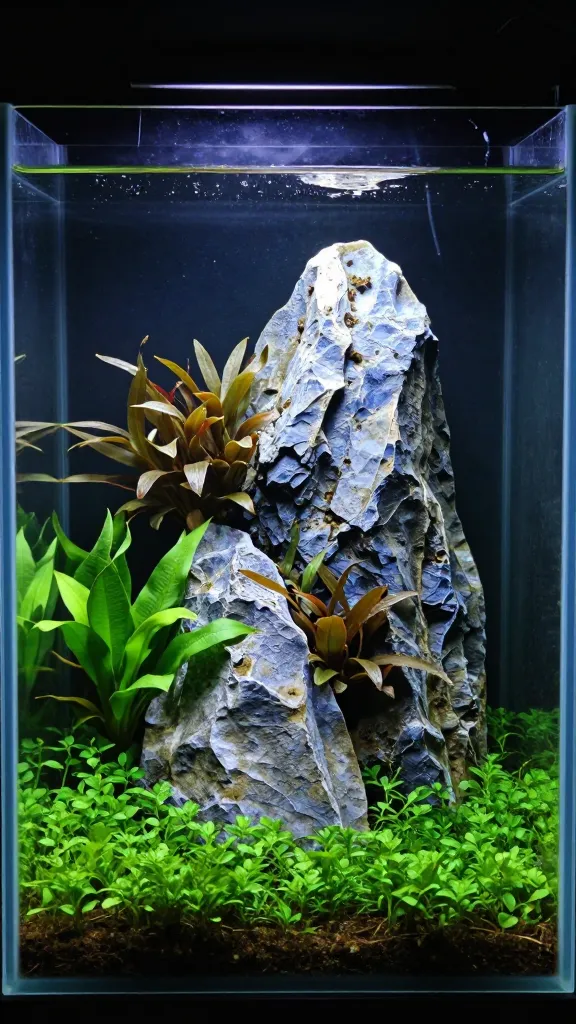
The eye settles when mass climbs to a single peak and descends cleanly, which in a 40-gallon means setting the high point at 1/3 from either end and grading everything else toward the opposite corner. Build a backbone with two larger seiryu stones and one smaller, stacking soil so the highest point reaches 2/3 of the tank’s height on that side. Plant Micranthemum ‘Monte Carlo’ (M. tweediei) across the foreground, then let Cryptocoryne wendtii ‘Green’ and Hygrophila pinnatifida form the midground step-down, with a back wall of Limnophila sessiliflora. Give it 6 weeks for the carpet to knit and the stems to top out before your first real trim. When this fails, it’s because the peak is centered or duplicated, and the slope reads as two small hills fighting.
2. Canyon Pass: Negative Space That Fish Can Use
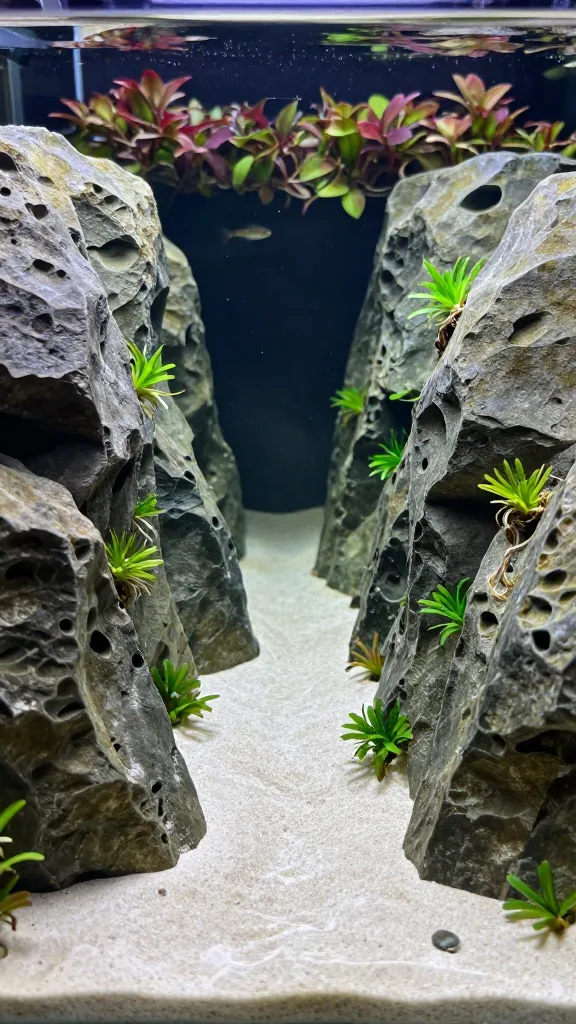
Empty space is not a gap to be filled; it’s a corridor the eye and the livestock can traverse. Lay two ridges of dragon stone (Ohko) from front to back, opening a 4 to 5 inch winding pass that narrows toward the rear to create depth. Tuck Staurogyne repens and Anubias barteri var. nana ‘Petite’ into the inner faces of the stones, keep the path bare sand or fine gravel, and plant a modest rear hedge of Rotala rotundifolia to close the horizon. In a 40-gallon low-tech tank, this holds form with monthly trims; the midground is the mossed crevices rather than a hedge. It goes wrong when the pass is too wide all the way back — you lose perspective and the scape feels flat and empty.
3. Classic Iwagumi: Three Stones, One Leader, No Distractions

Hierarchy is the heart of iwagumi: one stone leads, one supports, one balances, and every plant stays quiet enough to let that happen. Choose a primary seiryu with a clear face tilted 10-15° toward the viewer, then flank it with two subordinate stones set at sympathetic angles; keep the leader about 1.5x the height of the next. Run a continuous carpet of Eleocharis acicularis ‘Mini’ and a sprinkling of Glossostigma elatinoides near the foot of the oyaishi for texture variation, and leave the back open water to 3/4 height. Wait 6 weeks for the carpet to fill before judging the balance. This collapses into noise when you add driftwood, ferns, or a tall stem midground that drags attention away from the stone faces.
4. Forest Scape: Repetition and Rhythm in the Midground Trunks
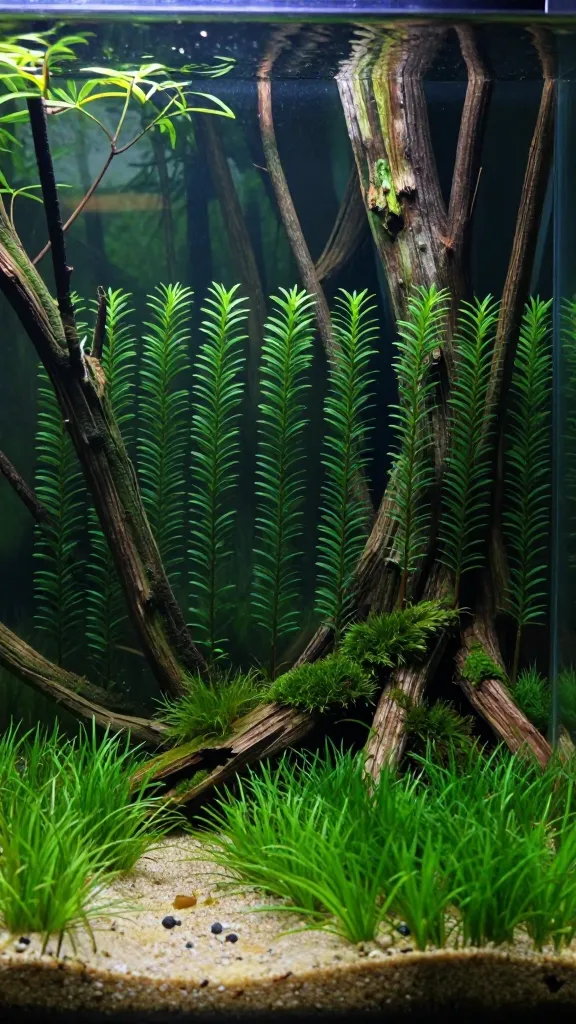
Forests read as believable when similar forms repeat at different scales and intervals, with a midground “trunk” band bridging carpet to canopy. Fix a line of slim manzanita branches rising to 1/2 tank height in front of thicker rear “trees,” keeping 1-2 inches between trunks and leaning them in a common direction. Lace their bases with Bolbitis heudelotii and patches of Taxiphyllum barbieri (Java moss), then run a soft foreground of Helanthium tenellum ‘Green’. A dimmer light suits this — you want shadow at the roots and space for small tetras to weave. The failure shows as a picket fence: trunks equally thick, equally spaced, and the eye lands on the monotony rather than the path between them.
5. Island Mound: Full Circle, Clear Shoulders, Middle Third Carries the Weight
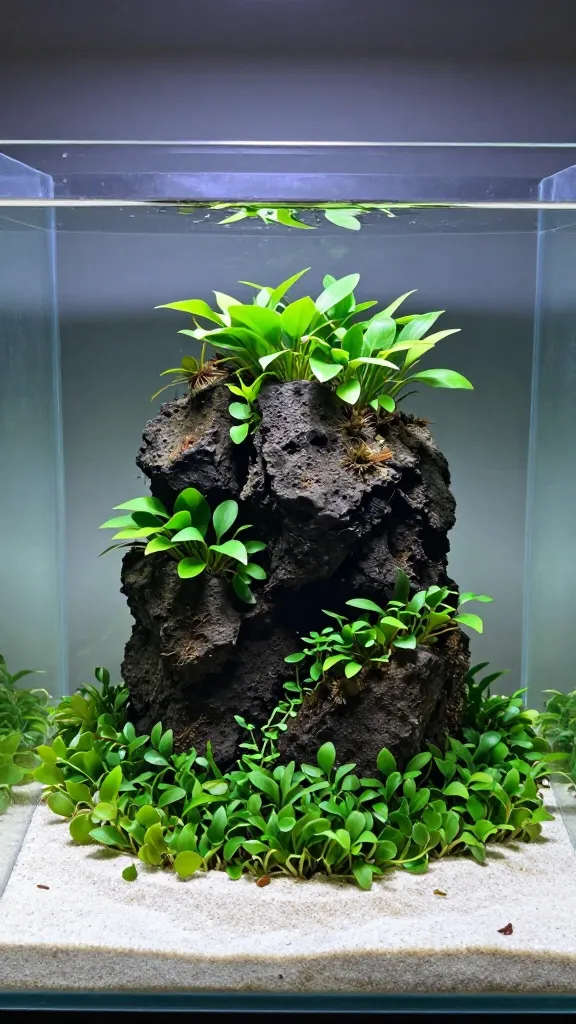
An island works when the mound reads as one landform with shoulders that breathe, not a blob pressed against glass. In a 36-inch 40-gallon breeder, center the island slightly forward of midline and offset 2 inches to one side; build to 1/2 tank height with lava rock and soil. Wrap the base with Cryptocoryne parva and Hydrocotyle tripartita ‘Japan’, cap the summit with Bucephalandra ‘Wavy Green’, and let a low ring of Pogostemon helferi form the midground drape. Keep the perimeter as clean sand so the island breathes, and give 6 weeks before you refine the shoulder line. It fails when the mound kisses the sides or back — you lose the island silhouette and the midground turns into a messy perimeter hedge.
6. Terrace Slope: Step the Substrate, Control the Midground Plane

Depth is as much about planes as it is about vanishing lines, and terraces give you planes you can control. Build 3 shallow steps with acrylic or slate strips from front to back, each rise 1 to 1.5 inches and each tread narrower than the last so the rear compresses distance. Plant Sagittaria subulata across the lowest terrace for a soft midground that stops at knee height, Cryptocoryne lutea on the middle for thicker clumps, and a fine-leaved back of Myriophyllum mattogrossense. This suits low to medium light and a 40-gallon with patient weekly maintenance. It fails when the terraces are tall or evenly deep — then they read like stairs rather than ground, and the illusion breaks.
7. Riverbank Sweep: One Direction of Flow Unifies the Midground
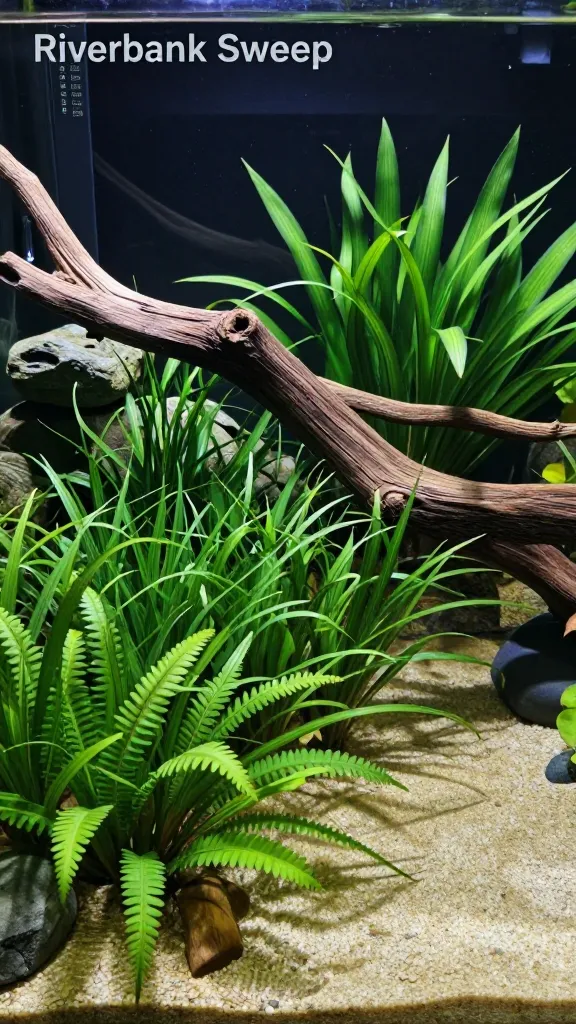
Flow unifies a layout when all angled elements lean the same way and the midground plants bend into that gesture rather than fight it. Anchor a length of spider wood sweeping left-to-right (or the reverse) and echo its line with smaller branches and the grain of your stones. Plant a low bed of Hygrophila angustifolia at midground, which throws fine leaves in the flow direction, and break the monotony with tufts of Cryptocoryne balansae in the rear third. Foreground Microsorum pteropus ‘Trident’ attached low can lace into the midground without stealing height. The weak version has wood pointing all directions and a vertical stem band — you lose the sweep and the scene feels stalled.
8. Shadowed Ravine: Light as a Compositional Tool, Not a Brightness Contest

Contrast is legibility; a deliberate shadow at midground pushes the focal plane forward and creates a place for shy fish to hold. Stack rhyolite or dark basalt to form a single overhang at midground left or right, 6 to 8 inches wide, then keep planting sparse beneath: Anubias barteri var. nana and a thin seam of Taxiphyllum ‘Flame’ on the rock. Let the opposite side take the light with a gentle hill of Cryptocoryne undulata leading to a back wall of Ludwigia repens for warm color under medium light. This thrives in a 40-gallon with a photo period around 7-8 hours. It fails when you flood the ravine with bright stems or crank light high — the shadow washes out and the composition flattens.
9. Meadow and Thicket: Contrast Textures, Not Just Heights

Texture contrast lets the midground read without needing a hedge; a soft field broken by a denser thicket tells the eye where to rest. Lay a 2/3-width “meadow” of Lilaeopsis brasiliensis from front to mid, then set a compact thicket of Cryptocoryne wendtii ‘Brown’ off-center as the anchor, backed by a loose stand of Heteranthera zosterifolia. Keep the thicket’s height at 1/2 the tank and never taller than the back stems, and trim the meadow every 3-4 weeks to knee height so fish pathways stay open. After two decades of scaping, the tanks that aged best were built on texture contrast more than color — greens last, gimmicks don’t. This falls apart when the meadow overgrows into one height everywhere and the thicket loses its edge.
Frequently Asked Questions
How long should I wait before trimming a new 40-gallon aquascape?
Wait 6 weeks before your first structural trim. Carpets like Monte Carlo and grasses need that time to root, and stems will have shown their true growth rate, so you can cut to a line that will hold. During those 6 weeks, remove only decaying leaves and keep the filter sponge clean.
Do I need CO2 for these 40-gallon aquascape ideas?
No. Every layout here holds with low to medium light and no CO2 if you choose hardy species like Cryptocoryne, Java fern, Anubias, Limnophila sessiliflora, and Eleocharis ‘Mini’. CO2 expands plant choices and speed, but it also increases trimming and fertilization demands — a real tradeoff if you’re busy.
What fish suit a canyon pass or shadowed ravine layout?
Choose species that use corridors and shelter: groups of 12-20 Ember tetra (Hyphessobrycon amandae) or Harlequin rasbora (Trigonostigma heteromorpha) will school through the pass, while Apistogramma pairs appreciate the ravine’s cover. Keep the tank cycled and add livestock after plants have settled for 6 weeks so territories and sightlines are established.
How do I keep the midground from turning into a wall of stems?
Plant midground with clumping species and attach epiphytes to wood and rock so the mass breaks into pockets. Use Cryptocoryne, Bolbitis, and Anubias at 1/3 to 1/2 tank height, and confine stems to the rear third where you can top weekly or biweekly without ruining the silhouette.
What substrate depth should I use for slopes and terraces in a 40-gallon?
Run 1 inch at the front glass, 3-4 inches at the back, and build terraces with 1 to 1.5 inch rises. That supports rooted plants like Cryptocoryne without compressing anaerobic pockets, and it gives you enough material to shape clean midground planes that won’t collapse during maintenance.
Choose the Line, Then Choose the Plant
One decision governs a 40-gallon: where the middle third lives and what it asks the eye to do. Set that line first — a spine, a pass, a terrace — and let your plant list serve it rather than fight it.
Tonight, stand at the glass and mark your midground with painter’s tape on the outside: height, angle, and where the path or mound shoulders will breathe. If the line reads in tape, it will read in stone and fern after 6 weeks.
Questions about your own scape? Leave them in the comments and I will answer them. — Julian