12 Nano Tank Aquascape Ideas — Restraint as the Governing Rule
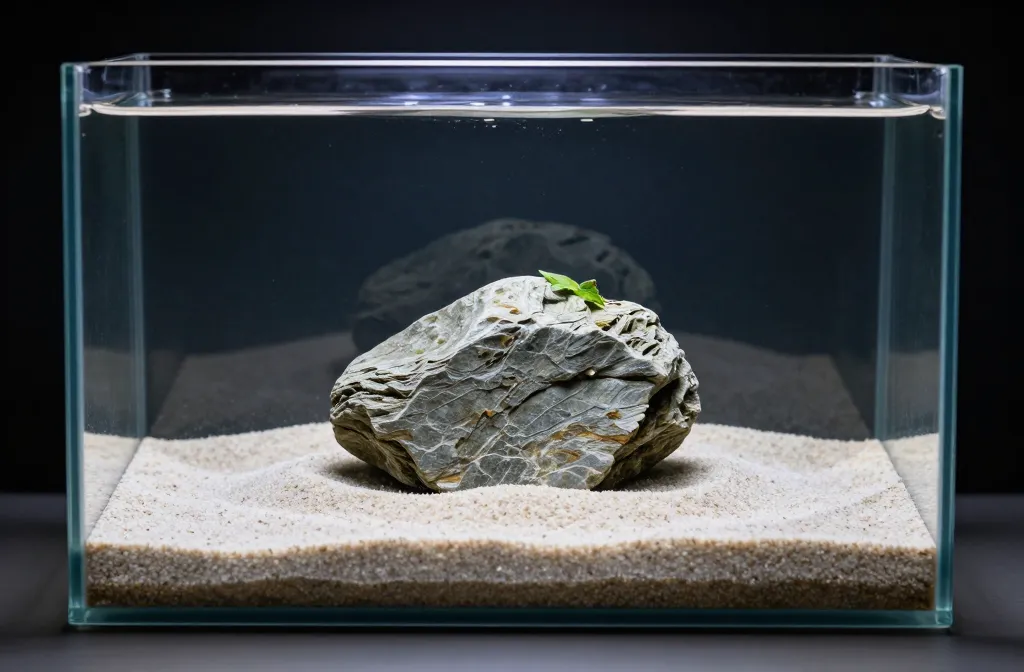
Most nano tank aquascape ideas fall apart because too much is asked of too little space: too many plants, too many lines, too many stories. In a container under 10 gallons, every choice is loud, so restraint is not a style but the scaffold that holds the work. By the end of this article you will have chosen a single direction for your tank and the few species, stones, and proportions that make it read clearly at arm’s length. You will also know what the next 6 weeks look like, because that is how long a layout takes to settle under ordinary tap water and regular light.
1. The Single-Stone Iwagumi: One Focal Point, Nothing Competing
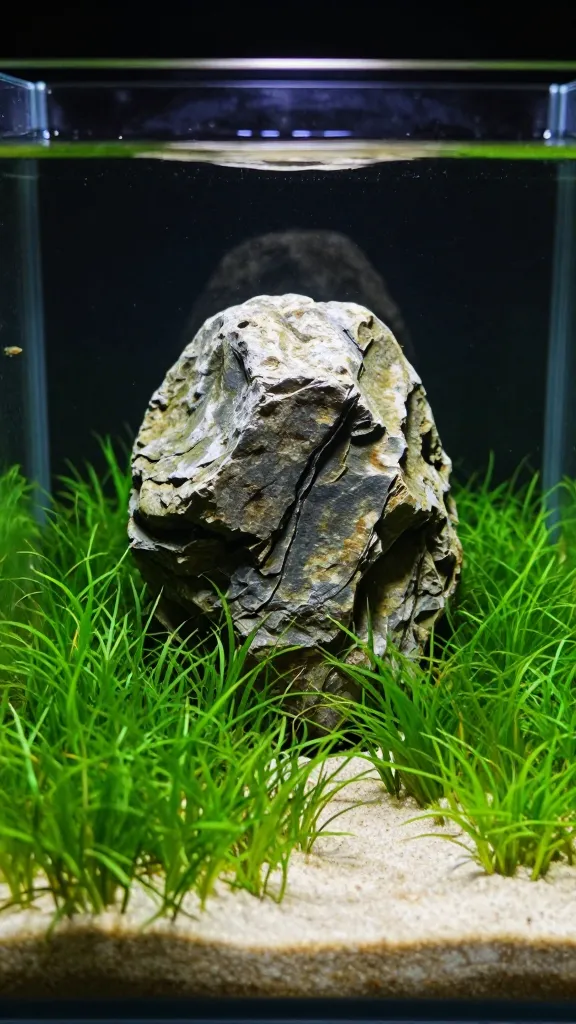
The eye needs a place to land, and in a nano the cleanest answer is one stone given room. Choose one piece of Seiryu stone or Ryuoh stone with a clear face and set it off-center at the rule-of-thirds line, leaning slightly forward so its strata lift the scape. In 5 to 7 gallons, keep substrate depth at 2 inches in front, 3 inches behind, and plant a single carpet of Dwarf hairgrass (Eleocharis acicularis) or Monte Carlo (Micranthemum tweediei) to 2/3 of the footprint, leaving a bare path. It reads wrong when supporting pebbles start to collect around it — remove anything that looks like a second focal point and let negative space do the rest.
2. Low Bush Island: Mass and Void in a Balanced Pair
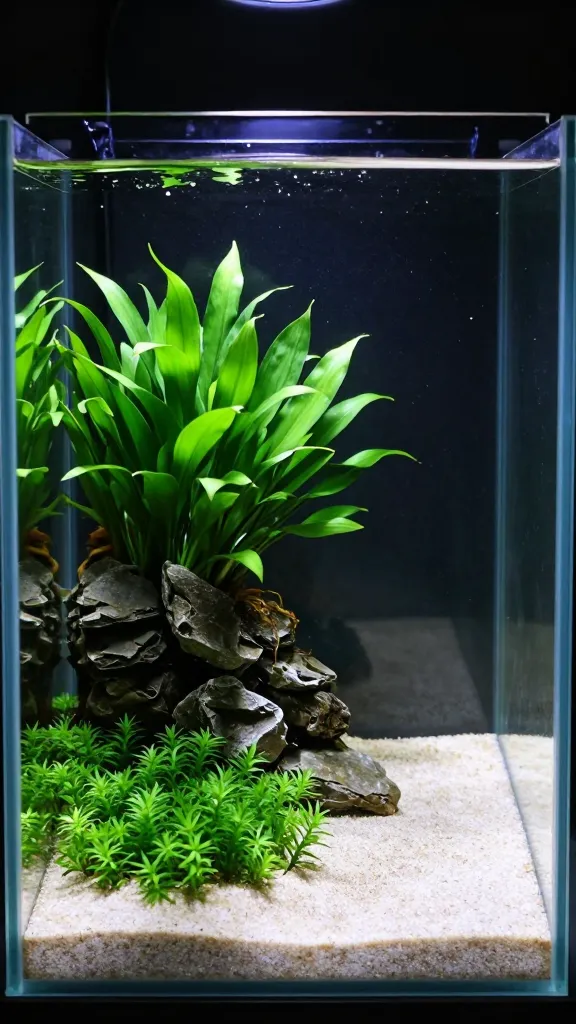
Form works best when it is answered by formlessness: a planted mass facing open sand. Mound a 6-inch oval of soil to 3 inches high in a 9- to 12-gallon long, pin with small dragon stone, and plant only two textures: a base of Cryptocoryne wendtii ‘Green’ and a skirt of Staurogyne repens. The opposite 1/2 of the tank is open — a pale sand like pool-filter silica elicits the shape. Give it 6 weeks for the crypts to root before heavy trims; the failure is letting the bush wander across the sand, blurring the silhouette the whole composition depends on.
3. Blackwater Thicket: Light as a Material

In dim water, you compose with shadow and line instead of color. Tannin-stained water from a few catappa (Indian almond) leaves and alder cones shifts the palette; rooty spider wood rising 2/3 of the height makes the thicket. Under low light in 5 to 10 gallons, plant sparse clumps of Java fern (Microsorum pteropus) and a single floating veil of Amazon frogbit (Limnobium laevigatum) to filter light. This collapses when the surface is choked — keep Frogbit to 1/3 coverage so the mood stays dappled, not dark.
4. Foreground Terrace: Steps That Slow the Eye

Terracing turns a short front-to-back into a journey. Build two shallow shelves with slim Ohko stone or shale, front shelf 1 inch high, second 2 inches, the rear rising gently to 3 inches in a 7.5-gallon cube. Plant Helanthium tenellum ‘Green’ on the middle terrace, reserve the front step for Riccardia chamedryfolia tied to slate, and let the back dissolve into Cryptocoryne parva. It fails when the steps are too tall or symmetrical — keep risers thin and stagger breaks so the terraces read as landforms, not stairs.
5. The Monochrome Stem Bank: One Hue, Many Notes

Color unity calms small spaces more reliably than contrast. Choose a single green family and vary only leaf shape and height: a 10-gallon with a back wedge of Hygrophila polysperma, midground arcs of Lobelia cardinalis ‘Small Form’, and a low run of Marsilea hirsuta. Trim the stems weekly for the first 6 weeks to set the gradient at 1/3, 2/3, full height. It goes wrong when a red accent sneaks in or trimming is uneven — one rogue color or ragged line wrecks the intent.
6. Wood and Moss Spire: Vertical Without Clutter

Height in a nano has to be drawn with as few lines as possible. Select one main branch of manzanita that reaches 2/3 of the waterline in a 6-gallon and anchor it to a narrow base rock; wind two thinner supports behind it to suggest a grove without doubling the focal point. Wrap only the shaded undersides with Taxiphyllum barbieri (Java moss) so the top silhouette stays clean. It looks busy when every twig is mossed — leave 1/2 of the wood bare to keep the negative spaces legible.
7. Sand Meander: The Path That Decides the Depth

A continuous path gives shallow tanks depth by implication. Pour a 2- to 3-inch-wide S-shaped river of pale sand from front-left to rear-right in a 10-gallon standard, banking darker planted soil on both sides. Plant edges with Cryptocoryne lutea and patches of Bucephalandra sp. on small stones, keeping plants 1 inch off the sand to maintain the line. The failure is drift — vacuum and re-edge weekly at first, or the river flattens into a beige smear.
8. The Epiphyte-Only Layout: Roots Where Leaves Belong

When maintenance time is scarce, slow-growing plants glued to hardscape create a stable composition that changes in months, not days. In a 5- to 8-gallon, assemble a low arch of lava rock and a single forked branch, then attach only epiphytes: Anubias barteri var. nana ‘Petite’, Bucephalandra ‘Wavy Green’, and small Bolbitis heudelotii fronds. Leave the substrate inert and mostly bare with a scattering of river pebbles; 6 weeks sees the first new leaves, and algae stays controllable under moderate light. It fails when rhizomes are buried — keep every rhizome exposed to water flow or the plants rot.
9. Crescent Valley: Flow That Bends Around the Subject
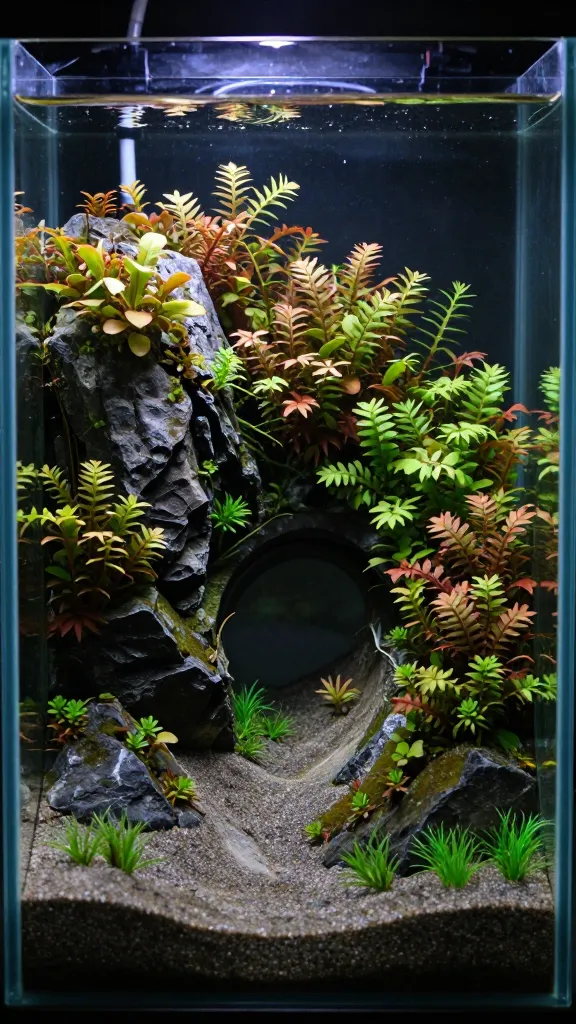
Curvature leads the gaze more gently than straight lines. Shape the substrate into a shallow crescent open to the front in a 9-gallon rimless, building 3 inches high at the horns and 1 inch in the bowl. Plant the horns densely with Rotala rotundifolia and Hygrophila pinnatifida on stones, keeping the valley open except for a low Eleocharis pusilla scatter. The error is symmetry — let one horn be 20% longer and the other 10% taller so the valley reads as found, not engineered.
10. Nano Tank Aquascape Forest Edge: Trunks, Not a Wall

A forest in a nano is not a canopy — it is the suggestion of trunks emerging from groundcover. In a 7.5-gallon, plant a front carpet of Micranthemum tweediei (Monte Carlo) to 1/2 depth, then set 5 to 7 vertical twigs of spider wood at odd intervals, tilting 10-15° to the same vanishing point. Epiphytes belong near the “root flare”: a few tufts of Taxiphyllum ‘Spiky’ and a midground of Cryptocoryne walkeri var. lutea. It fails when the trunks line up or the carpet runs to the back pane — preserve a 1-inch soil margin behind the wood so the “edge” breathes.
Across two decades of tanks, this is the layout I see overstuffed more than any other; removing one stick and one plant group almost always improves it.
11. The Negative Space Betta Sanctuary: Calm Water, Clear Lines

Livestock sets the brief; composition follows. For a single male Betta splendens in a 5- to 7-gallon, keep flow gentle, sightlines broken, and surfaces open for air-breathing. Build two opposing low mounds with river stones, plant Anubias ‘Petite’ and a ring of Cryptocoryne wendtii ‘Brown’, and float a sparse raft of Salvinia minima over 1/3 of the surface; the center remains a 3-inch-wide corridor of open water. It fails when the surface is fully covered or hardscape pinches the fish — leave routes and air always accessible, and cycle the tank before you add the betta.
12. Nano Tank Aquascape Shadow Box: Framed Depth, Controlled Light

Framing makes a small tank feel intentional and controls glare that makes fine lines disappear. In a 10-gallon, darken the back and one side with removable black vinyl, then build a stepped slope rising to the dark corner with Seiryu stone, tallest stone 1/2 the water height. Plant shade-tolerant Cryptocoryne nurii and low Bucephalandra ‘Kedagang’ on the stones, keeping the front-right quadrant open. It fails when the frame is bright — if the back film stops short or the room light hits it, the illusion breaks and the scape feels shallow.
Frequently Asked Questions
How long should I give a nano tank aquascape before I judge it?
Give it 6 weeks. That window allows root systems to anchor, early algae phases to pass, and your first trims to set proportions — especially with plants like Cryptocoryne and Monte Carlo that need time to settle.
Do I need CO2 for these layouts, or can I stay low-tech?
You can build every layout here low-tech with moderate light and weekly water changes. Choose slower species like Anubias, Bucephalandra, Java fern, and Cryptocoryne, and expect 6 weeks for them to establish before shape holds; stems will demand more trimming without CO2.
What hardscape size works best for a nano tank aquascape in 5 to 10 gallons?
Use fewer, larger pieces rather than many small ones. One primary stone or branch reaching 1/2 to 2/3 of the tank height creates scale and reads cleanly; scatter only a handful of supportive fragments to stabilize substrate, not to decorate it.
How do I keep a layout from looking cluttered in a small tank?
Limit the palette to two or three plant species and one hardscape type. Leave at least 1/3 of the footprint as negative space — sand, open soil, or water — and repeat trims on the same day each week for 6 weeks so lines stay consistent.
Which fish are suitable for these small layouts?
Stock lightly and only after the tank is cycled. A single Betta splendens in 5 to 7 gallons, or small groups of Ember tetra (Hyphessobrycon amandae) or Chili rasbora (Boraras brigittae) in 10 gallons, are appropriate; add shrimp only where fish will not prey on them.
Begin with the Space You Leave, Not the Plants You Add
Restraint is a design choice you practice every time you remove a stone that muddies the line or stop at three species when a fourth would be redundant. Tonight, stand at the glass and mark a 1/3 area you will keep empty for 6 weeks; every plant and rock you place must justify crossing that boundary.
Questions about your own scape? Leave them in the comments and I will answer them. — Julian