9 55-Gallon Aquascape Ideas — Filling a Long Tank Without Repeating Yourself

Most 55-gallon aquascape ideas fall apart in the middle third of the tank, where the length exposes every lazy decision. A 55-gallon is long, shallow front-to-back, and tall enough to punish sloppy foregrounds — so you choose a layout that manages depth, rhythm, and maintenance from the start. By the end of this list, you’ll have nine directions you can actually build, with plant lists, proportions, and timelines that hold together for months, not days. These are composed as living communities first, with space for fish to move and hide without forcing them into narrow corridors. I’ve built and refined each approach over two decades; what you’ll read here is what still earns its keep when you stand in front of the glass at week 6.
1. Valley Pathway: Depth From Side-to-Side Flow

A long tank rewards a left-to-right journey more than a straight tunnel to the back, so use a path that meanders across the tank rather than into it. Lay two ridgelines of Seiryu stone at 2/3 and 1/3 tank height, opening a sand “S” that crosses the midline twice. Plant the ridges with Micranthemum tweediei (Monte Carlo) on the lower slopes and Cryptocoryne wendtii ‘Green’ at the shoulder; flank the back corners with Hygrophila pinnatifida on wood. In a 48 x 13 x 21 inch 55-gallon, keep the sand path 3-4 inches wide and break it once with a small stone to avoid a runway. If it fails, it’s because both sides mirror each other — offset heights and angles, or the eye will march along a boring railroad.
2. Midwater Forest: Canopies for Fish, Negative Space for You

When the center is a quiet void, fish own the water and the viewer gets a place to rest — that negative space is the composition, not an absence. Fix three branching Manzanita pieces into a triangle with the tallest at 2/3 tank height, crowns leaning forward, and keep the open water between them free of tall stems. Epiphyte the wood with Bolbitis heudelotii and Anubias barteri var. nana; ground the bases in small clumps of Cryptocoryne lucens. A 55-gallon with moderate light and no CO2 will fill the crowns in 8-10 weeks. When it goes wrong, it’s because you filled the midwater with stems “just to see” — the canopies read heavy unless the space beneath is left clean.
3. Split Horizon Iwagumi: One Focal Point, Two Temperatures
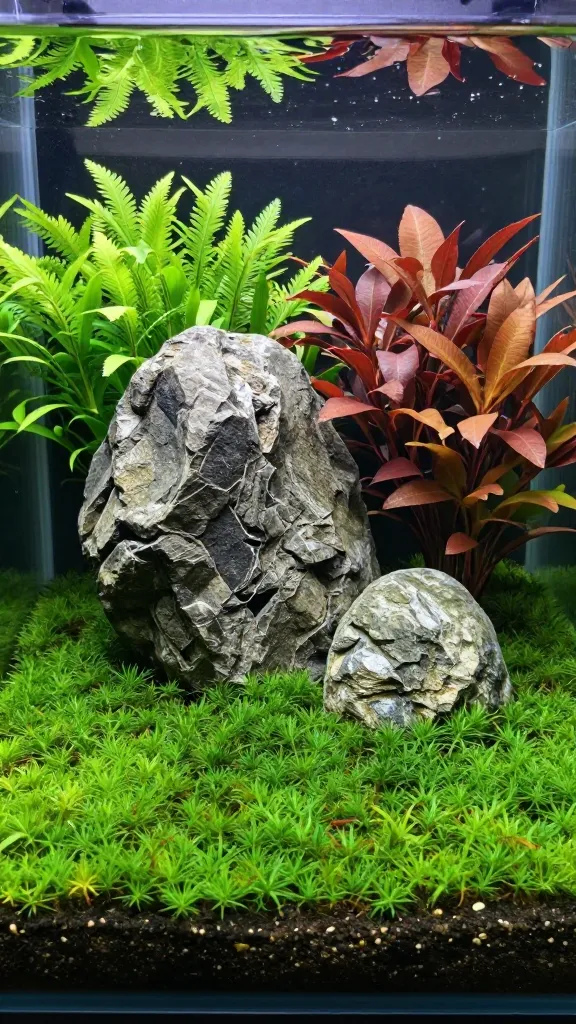
The eye needs one stone to lead and the rest to support; in a long tank, temperature contrast does the rest with remarkable restraint. Choose a single Oyaishi in Seiryu or Ryuoh at roughly 1/3 tank length from the left, leaning slightly inward; flank with two subordinate stones at 40-60% of its height. Carpet the front 2/3 with Eleocharis acicularis ‘Mini’; plant the rear third with a cool-toned stand of Rotala rotundifolia ‘Green’ on one side and a warm-toned Ludwigia repens group on the other, each 8-10 inches wide. Expect 6-8 weeks to close the hairgrass under medium light; CO2 helps but isn’t required if you allow time. This fails when every stone tries to be a hero — keep the sub-stones lower and buried 1/3 in the substrate or the set reads scattered.
4. Terrace and Meadow: Elevation Creates Pace
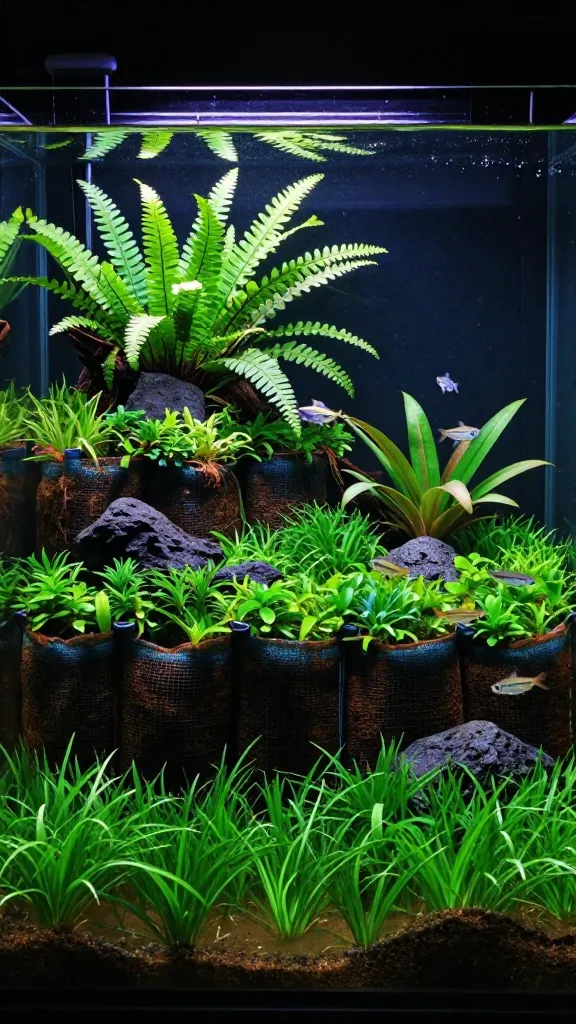
Stepped elevation breaks the straight sprint of a 55 and gives slower plants a stage where they won’t be swallowed. Build two terraces from inert mesh bags of substrate or lava rock, one at 1/4 tank height across the midline and a second at 1/2 height occupying the back left third. Skin terraces with soil, then plant the highest step with Bucephalandra cultivars and Java fern (Microsorum pteropus ‘Trident’); sow the mid-step with Staurogyne repens; leave a low meadow of Helanthium tenellum ‘Green’ in front. Under moderate light, the meadow thickens in 6 weeks and the buces settle over 10-12. It looks wrong when the steps are symmetrical shelves — break the edges and overlap corners so the terraces feel eroded, not engineered.
5. Riverbank Roots: Rhythm Over Repetition
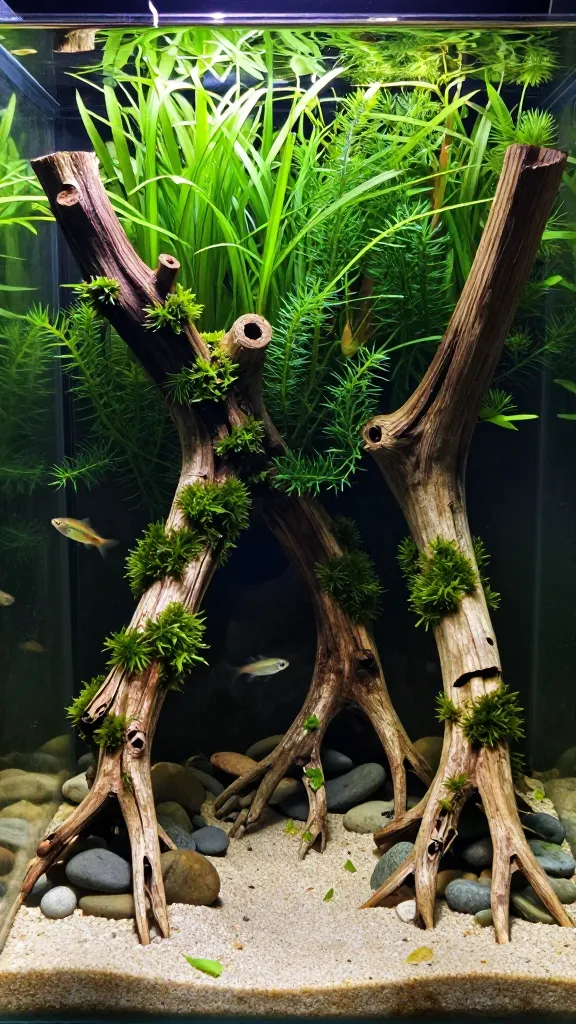
Repeat with variation: let similar shapes recur at uneven intervals so the eye travels without counting. Angle four Spider wood root bundles from the back down toward the front, spacing them at irregular gaps (2 inches, 5 inches, 3 inches, 6 inches), and let the tips end at different depths. Tuck Taxiphyllum barbieri (Java moss) in the crooks and weight the feet with pebble clusters; plant banks of Hygrophila polysperma and Limnophila sessiliflora behind the larger roots as a soft hedge. This is friendly to tap water and no CO2; expect 4-6 weeks for the moss to bind thread and stems to shape. It fails when every root leans at the same angle and distance — suddenly you’ve built a fence.
6. Island Mound: Proportions Decide the Silhouette
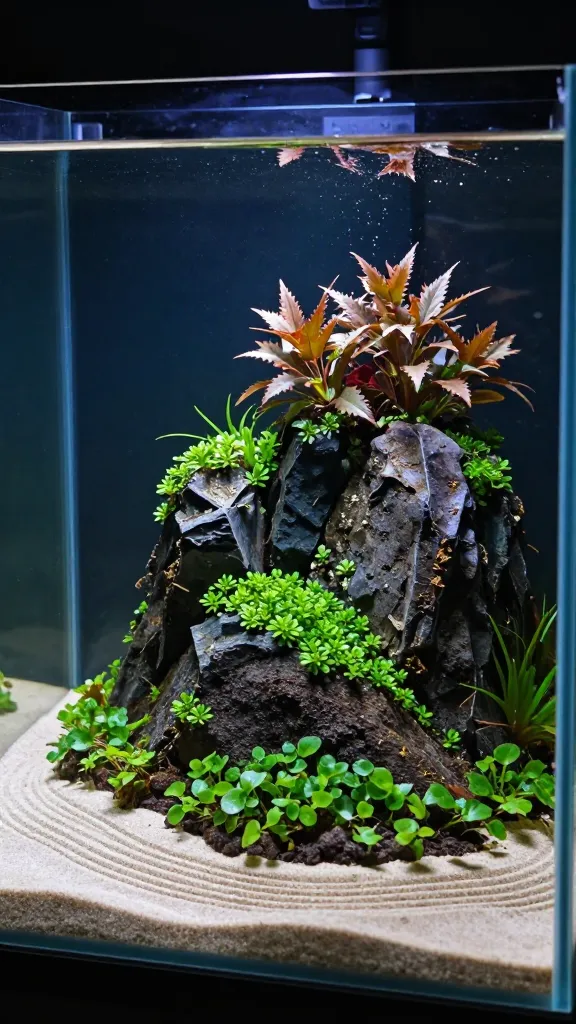
In a long, narrow footprint, a single island holds better than two; keep the mound within 60% of the tank length and off-center so the water can breathe around it. Build a dome from lava rock and soil, set at the right third; cap with Dragon stone shards rising to 1/2 tank height. Plant the crown with Hygrophila pinnatifida and small Bucephalandra; mid-slope with Cryptocoryne parva; toe with Monte Carlo or Hydrocotyle tripartita ‘Japan’. Leave a bare, raked sand margin 2-3 inches wide all around the island for scale and maintenance. This falls apart when the island touches the glass — once it does, the silhouette is lost and detritus has nowhere to settle out of sight.
7. Shaded Backline: Light Gradient as a Compositional Tool

A deliberate light falloff creates quiet in the background and lets the foreground carry detail without being upstaged. Raise the front edge of the light slightly or shade the back third with a strip of window screen; keep tall stems limited to textured greens like Hygrophila corymbosa ‘Compact’ against the rear. In the lit front half, weave a low tapestry of Cryptocoryne wendtii ‘Tropica’, Anubias nana ‘Petite’ on pebbles, and a sparse carpet of Littorella uniflora. Fish appreciate the dimmer rear as refuge; the viewer reads calm depth. If it fails, it’s because the foreground is overlit and pushed to algae — hold photoperiod to 7 hours for the first 6 weeks and lengthen only if plants ask for it.
8. Biotope-Inspired 55-Gallon Aquascape: Behavior Sets the Map

When you let the intended fish dictate open lanes, shade, and cover, the composition stops fighting the animals that will use it. For a group of Hyphessobrycon herbertaxelrodi (black neon tetras) and a pair of Apistogramma, create a leaf-littered back right quadrant with Catappa leaves and low Cryptocoryne usteriana, and leave a long diagonal swim from front left to back right. Use Heteranthera zosterifolia along the upper back to diffuse light and attach Subwassertang (Lomariopsis lineata) to twigs for fry refuge. Keep water flow gentle with a spray bar; cycle thoroughly and stock after 6 weeks of plant growth. This fails when decorations block the diagonal lane — tetras bunch and the whole layout feels cramped no matter how pretty the plants are.
Opinion, given freely once: in a 55, less hardscape mass beats more every time — open water is part of the layout, not leftover space.
9. Twin Ridges 55-Gallon Aquascape: Asymmetry Across the Length
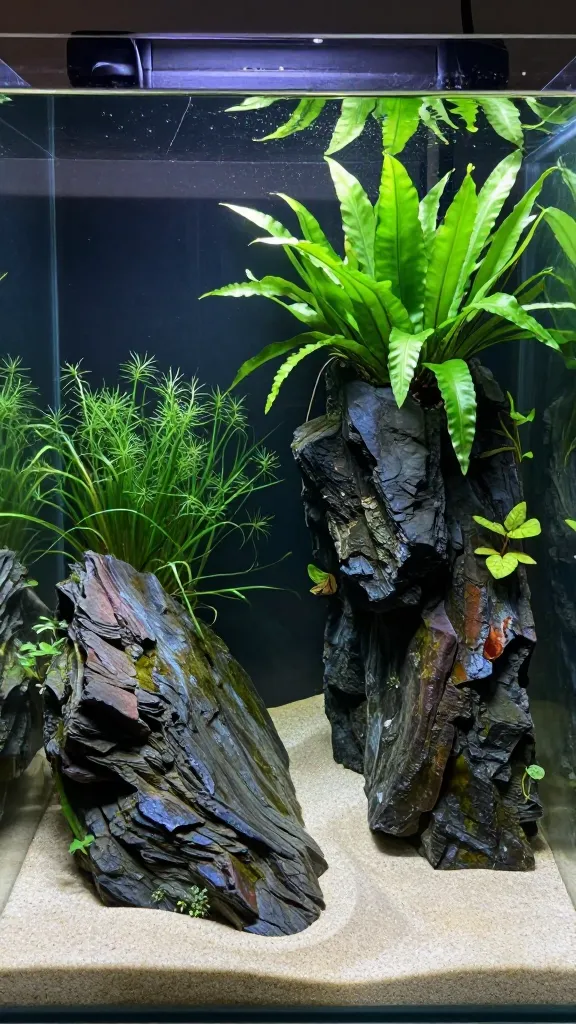
Asymmetry at the layout scale — not just a tilted rock — gives a long tank its pulse. Build two ridges from Manten stone: a lower one running 18 inches along the left front and a taller, tighter one 12 inches long on the back right, with their high points misaligned by 8-10 inches. Plant the left with fine leaves like Myriophyllum mattogrossense behind a drift of Sagittaria subulata; treat the right ridge with bolder textures like Java fern ‘Narrow’ and Bucephalandra. A pale sand channel threads diagonally between them. It reads wrong when the ridges are equal length and height — the moment they match, your long tank becomes a stage set with two identical wings.
Frequently Asked Questions
How long should I let a 55-gallon aquascape settle before adding fish?
Give it 6 weeks. That allows plants to root, biofilm to establish on wood and filters, and the nitrogen cycle to stabilize so fish aren’t added into a fluctuating system. Use that time to shape stems weekly, vacuum lightly, and watch how flow moves detritus.
Do I need CO2 for these 55-gallon aquascape ideas?
No, but CO2 widens your plant choices and shortens timelines. Every layout here can run low-tech with moderate light and patient trimming; choose hardier species like Cryptocoryne, Anubias, Java fern, and Hydrocotyle tripartita if you skip gas. Under those conditions, expect 6-10 weeks to reach balance.
What substrate depth works best in a long tank for carpets?
Use 2-2.5 inches in the foreground, feathering to 3-3.5 inches toward the back for rooters. That grade lets you set stones securely and gives Eleocharis acicularis ‘Mini’ or Monte Carlo enough soil to spread without floating. Keep a sand path at 1/2 inch so debris sits on top where you can siphon it.
How do I maintain open pathways without them filling with plants?
Define them with a different material and a buried edge. A 1-inch border of small pebbles under the sand keeps Hydrocotyle and hairgrass from creeping; a monthly rake and siphon during water change preserves the line. If stolons jump, lift and trim them at the buried edge rather than tearing the path apart.
What fish suit these layouts without overwhelming the composition?
Choose midwater species that school and read as a single gesture, like 20-30 Paracheirodon simulans (green neon tetras), plus a substrate crew of Corydoras panda or Otocinclus. For a 55, avoid large, boisterous fish that demand the whole water column. Stock after 6 weeks, and always to the fish’s needs first — soft cover, stable parameters, and room to turn at speed.
Stand Back, Then Remove One Thing
A long tank is a composition of distances — between stones, between canopies, between the fish and your eye — and the spaces matter as much as the plants. Tonight, set your high point at 1/3, sketch a path 3 inches wide that crosses the midline, and place the first stone so it leans into that line; then take out the next piece you thought you needed and see what opens.
Questions about your own scape? Leave them in the comments and I will answer them. — Julian