10 Mini Aquascape Ideas — Composition at Two Gallons

Most mini aquascape ideas fail because they try to shrink a big layout rather than compose for a 2-gallon world. In two gallons, scale, pace, and plant choice are the composition. By the end of this, you will have chosen a layout that fits your box, your light, and your patience, and you will know what it should look like in 6 weeks, not just on day one. The stone you skip, the empty sand you leave, and the plant you omit matter more than the one you add. These are scapes you can actually build and keep, without CO2 if you prefer, and with life that thrives rather than merely survives.
1. The Single-Stone Scape: One Focal Point, Nothing Competing

One clear subject lets a tiny tank breathe. Place a single Seiryu stone or Dragon stone at 2/5 of the tank’s length from one side, leaning it slightly forward so its shadow reads as mass rather than height. In a standard 2-gallon (about 8-10 inches long), keep the rock under 2/3 of the waterline and plant a low carpet of Dwarf hairgrass (Eleocharis acicularis ‘mini’) around it, leaving 1/3 of the front as open sand (inert, fine-grain). Give it moderate light and 6 weeks to knit; hairgrass will send runners if you plant individual plugs 1 inch apart. When this goes wrong, a second stone creeps in and steals the subject — resist that, and the negative space will do the ornament’s work.
2. The Crescent Path: Guiding the Eye With Negative Space

A curve is a promise — it asks the eye to follow and to imagine what is beyond. Build a shallow crescent path from fine sand, starting at the front-left third and sweeping to the back-right corner, widening to 1.5 inches in the foreground and narrowing to a fingertip at the vanishing point. On the outer arc, mound aquasoil up to 1.5 inches and anchor Cryptocoryne parva and small clumps of Anubias barteri var. nana ‘Petite’ on Dragon stone chips; on the inner arc, keep plants lower with Staurogyne repens trimmed at 1 inch. Allow 6 weeks for the path edges to soften but not close. If the path runs dead straight, it reads as a gutter; keep the inside edge softer and the outside edge crisp to sell the depth.
3. Mini Jungle: Layered Canopy for Shade and Shelter
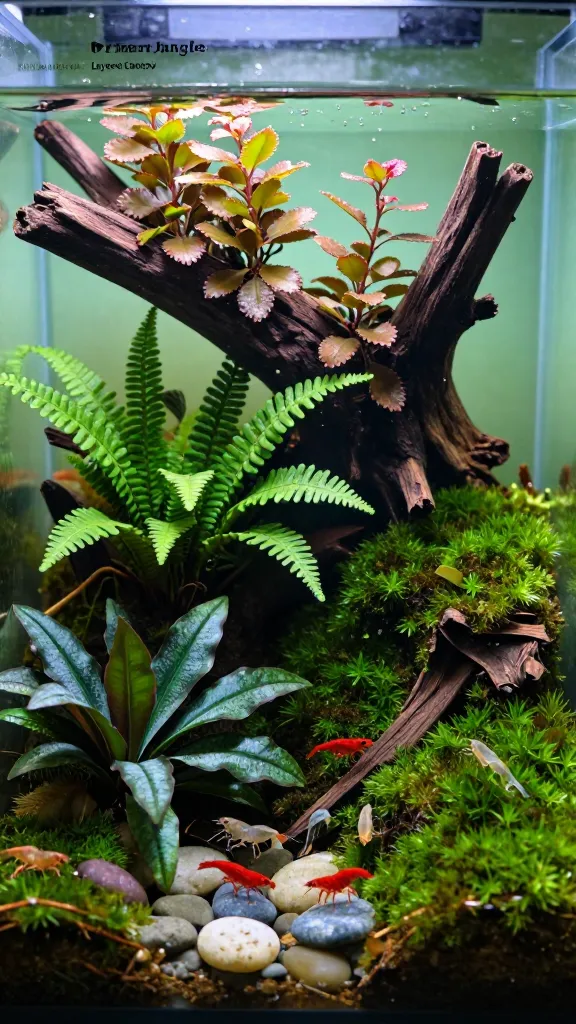
Depth in a small volume comes from layers more than from size. In a 2-gallon cube, terrace soil so the back is 2 inches higher than the front, then build a canopy with Hygrophila pinnatifida on small wood pieces, a mid-layer of Microsorum pteropus ‘Trident’, and a foreground of Bucephalandra varieties tied to pebbles. This creates dappled shade where Moss (Taxiphyllum barbieri) stays tight and shrimp feel secure; under modest light and with weekly 30% changes, it settles in 6 to 8 weeks. When it fails, every leaf sits at the same height and the “jungle” becomes a hedge — stagger stems and let some leaves arch over others to make shade a feature, not a side effect.
4. Island on Sand: Containment as a Compositional Tool

Containment asks the eye to read a shape before details. Pour a 1-inch sand field across the base and build a single soil island no larger than 2/3 of the footprint, set off-center by the rule of thirds. Edge the island with small Manten stone or Lava rock pieces to keep soil from bleeding, then plant the top with Cryptocoryne wendtii ‘Green’ and the edges with Hemianthus micranthemoides trimmed to a soft dome. The sand moat stays empty on purpose; vacuum it lightly during weekly care and let the island rise cleanly in 6 weeks. When misread, the island sprawls to every edge and looks accidental — if your soil touches the glass all around, you’ve lost the silhouette.
5. Root Tangle: Direction Through Flowing Lines

Lines tell the water’s story and give even still tanks a sense of movement. Use one main Spider wood root angled from the back corner down toward the front center at roughly 30°, then support it with two thinner roots following the same vector, never crossing. Plant fine-leaved Rotala rotundifolia behind the root fan to soften the exit line, and attach Riccardia chamedryfolia to the root undersides for texture that reads at 2-gallon scale. Under a steady photoperiod and with trims every 2 weeks after the first 6, the flow becomes unmistakable. The failure here is a bundle of branches pointing in every direction; if two tips fight, remove one and let the negative space between roots be part of the composition.
6. Low-Tech Glossy Carpet: Patience as a Material

Time is as real a material as stone. In a small, low-tech tank, a slow carpet like Micranthemum tweediei ‘Monte Carlo’ planted as 1/4-inch plugs 1 inch apart will close without CO2 if given 10-12 hours of consistent light and lean water changes for 6 weeks, then a gentle trim with curved scissors. Keep hardscape minimal — a single Ohko stone chip or two — so the carpet is the subject, and stop at 2/3 tank coverage to preserve a breathing edge of sand. If you rush and over-plant, the mat will float; press each plug deep and accept a sparse week one so week six is coherent.
7. The Diagonal Ridge: Weight and Counterweight

A diagonal establishes tension you resolve with a counterweight. Build a ridge of Seiryu stone from back-left to front-right at a 40° angle, tallest piece at the back under 2/3 of the waterline, smaller satellites stepping down the slope. Plant the high side with Eleocharis pusilla to keep texture consistent, and the low side with a creeping Hydrocotyle tripartita ‘Japan’ to drape lightly over the stones. Leave the opposite front corner as open sand to balance the mass; the piece reads complete once the hydrocotyle breaks the straight edges at around 6 weeks. When it fails, every stone is the same size and the line becomes a pile — choose one anchor stone and let the rest support.
8. Blackwater Mini: Silhouette Over Color

When clarity drops, shape must carry the scene. In a 2-gallon blackwater layout, tint with a small bag of Indian almond leaves and a fingertip of peat in the filter to tea-brown, then build a thicket of fine Redmoor wood twigs rising no higher than 3/4 of the tank. Use Bucephalandra and Anubias nana ‘Petite’ on the lowest branches, and float a handful of Salvinia minima to dapple the light; rooted plants are optional because tannins slow growth. This type takes 6 weeks to clarify and settle. The danger is suffocation — too many leaves at once crash oxygen; introduce botanicals slowly and stock shrimp only after the tank is fully cycled and stable.
9. Moss Cliff: Texture in Three Scales

Texture catches light in a small box where color can’t. Stack thin Lava rock plates into a 3-step cliff on one side, each step 1/2 inch back from the one below so shadows form, and wrap the faces with a single moss species like Taxiphyllum ‘Flame’. At the cliff’s base, dot Bucephalandra ‘Green Wavy’ sparingly, and keep the floor open with sand to 1/2 the tank’s footprint so the cliff reads as tall. In 6 to 8 weeks, the moss locks in and the light skims the ridges. Failure is mixing three mosses for variety; at this size, mixed textures turn to fuzz — one moss, well-trimmed, is the discipline that pays off.
10. Shallow Riverbank: Foreground Dominance With a Subtle Back

Foreground dominance suits tiny tanks because it brings detail to where you can see it. Create a meandering pebble line with natural river pebbles no larger than 1/2 inch, then plant between them with Marsilea hirsuta to form a low, clover-like lawn at 1 inch, leaving the back 1/3 to a short stand of Cryptocoryne lutea to suggest distance. Keep the pebbles 60% immersed in soil so they look embedded, and let the Marsilea convert its emersed leaves over 6 weeks before the first trim. When this misfires, the back grows taller than the front and flips the balance; keep the crypts pruned to 3 inches and remove runners that reach forward.
Frequently Asked Questions
How long do mini aquascapes at two gallons take to settle?
Plan on 6 weeks before judging the layout. Carpets like Monte Carlo and hairgrass need that time to root and spread, and hardscape edges soften as biofilm and moss establish. Trim lightly only after week six to avoid uprooting.
Do I need CO2 for a 2-gallon aquascape?
No, but your plant list and trim rhythm should reflect it. Choose slower growers like Anubias, Bucephalandra, Marsilea hirsuta, and mosses, and accept 6 to 8 weeks for them to fill. If you add CO2, you can run finer stems like Rotala rotundifolia, but trims come every 1 to 2 weeks instead of monthly.
What livestock work well in a mini aquascape at two gallons?
Small invertebrates are the responsible choice: Neocaridina shrimp or a group of Thai micro crabs, plus a few snails like Neritina or Physella. A 2-gallon is too small for schooling fish and not appropriate for a betta; stability and oxygen are tighter margins here. Cycle fully and stock lightly after ammonia and nitrite hold at zero.
How do I keep sand paths and islands clean without ruining the layout?
Work with proportion and routine. Keep at least 1/3 of the foreground as open sand and vacuum lightly each week with a narrow tube while pinching the edge with your free hand to prevent scouring. Plant dense edging species like Staurogyne repens or Cryptocoryne parva to hold the line and re-tamp after maintenance.
Which hardscape is best for a mini aquascape?
Choose stone or wood that reads at small scale and holds texture: Seiryu, Ohko/Dragon stone, and fine-branching Spider wood are reliable. Keep the main piece under 2/3 of the water height and let satellites be 1/3 to 1/2 the anchor’s mass so hierarchy stays clear. Avoid boulders with no surface detail — they look like marbles at 2 gallons.
Can I make a blackwater mini aquascape without staining the room?
Yes; control the tint and keep it gentle. Use one or two Indian almond leaves and pre-soak driftwood, then run fine floss to catch particulates; the water should read light tea, not opaque. Plant epiphytes like Bucephalandra and add floaters such as Salvinia minima, and allow 6 weeks for stability before adding shrimp.
Begin With the Space You Leave
At two gallons, restraint is the craft: one subject, a clear hierarchy, and negative space that lets inhabitants own the water. Tonight, set your anchor stone or root, stop at two supporting pieces, and mark a 1/3 sand field with tape on the outside glass — build to that line and no farther, then give it 6 weeks to earn the quiet you designed.
Questions about your own scape? Leave them in the comments and I will answer them. — Julian