10 River Aquascape Ideas — Flow, Substrate and the Illusion of Current
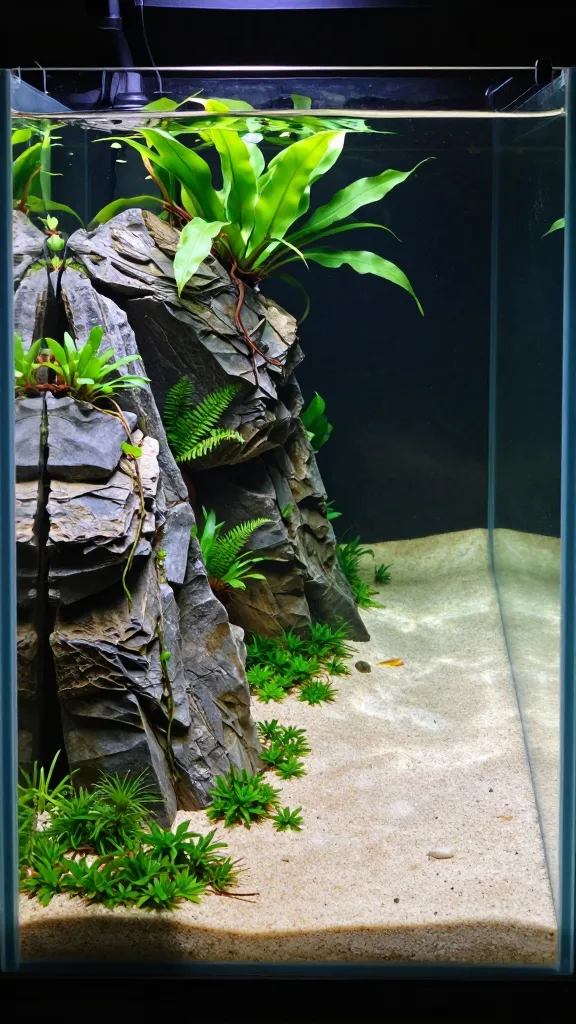
Most river aquascape ideas fail because the “current” is drawn only with wood instead of laid into the substrate bed itself. A river aquascape is about guiding the eye — and the water — from an upstream tension to a downstream release, and the substrate, stones, and planting create that pull as surely as a filter does. The ten layouts here show you how to shape that path, name plants that thrive in tap water, and give honest timelines for when the scape stops looking built and starts looking grown. By the end, you’ll know which direction your tank runs and what to plant where along its banks.
1. Headwaters Triangle: Flow Begins in Compression
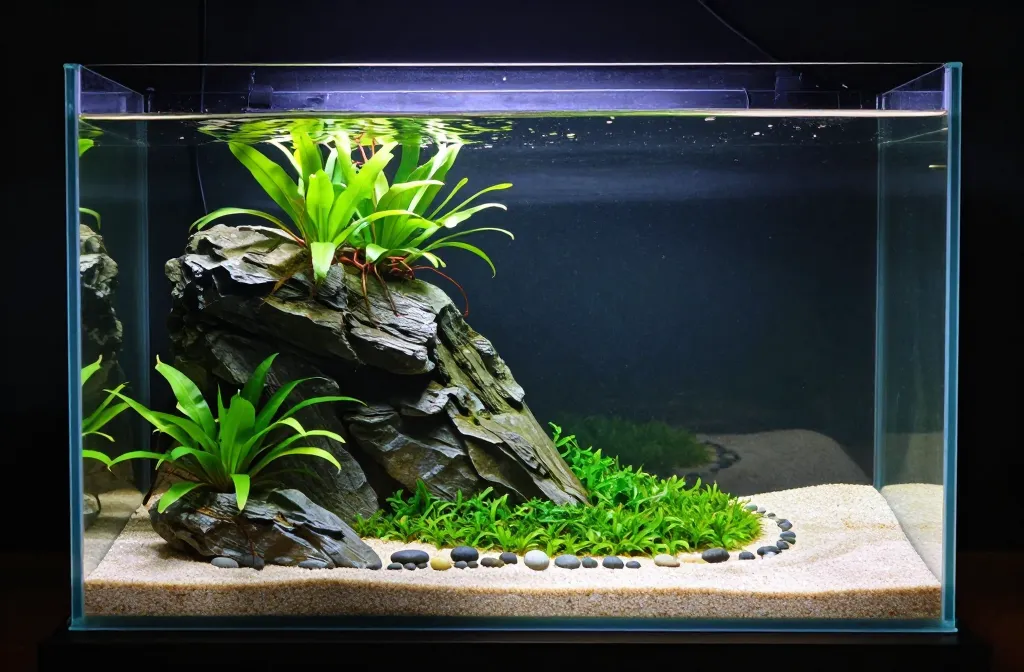
Movement reads clearest when it escapes from a tight place into a broad one, so build a triangular composition that narrows at the “source” and widens toward open water. In a 20-gallon long (30 inches), stack a headland of seiryu stone in the back-left third to 2/3 tank height, then taper substrate to a gentle bar across the front-right. Plant the high bank with Java fern (Microsorum pteropus) and Bucephalandra on stone, and let the “downstream” bar stay open with a low carpet of cryptocoryne parva (Cryptocoryne parva) so the flow line is visible. Give it 6 weeks for the carpet to knit. If you pile rock on both sides equally, the river stalls and reads as a canyon with no exit.
2. Meander Channel: Flow Is an S-Curve, Not a Straight Line
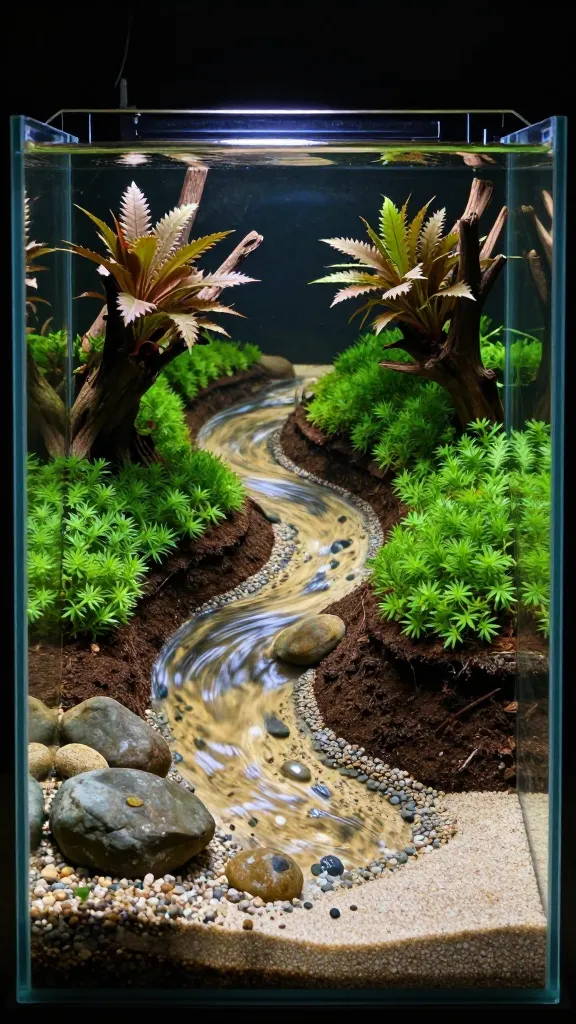
The eye follows a gentle S more naturally than a ruler-straight chute, so cut a sinuous channel through the substrate that touches neither pane. In a 29-gallon (36 inches), bank nutrient-rich soil 3 inches at back corners, 1 inch at the front, and carve an S-shaped path down the middle, dressing it with fine pea gravel and a dusting of pool filter sand. Anchor the outer bends with river stones and plant the banks with Hygrophila pinnatifida on wood and a midground of Staurogyne repens; leave the inner bend sparse with Eleocharis acicularis ‘mini’ so the inside looks scoured. At 8 weeks, the bends will feel inevitable. If you let the sand drift over the banks, the S flattens and the illusion breaks.
3. Cobble Bar Iwagumi: Weight Sets the Current
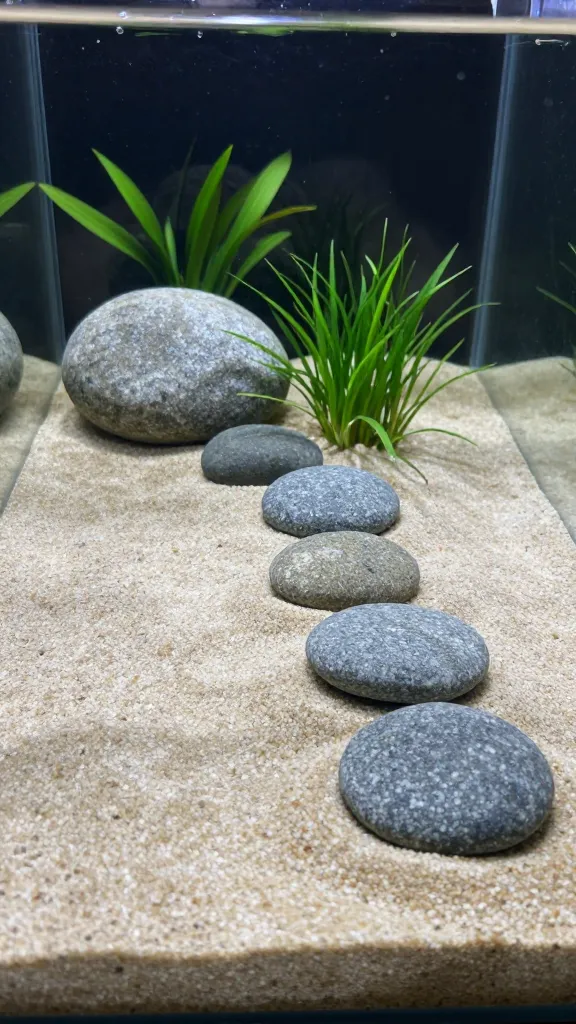
Current sorts stones by size; repeating that pattern creates flow without any wood at all. In a 10-gallon standard, use five to seven rounded granite cobbles from fist at the “upstream” corner to thumb at the “downstream” edge, spacing them so gaps shrink with the stones. Tuck Cryptocoryne lucens behind the largest rock, dotted not massed, and run a clean bed of coarse sand (1–2 mm) as your channel, with Sagittaria subulata planted off the bar to suggest a quieter backwater. Allow 6 weeks for the sag to send runners. If all stones are the same size, the river reads as a gravel lot and the eye stops moving.
4. Rooted Banks: Diagonals That Lean Into the Flow
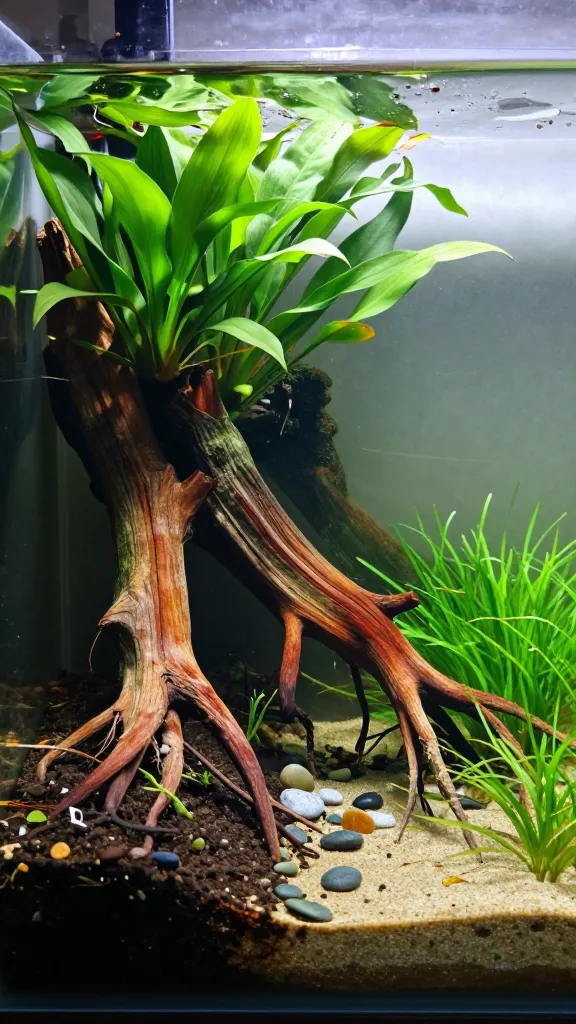
Angles that lean downstream communicate direction more strongly than straight uprights. In a 40-gallon breeder, set two gnarly redmoor roots into the left bank at a 30–40° tilt, tips pointing right, with root bases buried under 3–4 inches of soil to look anchored. Strap Anubias barteri var. nana and Bucephalandra ‘Green Wavy’ to the lower thirds, then plant the bank above with Cryptocoryne wendtii ‘Green’ and the far-right shallows with a loose lawn of Helanthium tenellum. Give the wood 4 weeks to waterlog and the plants 8 weeks to settle. If you angle branches against the “current,” the scape feels stalled and contrived.
5. Sand Spit and Side Channel: Negative Space as Water
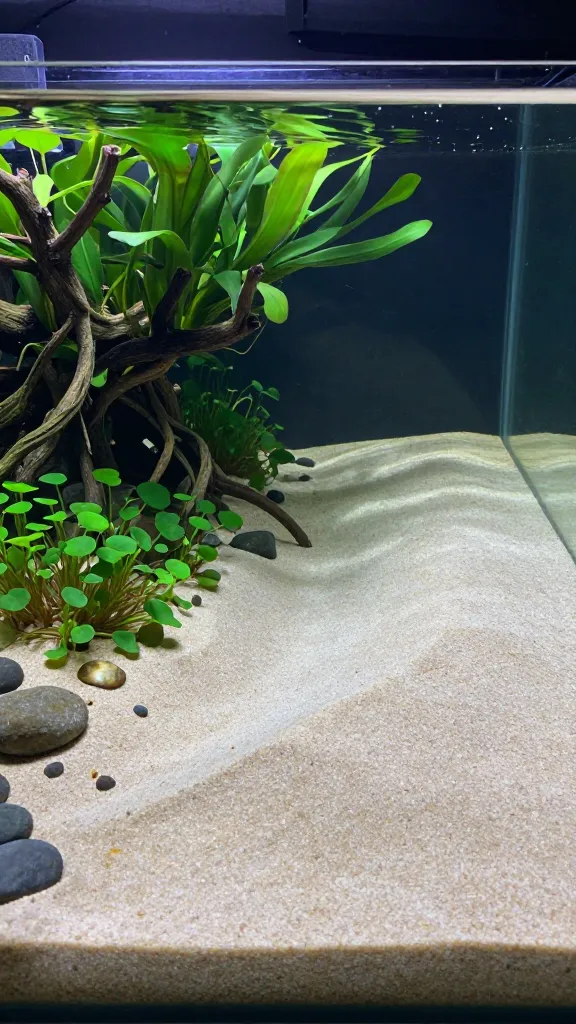
Empty space is your strongest current if you protect it. In a 20-gallon long, build a crescent sand spit that covers roughly 1/3 of the footprint on the right front, pinched to a narrow neck halfway back, with river sand contained by a hidden border of larger stones under the sand. Keep the spit unplanted, and stack a low tangle of manzanita on the left behind it, planted with Bolbitis heudelotii and a bank of Hydrocotyle tripartita ‘Japan’ to soften the edge. At 6 weeks, the spit should still read open; vacuum its edge lightly during water changes so stems don’t creep over and choke the channel. If the sand boundary wanders, the negative space loses its tension and the river disappears.
6. Rapids Texture: Fine to Coarse Gradients Read as Speed
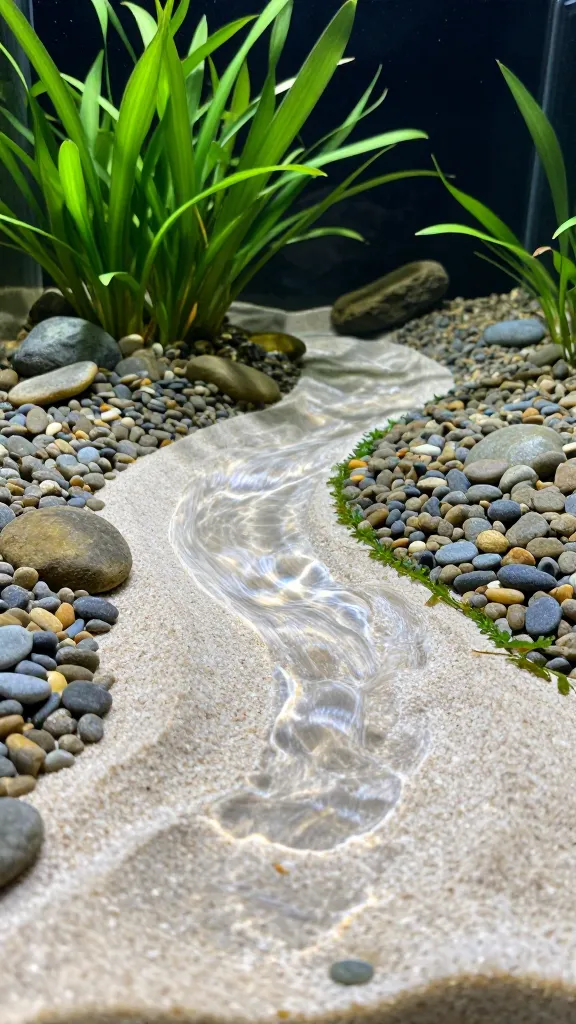
Texture gradients create the sensation of acceleration: fine particles where water is “fast,” coarser where it slackens. In a 15-gallon, lay 1 inch of light pool filter sand in a winding strip that narrows toward the “downstream,” then flank it with 2–3 mm gravel that blends to 5–8 mm at the far back. Plant the coarse, slow “bank” with Cryptocoryne balansae and the fine, fast “run” with only a sparse line of Micranthemum tweediei ‘Monte Carlo’ at the seam so it reads as river foam rather than a full carpet. Allow 8 weeks for the crypts to hit stride; their tall, flowing leaves amplify motion. If you scatter the same grain everywhere, the eye can’t tell where the water is “moving.”
7. Seasonal Floodplain: Height Tells the Story
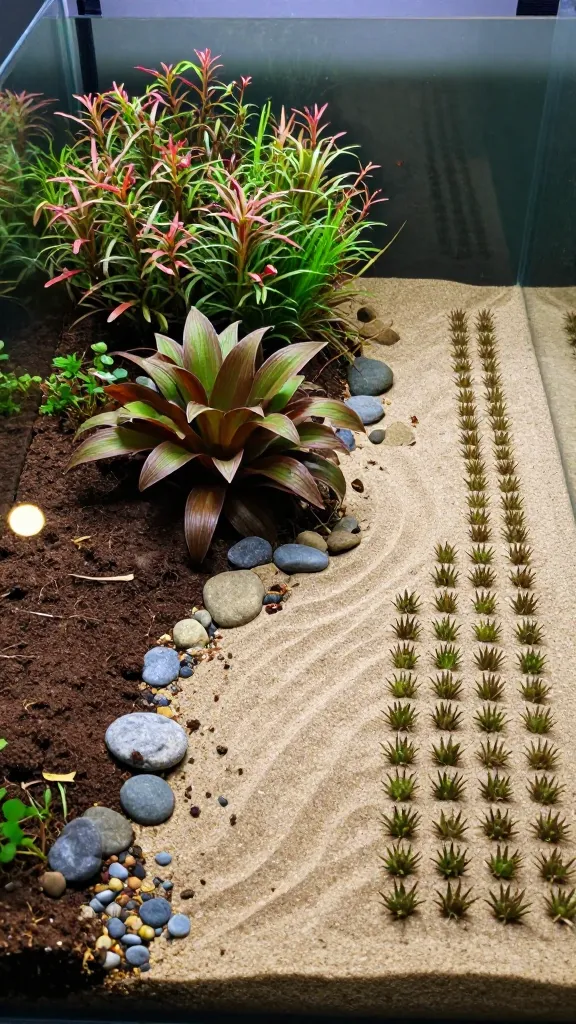
Floodplains grade from frequently scoured low ground to safe high benches; height and density should echo that. In a 55-gallon, build a terrace: 4 inches of soil on the left dropping to 1 inch on the right over 24 inches. Plant the top bench with a dense stand of Hygrophila polysperma and Rotala rotundifolia (no CO2 needed under moderate light, trim every 2–3 weeks after establishment), the mid-slope with groups of Cryptocoryne undulata, and the low floodplain with a sparse grid of Echinodorus tenellus so the “water line” is legible. It takes 8 weeks to settle. If you mass tall stems on the low ground, the floodplain reads backward and the story breaks.
8. Driftwood Rakes: Lines That Point Downstream
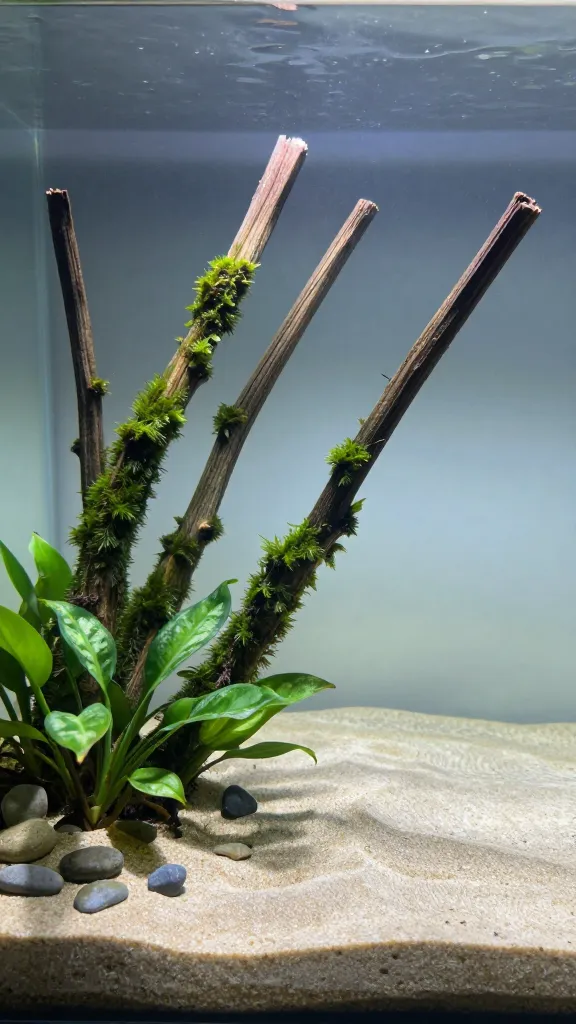
Repeated parallel lines cue direction like ripples on a sandbar. In a 12-gallon long, arrange four to six slender spiderwood branches in the midground all pointing toward the same corner, tips within 1 inch of one another but staggered by length. Wrap the base joints with Taxiphyllum barbieri (Java moss) for bulk, and plant the “lee” side with Cryptocoryne nurii while leaving the “windward” sand clean. Expect 6 weeks for the moss to bind and the crypts to root. If the branches cross or fan in multiple directions, your rake becomes a thicket and the sense of flow collapses.
9. Stones as Deflectors: Vortices, Not Walls
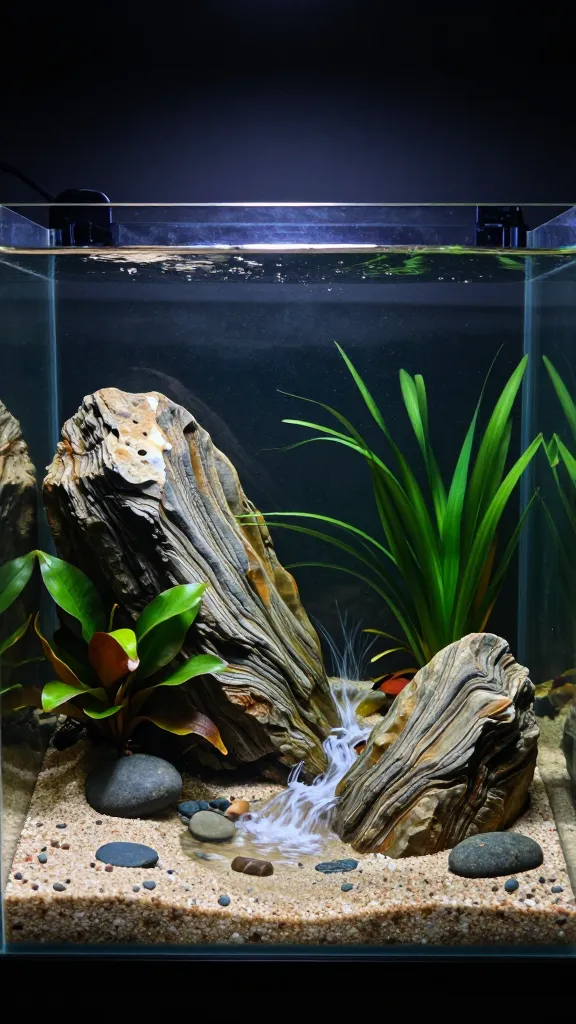
Rivers curve around obstacles; stones should feel like they’re turning water, not stopping it. In a 36-inch tank, place three ohko (dragon) stones as deflectors: one large stone set 6 inches off the left pane, angled 20° downstream, and two smaller staggered on the right bank 8 inches apart, all tilted so their strata aim with the flow. Tuck Bucephalandra ‘Brownie’ into sheltered pockets and plant Vallisneria spiralis in the “eddy” behind each stone so its leaves trail downstream. Give it 8 weeks for the vallis to send ribbons that draw the current line. If you face stones flat to the front, they read as dams and the scene becomes static.
10. Low-Tech River Biotope: Inhabitants Decide the Current
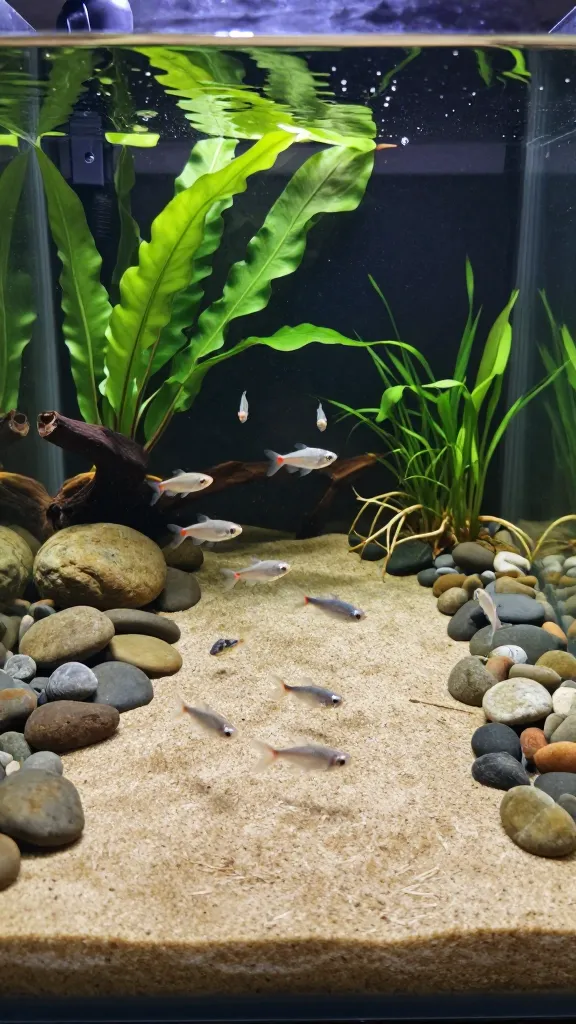
Livestock welfare sets the pace — choose fish that enjoy a steady run without needing a torrent. In a 33-long with a single sponge filter or a gentle hang-on-back, shape a broad sand run down the center and cobbled margins. Plant rooted clumps of Cryptocoryne retrospiralis and a drift of Microsorum pteropus ‘Trident’ on wood, leaving 1/2 of the footprint open for swimming; stock after cycling with a group of White Cloud Mountain minnows (Tanichthys albonubes) or Black neon tetras (Hyphessobrycon herbertaxelrodi), never forcing them into excessive flow. Wait 6 weeks after planting before adding fish so biofilm forms on stones. Overpowering the tank with a strong powerhead just to “sell” the river stresses the fish and makes the scape read like a water park — flow should be drawn, not blasted.
Frequently Asked Questions
How do I keep the sand channel clean without ruining the layout?
Vacuum the channel lightly by hovering the siphon 1/2 inch above the sand and letting detritus lift without digging. Add 2–3 small Neritina snails to graze film, and clip creeping plants at the edge weekly once growth begins. During water changes, pinch the boundary stones back into place before silt can jump the seam.
Do river aquascapes need CO2 to look healthy?
No. Choose plants that thrive in moderate light and tap water, and let structure do more of the talking. Cryptocoryne, Java fern, Bucephalandra, Bolbitis, and Hydrocotyle tripartita all perform well without CO2 if you give them 8 weeks to establish and trim sparingly to maintain the flow line.
How long should I wait before adding fish to a river aquascape?
Wait 6 weeks after planting, and only after the tank is fully cycled. That window allows bacteria to colonize substrate and stones, stabilizes water parameters, and grows biofilm on hardscape, which grazing fish and shrimp use immediately.
What size tank is best for a beginner river aquascape?
A 20-gallon long is forgiving because its footprint lets you draw a believable channel with real negative space. It also allows stable water parameters and room for schooling fish like Tanichthys albonubes while keeping maintenance to weekly water changes and a monthly trim.
How do I stop my sand and soil from mixing in the channel of a river aquascape?
Build hidden containment: lay a low border of pebbles or plastic mesh 1–2 stones wide under the sand along the seam. Slope the soil away from the channel by 5–10°, and cap it with 1/2 inch of matching gravel so roots hold it in place over 6 weeks as they establish.
Let the Water Decide the Lines
Flow is an act of restraint as much as placement: what you leave open reads as strongly as what you plant. Tonight, pour a shallow ribbon of sand diagonally across the bare glass, place three stones as if they’re turning water aside, and step back until you feel where the downstream space wants to be — then draw everything else to serve that line.
Questions about your own scape? Leave them in the comments and I will answer them. — Julian