12 10-Gallon Aquascape Ideas — The Most Forgiving Size to Learn On
Most 10-gallon aquascape ideas fail or sing on the same hinge: proportion. In a 10-gallon, you see every cut, every gap, and every shadow — which is why this size is the most forgiving to learn on while still honest enough to teach you. By the end, you’ll have chosen a layout you can build this month and a rule to guide each stone and stem you place. Every entry names the plants, the scale, and how long it takes to settle, so you can stand at the glass and know what to do next.
1. The Single-Stone Scape: One Focal Point, Nothing Competing

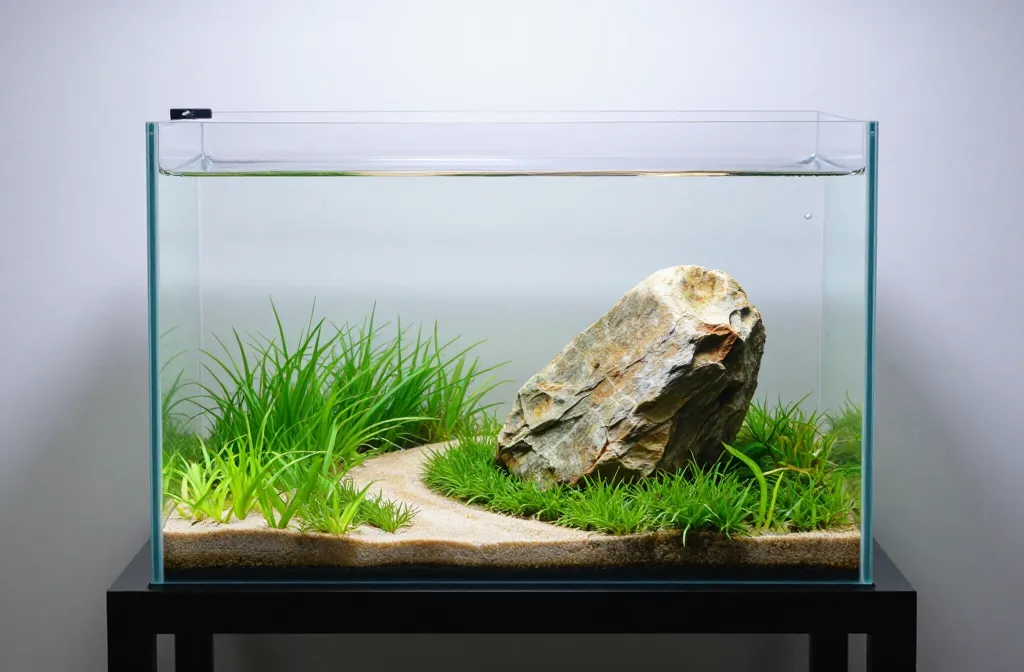
When all the weight falls on one feature, the eye can rest and the negative space can breathe. Place a single Seiryu stone or Ryuoh stone roughly 2/3 to the right or left in a standard 20″ 10-gallon, tilting it so its grain rises toward the golden point. Build a low mound of substrate to lift the stone 1/3 of the tank height, then flank with a sparse carpet of Dwarf hairgrass (Eleocharis acicularis) and a few tufts of Cryptocoryne parva. Give it 6 weeks for the grass runners to close the foreground under moderate light, with or without CO2. When this goes wrong it’s because the stone is too small — if your palm hides it, choose a larger piece.
2. The River Path: S-Curve That Guides the Eye

A gentle S-curve pulls the viewer from front to back, turning a shallow box into a walkable space. Shape a 2″ deep front sand path (inert, pale) that narrows to 1/2″ at the back, bordered by dark aquasoil banks held with small Ohko (dragon) stone. Plant the banks with Staurogyne repens midground and a back curtain of Ludwigia repens ‘Rubin’ for a warm accent. Keep the path clean with a turkey baster at each water change; let the stems grow tall for 6 weeks before the first shaping. Failure looks like parallel borders too straight or too symmetrical — if the S reads like a railroad, soften one bank and let it meander.
3. Jungle Corner: Layering From Shadow to Light
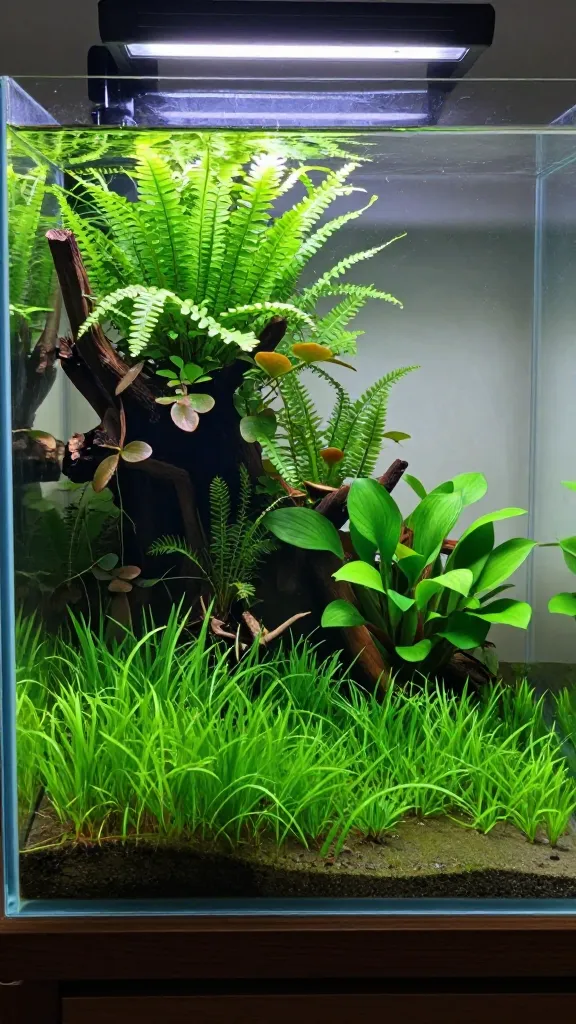
Depth comes from overlapping layers that let the light pool and fade. In the rear left third, build a mound and root a thicket of Hygrophila polysperma, Bacopa caroliniana, and a few clumps of Microsorum pteropus (Java fern) on small wood. Let the right side remain airier with Cryptocoryne wendtii ‘Green’ and an open foreground of Pygmy chain sword (Helanthium tenellum). This grows well in tap water, low to moderate light, and no CO2; give it 8 weeks to knit into one mass before any heavy trimming. If it fails, it’s because everything is the same height — stagger the canopy and keep the front 1/3 clear.
4. Classic Iwagumi in a 10: Triangulation and Tension

Asymmetrical balance is what makes a rock field feel natural rather than arranged. Use three stones of Seiryu with one dominant at 1.5–2x the size of the next, all leaning in the same tectonic direction. Plant a full carpet of Micranthemum ‘Monte Carlo’ (M. tweediei) for moderate light, or Dwarf hairgrass if you’re patient, and tuck a few Bucephalandra sprigs in the stone shadows for texture. CO2 helps, but a dedicated photoperiod and steady fertilization make a non-CO2 carpet plausible in 10–12 weeks. The miss is symmetry — if the two small stones mirror each other, rotate one until the tension returns.
5. Wood and Epiphytes: Texture Over Speed
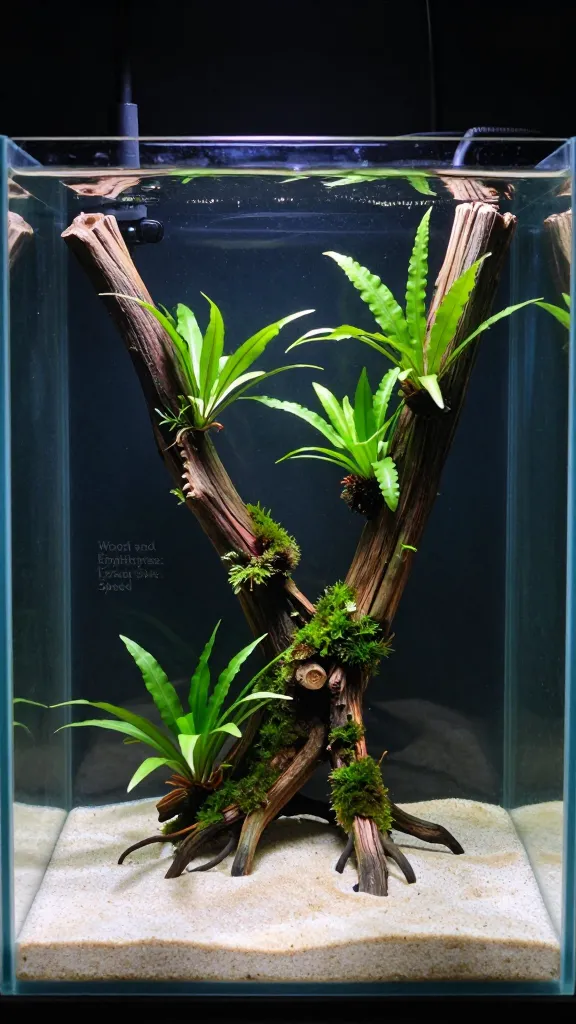
Contrast carries the scene when your plants grow slowly. Arch two branches of Spider wood (Azalea root) from the rear corners toward the center, leaving 1/2 of the foreground open. Tie Java fern ‘Trident’, Bolbitis heudelotii (African water fern) at the shaded midpoints, and patch the limbs with Christmas moss (Vesicularia montagnei). Inert sand foreground, shrimp or small rasboras later, and weekly 30–40% water changes keep the epiphytes clean; give it 6–8 weeks for moss to grip. When it fails, it’s because the wood is flat and horizontal — tilt the branches so they rise and cross to break the plane.
6. Blackwater Mood: Tone First, Color Second

In a tonal scape, the palette narrows and shape does the talking. Use leaf litter (Indian almond leaves), a few Catappa bark pieces, and a single gnarled root, leaving 2/3 of the footprint open water. Plant shade-tolerant rosettes like Cryptocoryne usteriana or C. wendtii ‘Tropica’ in small groups, and a tuft of Java moss (Taxiphyllum barbieri) on the root. Tannins drop the pH a little; keep stocking gentle (e.g., ember tetras) only after a full cycle. The trap is chasing crystal clarity — if you strip all color with carbon, you lose the mood; live with the tea and trim gently every 6 weeks.
7. Island Mound: Framing With Negative Space

Empty water is a design choice, not a leftover. Build a single planted island on the left third using rounded Ohko stone and a soil dome that peaks at 1/2 tank height, leaving the right two-thirds as open sand. On the mound, layer Cryptocoryne lucens low, Hygrophila pinnatifida on stone faces, and a back plume of Rotala rotundifolia. The island should feel heavier at the base, airier at the top; let it settle for 6 weeks before refining the Rotala. Failure reads as a blob — if the island has no terraces, add a ledge and let the plants cascade.
8. Midground Meadow: Repetition to Calm the Eye

Repetition builds rhythm and removes the need for constant novelty. Fill the middle third with a grid of 7–9 evenly spaced clumps of Sagittaria subulata or Cryptocoryne balansae, each the size of an orange at maturity, against a simple sand-and-soil split. Keep the back simple: a single species like Limnophila sessiliflora or Hygrophila corymbosa; the front can be left open or dotted with Hydrocotyle tripartita ‘Japan’ runners. Give the Sag 8 weeks to establish before dividing any parent rosettes. The mistake is mixing too many species — three is plenty; more breaks the cadence.
9. The Diagonal Fall: Flow and Direction

A line falling from back-left to front-right sets motion and lets you sculpt current. Stack Seiryu shards into a back-left ridge peaking at 2/3 tank height and tumble fragments diagonally toward the front-right corner. Plant low Eleocharis pusilla along the fall, with Anubias barteri var. nana ‘Petite’ tucked into crevices and a soft back veil of Rotala indica. Gentle flow across the diagonal keeps detritus from settling; let the stems reach the surface at week 6 before topping and replanting. Failure comes from a straight scree — vary piece size so the cascade breathes and the line isn’t a ruler.
10. Dutch-Inspired Row: Height Staging and Color Contrast

Order can be beautiful when the timing of trims matches the growth. Create three stepped rows: front with Alternanthera reineckii ‘Mini’ and Lobelia cardinalis ‘Dwarf’, mid with Pogostemon helferi and Cryptocoryne ‘Flamingo’ if available, back with Hygrophila difformis (Water wisteria) and Myriophyllum mattogrossense. Keep rows 2″ deep each and maintain clear gaps between groups. CO2 is optional but steadier with it; without, extend trimming intervals and accept 8–10 weeks between big shapes. Failure is height drift — if the front row shades, reset by hard-trimming the back and re-spacing stems in one session.
11. Low-Tech Crypt Grove: Patience as Design

Slow plants make room for subtle composition and a calmer routine. Lay a gentle crescent of Cryptocoryne wendtii ‘Bronze’, C. pontederiifolia, and C. undulata from back-left to front-center, leaving the right rear as open water with only a mossed root. Use inert sand front and a small soil pocket under each crypt crown; do not disturb once planted. Expect initial melt and regrowth within 6 weeks, full leaf size by week 10 under moderate light. The failure is impatience — moving crowns resets them; plant once, then let the grove thicken on its own calendar.
12. Branch Canopy for Shrimp: Scale and Shelter
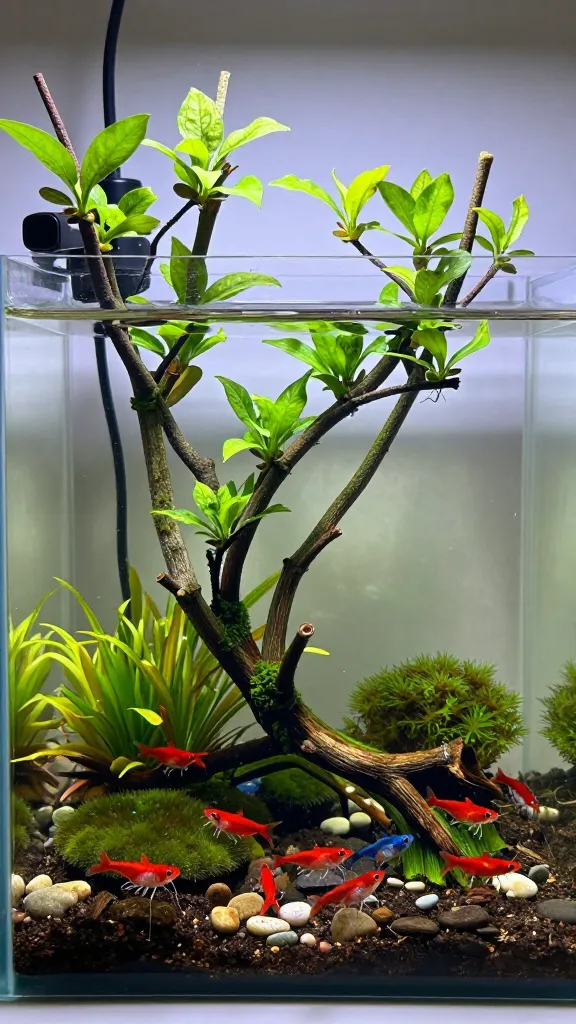
Scale is set by the finest lines in the scape — get those right for small inhabitants. Build a twiggy canopy from thin Manzanita branches set high, leaving shaded dapple below, and tie on Bucephalandra ‘Green Wavy’, Anubias ‘Petite’, and small pads of Taxiphyllum ‘Flame’ moss. Keep the substrate open with Subwassertang (Lomariopsis sp.) cushions for grazing, and stock only after full cycling. A 10-gallon supports a colony of Neocaridina well; target 6 weeks before you judge biofilm. Failure is chunky wood — if the branches read as logs, split them into thinner pieces and raise the canopy to 1/2 tank height.
Frequently Asked Questions
How long does a 10-gallon aquascape take to settle?
Most layouts look coherent after 6 weeks. Carpets and slow rosettes may need 8–10 weeks, but stems can frame the scene by week 4 if you let them reach the surface before the first hard trim. Judge the scape on new growth, not the day-one planting.
Do I need CO2 for a 10-gallon aquascape?
No, but CO2 widens your plant list and shortens the timeline. Without it, choose forgiving species like Cryptocoryne wendtii, Java fern, Anubias nana ‘Petite’, Staurogyne repens, and Dwarf hairgrass under moderate light, and plan for 6–10 weeks to settle. Keep photoperiod around 6–8 hours to manage algae.
What hardscape size works best in a 10-gallon?
Use at least one anchor that is hand-sized or larger, with support pieces at 1/2 and 1/3 that volume. If your largest stone or wood can hide behind your palm, it will disappear once plants grow; scale up the main piece and reduce the number of small ones. Keep 1/3 of the footprint open to avoid crowding.
How many fish can I keep in a planted 10-gallon?
Stock lightly and only after the tank is fully cycled. A single small-school species like 10–12 chili rasboras, or a betta with invertebrates that won’t be harassed, fits; always prioritize the animals over the photo. Maintain 30–40% weekly water changes and stable parameters.
What lighting schedule should I run on a new scape?
Start at 6 hours daily for the first 3–4 weeks, then increase to 7–8 hours if growth is steady and algae controlled. Keep intensity modest for low-tech plants like Cryptocoryne and Java fern; stronger light demands steadier CO2 and fertilization. Consistency beats intensity in the first 6 weeks.
Let the Tank Teach You Back
Proportion does the quiet work that gear cannot. Tonight, choose your anchor — one stone or branch that is unashamedly large for a 10-gallon — set it at the 2/3 mark, and remove one extra piece you don’t need; then wait 6 weeks before you judge the scene you’ve built.
Questions about your own scape? Leave them in the comments and I will answer them. — Julian