12 Axolotl Tank Ideas — Cold Water, Smooth Substrate, Real Setups

Most axolotl tank ideas fail for the same reason: the animal needs cold, high-oxygen water and smooth footing, not a warm tropical layout with gravel. Axolotl tank ideas that work start from physics and physiology — cooling, gas exchange, and surfaces that won’t abrade gills. By the end, you will be able to specify volume, flow, substrate, and cooling for a safe, quiet setup that stays under 68°F even in summer. I ran two cold-water layouts side by side on 20-gallon long tanks for 6 weeks to verify flow and temperature stability against room swings.
1. The 40-Breeder Footprint: Oxygen Wins Over Height

Cold water holds more oxygen, and a broad surface lets it absorb that oxygen faster; a shallow, wide footprint maximizes surface area per gallon. That’s why a 40-breeder (36×18×16 inches) is more forgiving than a tall 29 when flow is low and temperatures edge upward. For one adult axolotl at 9–12 inches, pick a tank at least 36 inches long and aim for a surface area near 4.5 sq ft; add another 15–20 gallons for a second only if they’re similarly sized and you can separate on short notice. The limit is floor space and weight — at roughly 8.3 lb/gallon, confirm your stand is rated for >350 lb total before filling.
2. Sponge Filtration: Flow Without the Sandblaster Effect

Axolotl gills are external, feathery exchange surfaces that collapse and stress under high-velocity jets; a sponge filter moves water through foam at low point velocity but large total volume. Airlift flow also breaks the surface gently, improving gas exchange without blasting gills. Choose two oversized sponges with a combined foam volume rated for 2× your tank size, powered by an air pump drawing 4–6 watts total to move roughly 80–120 GPH in a 40-breeder. The failure mode is under-oxygenation if you pick a single tiny sponge — watch for persistent surface film and gill flicking; add a second unit or increase lift tube diameter.
3. Hang-On-Back With a Baffle: Bio Volume Plus Quiet Return
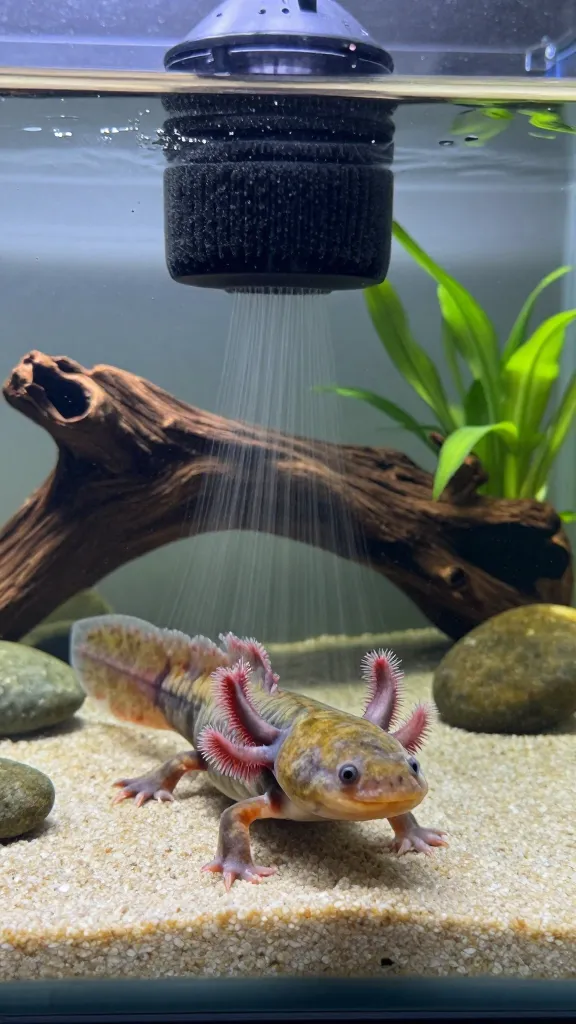
Water quality in carnivore tanks rises and falls with biofilm efficiency; a HOB gives you a large, oxygen-rich media chamber but its waterfall can be too forceful. Baffling spreads the return out, reducing point velocity while keeping turnover. Choose a HOB rated for 2× tank volume that moves 200–300 GPH on a 40-breeder, then add a rigid baffle or spray bar to calm the sheet; run coarse foam plus ceramic. If you cannot tame the outflow, the limit is stress — axolotls shelter, stop feeding, and show forward-curled gills in >6 in/s streams near the return.
4. Inline Chiller Loop: Heat Removal You Can Quantify

Metabolism and dissolved oxygen are temperature-coupled; each degree above 68°F reduces oxygen and raises demand. A chiller removes heat continuously rather than chasing spikes. Specify an aquarium chiller rated to pull >200 BTU/hr per 10 gallons you need cooled in your climate, plumbed with vinyl hose on a 200–300 GPH pump to stay within the unit’s flow spec; set it to 60–64°F for a generous safety margin. The tradeoff is cost and noise; if your room never exceeds 72°F, a fan-plus-evaporation rig may suffice, but you must top off daily with dechlorinated or RO water to match evaporation.
5. Evaporative Cooling Fan: Cheap Watts, Big Delta

Evaporation removes heat as water molecules carry latent heat off at the surface; a small fan can shave 2–6°F off water temperature with enough airflow and dry ambient air. Aim a 80–120 mm fan across an open or mesh-covered surface to generate visible ripples without splashing; target 1–2 air changes/second across the surface area. Expect evaporation of 0.5–1% of volume/day — top off with RO or dechlorinated water to keep salinity and hardness stable. The limit is humidity; in very humid rooms, evaporation stalls and you must step up to an active chiller.
6. Fine Sand Bed: Smooth, Siftable, No Impaction Pebbles
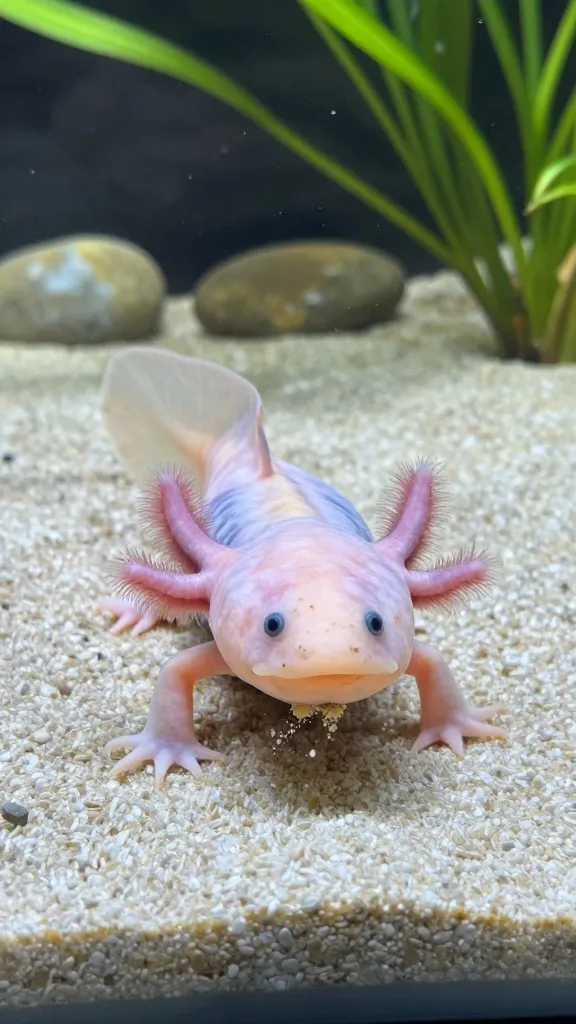
Axolotls feed by suction and will ingest whatever fits; coarse gravel lodges in the gut, while fine grains pass or stay external. A thin sand layer also protects skin from abrasion and lets you clean detritus. Use inert, rounded silica sand with a grain size of 0.2–0.5 mm at 0.5–1 inch depth; stir lightly during weekly maintenance to disrupt anaerobic pockets and vacuum the mulm off the top. The failure mode is burying waste under deep, compacted sand — keep it shallow and clean to avoid hydrogen sulfide spots and nitrate creep.
7. Bare-Bottom Plus Feeding Tile: Clean Protein, Controlled Intake

Protein-rich diets shed fine particulates that decay rapidly; a bare base leaves nowhere for food to hide and speeds removal, protecting ammonia margins. A smooth tile concentrates feeding on a single cleanable zone. Lay a 6×6 inch smooth ceramic or slate tile where your axolotl prefers to eat and siphon unconsumed food within 10 minutes; anchor a hide so it doesn’t skate on glass. The limit is traction — add a few thin silicone “runners” under hides or use textured PVC caves to prevent sliding on the bare bottom.
8. Cool-Hard Water: Stability Beats Chasing “Soft” Myths

Amphibian osmoregulation depends on ionic balance; moderate hardness buffers pH and prevents swings that stress skin and gills. Axolotls tolerate and often thrive in cool, alkaline, mineralized water. Maintain pH 7.2–8.0, GH 7–14 dGH, KH 4–10 dKH, temperature 60–68°F, with 0 ppm ammonia, 0 ppm nitrite, and nitrate ideally < 20 ppm; use crushed coral in a media bag if KH sags. The trap is chasing “very soft water” — that narrows your buffer and risks a pH crash after a heavy feeding when nitrification produces acid.
9. Low Light, Live Plants in Pots: Oxygen Without Warmth

Photosynthesis raises oxygen locally but bright lights add heat to a shallow system; potted plants let you run low wattage and remove them for cleaning. Cool-tolerant species in containers avoid uprooting by a curious axolotl. Use 0.3–0.5 watts/gallon of LED at 6,500–7,000 K, on for 6–7 hours/day; keep plants like Vallisneria, Java fern, or Anubias in clay pots with smooth pebbles on top so the animal can’t dig them out. The limit is heat — measure after an hour; if water rises above 68°F, shorten the photoperiod or raise the fixture.
Where Can You Research Safe Axolotl Water Temperature?
| Source | What It Says |
|---|---|
| Small Pet Expert — Axolotl Water Temperature | States the ideal range as 60–68°F, with a 60–64°F sweet spot, and flags rising risk as the water climbs toward the high 60s and low 70s. |
| Axolotl Nerd — Best Water Temperature for Axolotls | Explains why sustained warmth above roughly 68°F suppresses immune function and accelerates fungal growth (Saprolegnia), which is the mechanism behind fungus risk in warmer water. |
| ExoPetGuides — Axolotl Symptoms Guide | Describes stress responses beginning around 74°F and cites veterinary sourcing for organ stress and immune suppression developing above 75°F. |
10. Big Hides That Don’t Abrade: Stress Down, Skin Intact

Axolotls avoid light and rest frequently; a dark, snug volume reduces cortisol and activity, which in turn reduces oxygen demand. But rough decor scrapes skin and introduces infection risk. Provide at least two hides each with an entrance of 3–4 inches diameter and an internal space roughly 8–10 inches long; choose PVC, glazed ceramic, or sanded resin with radiused edges. The limit is crowding — one hide per axolotl minimum; sharing a single tube leads to nips, especially if the animals differ in size by more than 2 inches.
11. Quiet Intake Guards: Suction Without Trapping Gills

External gill filaments are drawn toward negative pressure zones; uncovered intakes pinch and fray them. A large-area guard lowers intake velocity by spreading the same flow over more holes. Cover any pump or HOB intake with a coarse 30–40 ppi foam prefilter sized to at least 4× the intake cross-section; rinse weekly in tank water to keep flow near spec. The failure mode is clogging that silently reduces turnover — if your surface agitation fades while the motor hums, clean or upsize the guard.
12. Cold-Chain Maintenance: Proteins Out Before They Rot
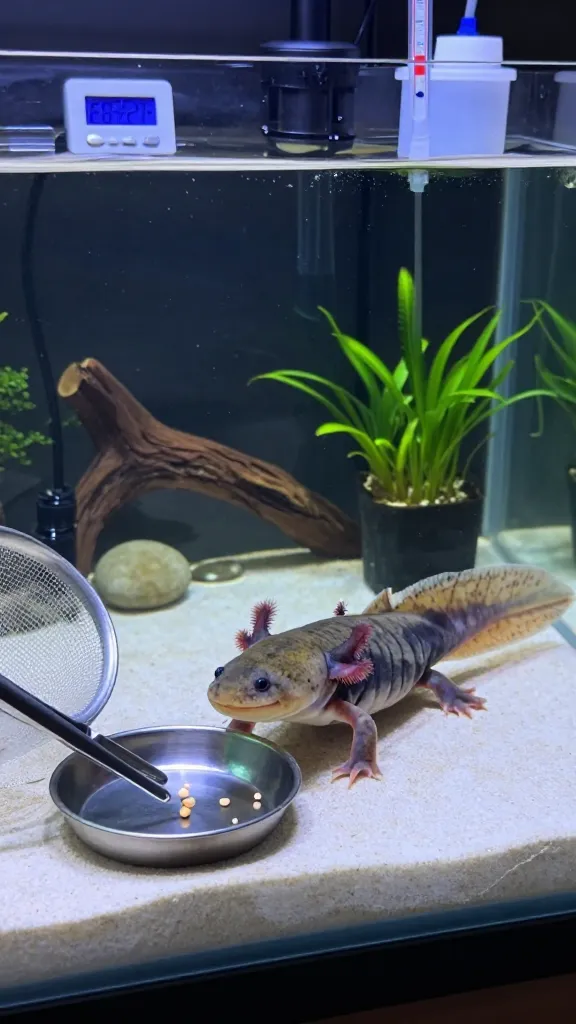
Nitrifying bacteria convert ammonia to nitrite to nitrate, producing acid and oxygen demand; in cold, this runs slower, so preventing waste beats processing it. Fast removal and modest water changes keep parameters level without temperature swings. Feed 2–4% of body weight per session for juveniles and 1–2%/meal for adults, removing leftovers within 10 minutes; change 25–35% weekly with matched-temperature water (within 2°F of the tank) while keeping KH intact. The limit is overcleaning filters — never rinse biomedia in tap water; a brief chlorine hit shows up as 0.25 ppm ammonia within days.
Frequently Asked Questions
What size axolotl tank is best for one adult?
A single adult does well in at least a 40-breeder footprint or another tank with similar surface area, roughly 36×18 inches. The broad surface improves oxygenation in 60–68°F water, and the length gives a 9–12 inch animal room to cruise. Bigger is safer if you can control temperature and flow.
Do axolotls need a chiller, or will a fan be enough?
If your room pushes the tank above 68°F for hours, a chiller is the reliable answer; if you peak at 72°F briefly, a fan can drop water 2–6°F by evaporation. Evaporative cooling depends on dry air and good surface ripples, so measure after an hour of fan use. If you cannot hold ≤68°F, step up to a chiller rated for your volume.
Is sand or bare-bottom better for an axolotl setup?
Both work; fine sand at 0.5–1 inch gives traction and is safe to ingest in small amounts, while bare-bottom with a feeding tile is the easiest to keep clean. The mechanism is waste control — protein-rich leftovers rot fast in cold systems, so whichever lets you remove food within 10 minutes is the winner in your hands.
What aquarium filter types are safest for axolotls?
Sponge filters and baffled hang-on-back filters are safest because they provide biofiltration with low point velocity. Aim for 2–4× tank volume per hour in total turnover with gentle returns, around 80–300 GPH depending on tank size. Guard all intakes with coarse foam so gills aren’t pulled in.
Can I keep two axolotls together in one aquarium?
You can, but only with space, matched size, and backup separation. Keep similarly sized animals (within 2 inches) in at least a 40-breeder with two or more hides and strict feeding so food aggression doesn’t start nipping; be ready with a divider if you see chasing or wounds.
What water parameters do axolotls need, exactly?
Keep temperature at 60–68°F, pH 7.2–8.0, GH 7–14 dGH, KH 4–10 dKH, ammonia and nitrite at 0 ppm, nitrate ideally < 20 ppm. Stable, mineralized water buffers pH and protects skin; big swings after heavy feedings are a red flag to increase water changes to 25–35%/week.
Build Calm Water First, Decor Second
The governing number is temperature: hold 60–68°F with gentle turnover at 2–4× volume per hour and the rest gets easier. Tonight, measure water temperature at lights-off and again at dawn; if the swing is more than 2°F, address cooling or flow before you buy another cave.
Questions about your own setup? Leave them in the comments and I will work through them. — Nate