12 Turtle Tank Ideas — Water, Basking and Filtration That Keeps Up

Turtle tank ideas live or die on physics: water volume to dilute waste, basking heat to let skin dry, and filtration that turns ammonia into nitrate before it burns a shell. If you understand how a turtle’s metabolism loads the system — heavy solids, constant protein, warm basking — you can specify equipment that actually keeps up. By the end you’ll be able to size flow in GPH, set basking and water temperatures, pick UVB output by percent and distance, and decide when a pond-style filter beats an aquarium one. I ran a canister and an internal power filter on identical 40-breeders for 8 weeks and tracked nitrogen and clarity to compare service intervals. This is the build sheet that trades ornaments for numbers that hold.
1. Big Water First: 10x Shell Length of Swim Space and Depth You Can Reach
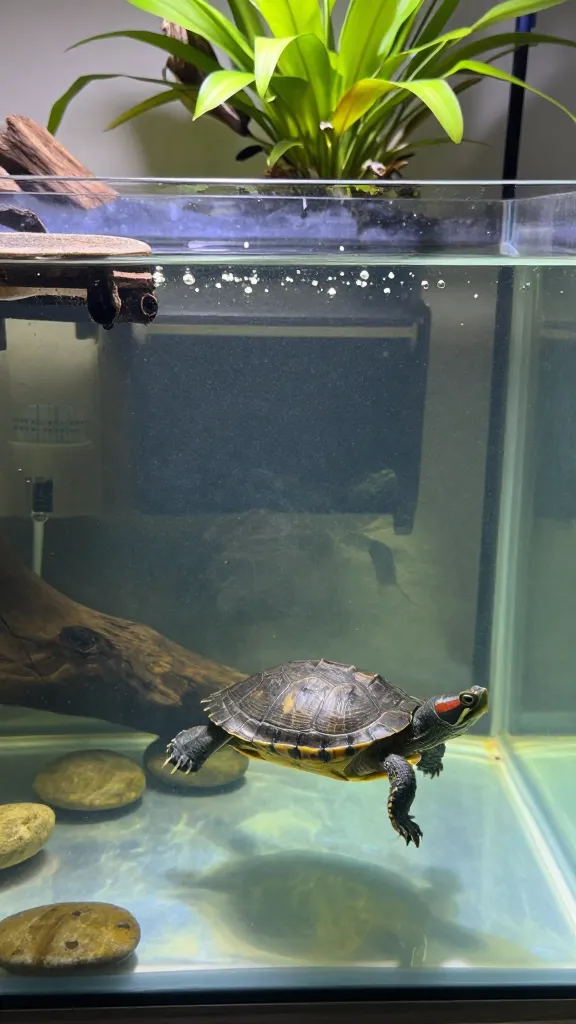
Dilution is not decoration — more water slows the rise of ammonia and temperature swings because every gram of waste is spread across a larger volume. Turtles also push solids into suspension, and depth gives those solids space to settle without being blown back up by outflow. For a single juvenile slider or painted turtle, target a footprint like a 75-gallon (48×18 inches) with 40–60 gallons of water initially; for adults at 7–10 inches shell length, plan a true 75–125 gallons of water. Keep water depth at least 1.5× shell length so flips are recoverable, but shallow enough that you can net debris daily. The limit here is floor load and budget — if your stand cannot bear it, do not exceed the manufacturer’s rating and verify with a professional.
2. Basking Platform: Dry Air, Not Just Dry Shell

Evaporation cools the shell; a basking spot must heat the turtle above water temperature so drying completes and shell flora stay in check. Heat moves by radiation more than convection here — you need a hot beam landing on a surface that stays bone dry. Set a platform that holds the turtle fully out of water with a lamp producing a surface temperature of 90–95°F, measured at shell height, and position it 8–12 inches below the bulb depending on reflector and wattage. Keep the water at 74–78°F for most North American baskers; the contrast drives actual basking. The failure mode is “warm water, cool bask,” which suppresses basking and invites fungus despite a lamp being present.
3. UVB Lighting: Distance, Output and the Inverse Square Reality

Vitamin D3 synthesis in skin depends on UVB photons reaching it; intensity drops with the square of distance, so halving the distance increases exposure fourfold. Mesh screens can cut UVB by 30–50%, turning a correct bulb into an underdose. Use a linear T5 HO UVB lamp with 5–7% UVB output placed 10–14 inches from the basking surface with no mesh between if possible. Replace the tube at 12 months of use to avoid invisible decay in UVB despite visible light. The limit: compact coil bulbs can work only at short distances and tight beams — easy to mis-aim and underdose across a moving turtle.
Where Can You Research Turtle UVB Requirements?
| Source | What It Says |
|---|---|
| ReptiFiles — Red-Eared Slider UVB & Lighting Requirements | Explains why UVB is required for vitamin D3 synthesis and calcium metabolism, and recommends linear T5 HO tubes over compact bulbs for even coverage. |
| Zoo Med Laboratories — Red Ear Slider Resources | Manufacturer/husbandry guidance on UVB output percentages, basking distance, and bulb replacement intervals for aquatic turtles. |
4. Canister Filtration: Media Volume Over Motor Size

Biological filtration is surface area for nitrifiers to colonize; the pump only moves water to that colony. Turtle waste is protein-rich and copious, so you need large baskets that trap solids without starving the biofilm of flow. Aim for a canister with 1–2 gallons of media volume and a real-world turnover of 4–6× water volume per hour (e.g., 240–360 GPH for 60 gallons of water) after media and head loss. Pack stages as coarse (20–30 ppi), fine (50 ppi), then ceramic or sintered media; clean mechanical stages every 1–2 weeks and only swish bio media in tank water. The limit is clogging: undersized baskets channel and starve bacteria, forcing weekly tear-downs.
5. Internal Power Filter: The Solids Mower You Can Rinse Daily
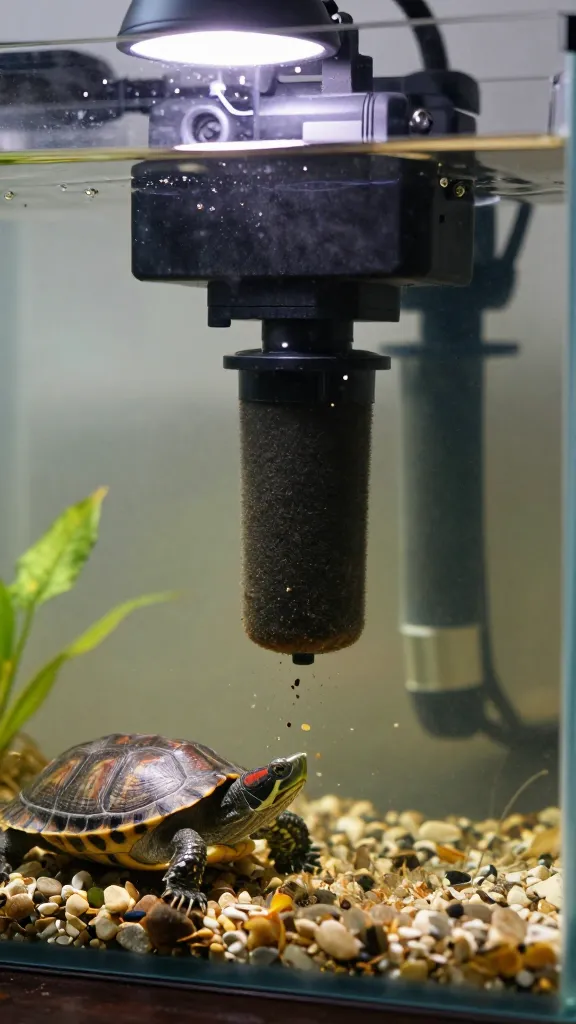
Heavy particulates settle fast; catching them before they dissolve reduces ammonia load on bio media. An internal power filter placed low acts like a skimmer for the bottom, pulling in sinkers you’d otherwise stir up. Choose a sealed internal unit rated for at least 5× water volume per hour and run it with coarse foam you can pop out and rinse in 30 seconds daily. This prefiltering extends canister intervals from weekly to biweekly or longer. The limit is heat and volume — internals add a few watts of heat and eat swimming space in smaller tanks.
6. Flow Pattern: Create a One-Way Street for Waste
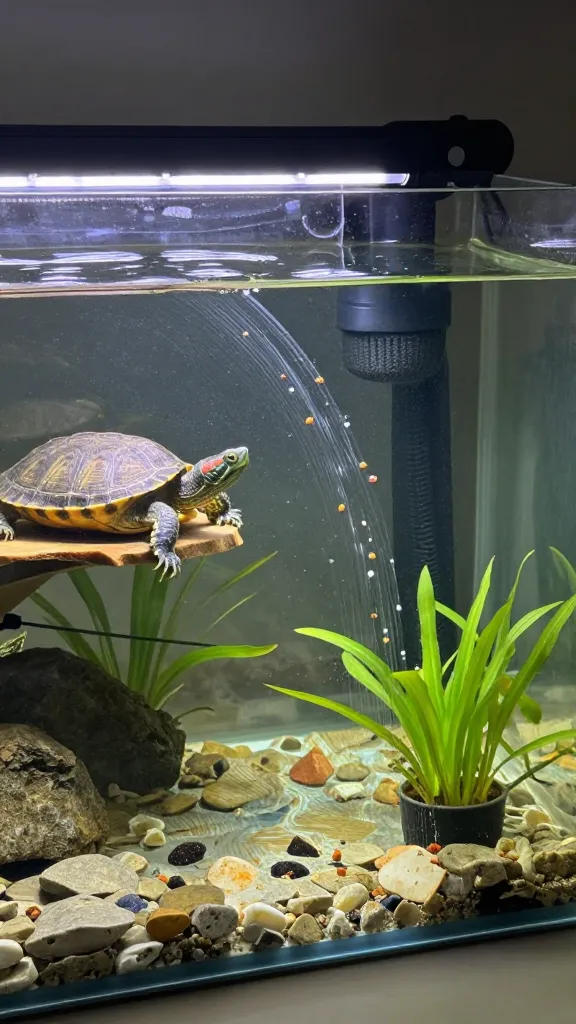
Solids move where the current takes them; random jets keep them suspended, while directional flow herds them to intakes. You want a gentle river from surface return to a low intake where a prefilter waits. Aim a spray bar along the back glass just under the surface to create a surface roll, and place the main intake at the opposite back corner near the bottom; set total circulation at 4–6× water volume. Check with a pinch of flake food: it should arc across the surface, descend at the far end, and march along the bottom to the intake within 60 seconds. The failure mode is dead zones behind the platform collecting anaerobic gunk — adjust or add a small 200–300 GPH circulation pump if you see it.
7. Heater Guard and Wattage: Warm Water Without Burn Risk

Glass heaters transfer heat by conduction to water; a turtle’s shell can press and insulate, spiking the heater’s surface temperature and causing burns or cycling. A guard or in-line placement keeps hot glass off keratin while delivering stable temps. Use an adjustable heater at 3–5 watts per gallon of water volume (e.g., 150–250 watts for 50 gallons) with a plastic or metal guard and place it in strong flow. Set a separate thermometer and confirm 74–78°F daily. The limit is single-point failure — a stuck-on heater can overheat quickly; a heater controller adds redundancy if you keep the room cool.
8. Bare Bottom or Large-Grain Substrate: Physics Beats the Gravel Vacuum
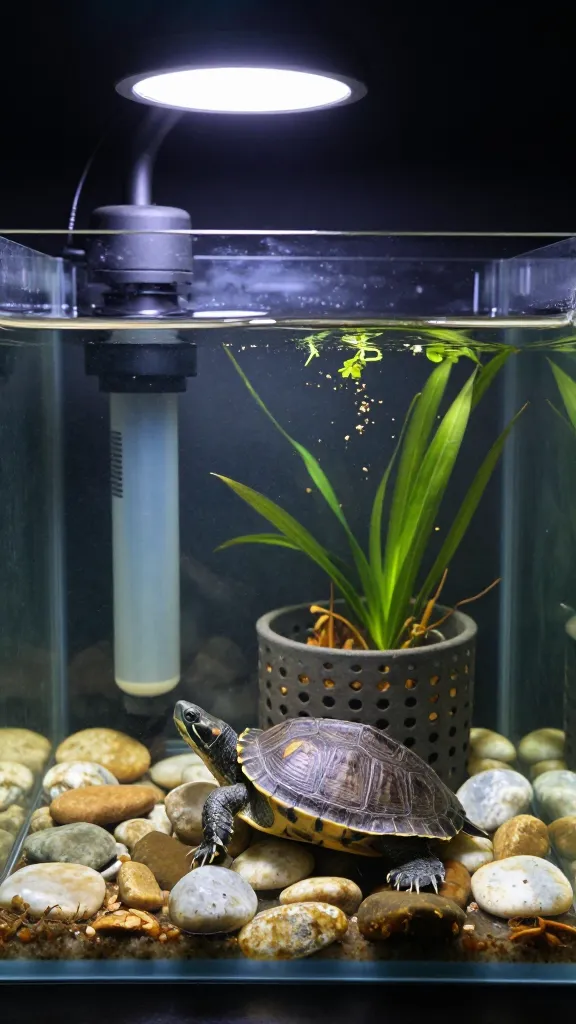
Small gravel traps organics where oxygen is low; proteins rot to ammonia and leach for days even after a water change. Either go bare so waste stays visible and removable, or use river stones larger than 1.5 inches so detritus falls between and can be siphoned. If you keep live plants in a refugium basket, confine substrate to that basket and keep the main footprint bare. The honest tradeoff: bare bottoms show everything — great for control, less “natural.” Fine sands compact and develop anaerobic pockets under turtle traffic.
9. Water Changes by Nitrate, Not the Calendar

Nitrification turns ammonia into nitrite then nitrate; nitrate is far less toxic but accumulates until you remove and replace water. Solids control slows nitrate formation, but it still climbs with feeding. Test weekly and keep nitrate under 40 ppm for general health; schedule changes that remove 30–50% of the water whenever you approach that mark. In a well-filtered 75 with a single subadult slider and disciplined feeding, that’s often every 7–10 days. The limit is tap compatibility — if your tap nitrate is already 20–30 ppm, consider mixing in RO water remineralized to GH 6–10° and KH 4–8°.
10. Feeding Station: Keep Protein Out of the Filter

Proteins break down to ammonia fastest in warm water; feeding in-tank spreads oils and bits that clog media and spike nitrogen. A separate tub prevents that load from ever entering your system. Feed in a dedicated container of warmed, dechlorinated water for 15–20 minutes, then return the turtle and discard the feeding water to the drain, not the tank. For hatchlings, target portions roughly the size of the turtle’s head (without neck) once daily; for adults, feed every other day. The tradeoff is handling stress if you rush — be gentle and consistent so the turtle learns the routine.
11. Outdoor Sun on a Schedule: UV Index Without Overheating

Natural sunlight delivers full-spectrum UVB and UVA; the risk is heat and predation. Glass blocks most UVB, so windows do not count — you need direct exposure and ventilation. Use a secure, shaded outdoor tote or pen with water at least 1.5× shell length, a dry basking ramp, and offer sun for 30–60 minutes when ambient air is 70–85°F; monitor with a thermometer at shell height and pull the turtle if it exceeds 95°F. The limit is safety: never leave unattended; birds, pets, and escapes happen fast.
12. Stocking Honesty: Adult Size Dictates the Whole Build
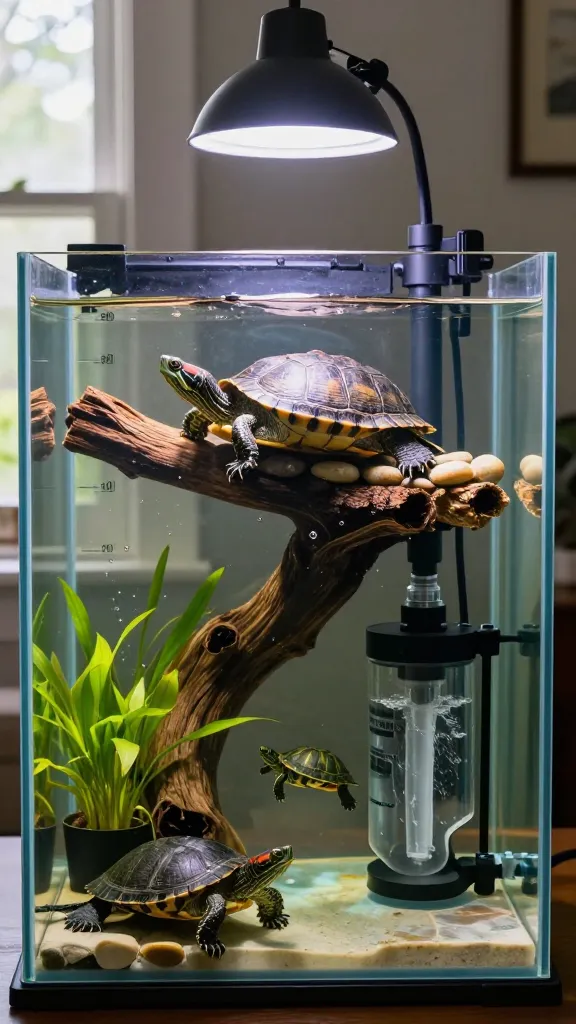
Every inch of turtle adds exponentially to waste and space needs; filtration that holds for a juvenile collapses at adult mass. Red-eared sliders (Trachemys scripta elegans) and painted turtles (Chrysemys picta) reach 7–10 inches; musk turtles (Sternotherus odoratus) 3–5 inches but stay messier-to-size. Plan a permanent enclosure with at least 10 gallons of water per inch of adult shell length as a floor, paired with the 4–6× turnover spec and UVB and basking numbers above. My one strong view: if you cannot house an adult’s volume on paper today, choose a smaller species now rather than “upgrading later” — rescues are full of upgrades that never happened.
Frequently Asked Questions
How big should a turtle tank be for a red-eared slider?
Plan for an adult at 8–10 inches shell length, which means 80–100 gallons of water as a practical minimum. Pair that volume with filtration that turns the tank over 4–6× per hour and a basking platform at 90–95°F. Smaller juveniles can start in less, but build once for the adult to avoid cycling gear and stress.
What temperature should turtle tank water be?
Most basking North American species do best at 74–78°F water with a basking surface at 90–95°F. The warmer air spot drives drying and metabolism while the cooler water prevents constant overexertion. Use an adjustable heater at 3–5 watts per gallon with a guard and verify with an independent thermometer.
Do I need a canister filter for a turtle tank?
You need media volume and flow equal to turtle waste, and a canister is the easiest way to get both. Look for 1–2 gallons of media and 4–6× turnover; an internal prefilter can help if your canister is borderline. Hang-on-backs rarely offer enough basket volume for adults without stacking multiples.
How often should I clean a turtle tank filter?
Rinse mechanical stages when flow drops or weekly; expect 7–14 days between cleans if you prefilter and keep feeding neat. Leave bio media alone except for a gentle swish in tank water monthly so you do not crash nitrification. If nitrates rise faster than usual after a clean, you overdid it — space cleanings and reduce how aggressively you rinse sponges.
What UVB light does a turtle need?
A linear T5 HO tube with 5–7% UVB at 10–14 inches from the basking surface works for sliders, painteds, and musks. Avoid mesh between lamp and turtle, or compensate by reducing distance; replace the bulb at 12 months of use. Pair it with a heat lamp that produces a 90–95°F basking spot.
Build Around Flow, Heat and Light — Then Enjoy the Behavior
The governing numbers are simple: 4–6× hourly flow, 74–78°F water, 90–95°F bask, and UVB at 5–7% within 10–14 inches. Tonight, time how long a pinch of food takes to reach your intake and test nitrate; if it takes longer than 60 seconds or reads over 40 ppm, you know where to tune first.
Questions about your own setup? Leave them in the comments and I will work through them. — Nate