9 Axolotl Aquarium Setups — Temperature First, Everything Else Second
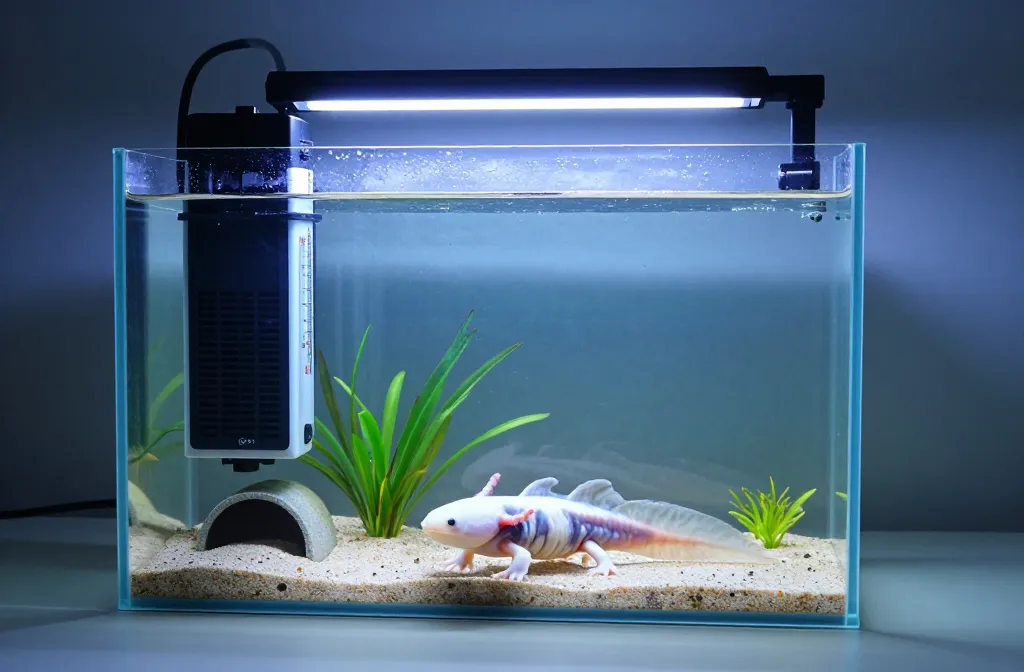
Most axolotl aquarium setups fail in the same place: keeping the water cold enough, consistently enough, to match the animal’s metabolism. The equipment decision changes when you realize heat is entering the system from lights, pumps, the room, and even your hands, and you must remove or reject that heat before you add anything else. By the end of this, you’ll be able to spec a tank size, chiller or cooling method, flow, filtration, and substrate that hold 60–64°F day and night, with ammonia and nitrite at 0 ppm and nitrate below 40 ppm. I ran two 30-gallon builds in a 75°F room for a full summer to validate the cooling math. The nine builds below are the ones that hold temperature, oxygen, and water quality without guessing.
Where Can You Research Safe Axolotl Water Temperature?
| Source | What It Says |
|---|---|
| Small Pet Expert — Axolotl Water Temperature | States the ideal range as 60–68°F, with a 60–64°F sweet spot, and flags rising risk as the water climbs toward the high 60s and low 70s. |
| Axolotl Nerd — Best Water Temperature for Axolotls | Explains why sustained warmth above roughly 68°F suppresses immune function and accelerates fungal growth (Saprolegnia), which is the mechanism behind fungus risk in warmer water. |
| ExoPetGuides — Axolotl Symptoms Guide | Describes stress responses beginning around 74°F and cites veterinary sourcing for organ stress and immune suppression developing above 75°F. |
1. The Cold Bath: Tank Volume Buys You Time

Heat change in water is about mass: a larger volume warms and cools more slowly because it takes more energy to shift its temperature. That thermal inertia gives you time to intervene before the tank creeps past safe range. For a single adult axolotl (10–12 inches), choose at least a 40-gallon breeder footprint for floor space and thermal mass; two adults need 75 gallons. In a 75°F room, a covered 20-gallon can swing 5–7°F in a day, where a 40 breeder moves 2–3°F with the same inputs. The limit here is space and weight: a 40 breeder holds ~330 lb of water alone, so confirm your stand and floor rating with a professional before you commit.
2. Active Chilling: Sizing a Chiller by Heat Load
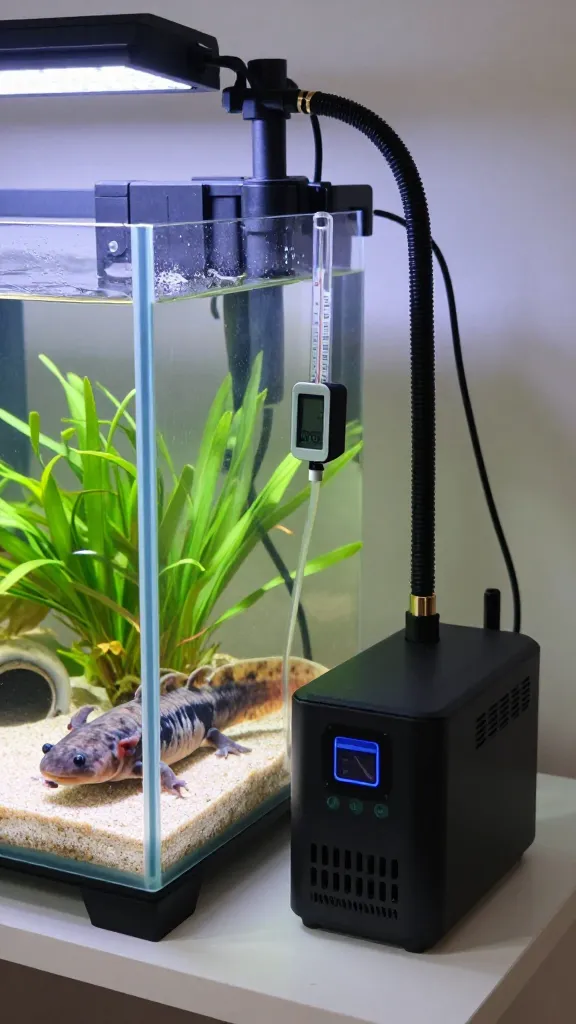
A chiller removes heat at a fixed rate, and your tank gains heat from ambient air, pumps, and lights; you win by outpacing that gain. The number to hit is the BTU/hr needed to pull the water from room temperature to 60–64°F and hold it there. As a rule of thumb, in a 75°F room, plan for about 15–25 BTU/hr per gallon to maintain a 10–15°F drop; that means 600–1,000 BTU/hr (about 175–300 watts of cooling capacity) for a 40 breeder. Plumb it with short tubing runs and the fewest elbows to minimize pump heat. The tradeoff is cost and hum—active chilling is the quiet, reliable answer, but it adds both upfront and ongoing electrical load.
3. Passive Cooling: Evaporation and Why the Room Still Wins

Evaporation removes heat because water takes energy from the tank to become vapor; the higher the air flow over the surface and the drier the room air, the stronger the effect. A fan across the surface can pull 2–4°F off a 40-gallon, and a dehumidified room increases that. Aim a clip fan to ripple the full surface and run a lid gap of 1–2 inches for crossflow; expect daily top-offs of 0.5–1 gallon. This only works if ambient is below the target plus the evaporation delta—if your room is >75°F, fans alone will not hold 60–64°F. The failure mode is salinity creep from topping off with tap: always top off with dechlorinated or RO water, not premixed salts or buffers.
4. Low-Heat Filtration: Flow Without a Heater in Disguise

Every watt you plug into the water becomes heat, so filtration must maximize biological surface area per watt and diffuse flow to avoid stressing gills. A sealed canister or a double sponge filter pair moves water with minimal splashing air contact (which is fine at cold temps) and spreads intake to avoid sucking in feathery gills. Target 3–4x tank volume per hour of turnover at the outlet, which is 120–160 GPH for a 40-gallon, and keep pump draw at or below 10–15 watts. Use ceramic media at 0.5–1 liter per 10 gallons for nitrification. The limit is oxygen debt in summer: if temperature creeps above 68°F, add gentle aeration to maintain dissolved oxygen without overheating the water with a giant pump.
5. Flow Management: Broad Outflow, No Sandstorms

Axolotl gills are adapted to low current; concentrated jets collapse the filaments and force them to shelter. Spread the same flow over more area and it becomes laminar and gentle. Use a spray bar the full back length of a 36-inch tank or an outflow lily set just below the surface to ripple without blasting; size the bar holes so pressure balances and the last hole actually flows. Keep velocity under about 2 inches/second at midwater—if a shed leaf drifts slowly and doesn’t streak, you’re in range. The failure here is detritus settling: check that the bottom clears to the prefilter within 24–36 hours or nudge the bar angle until it does.
6. Substrate and Suction: Sand Depth and Gravel Vacuuming Tempo

Axolotls ingest off the bottom, and large gravel can cause impaction because peristalsis may fail to pass stones larger than the intestinal diameter. Fine sand behaves differently: particles move as a mass, pass through, and compact enough to prevent deep anoxic pockets if kept shallow. Lay 0.5–1 inch of inert fine sand or go bare-bottom; vacuum detritus weekly with a wide-mouth siphon rather than stirring the whole bed. Keep organic load low by feeding with tongs and removing uneaten food within 10 minutes. The honest limit: deep sand beds (>2 inches) can go anoxic at cold temps where microbial turnover is slower, showing black layers and sulfur odor—if you want plants, use potted specimens instead of a deep bed.
7. Lighting Without Heat: PAR Is Irrelevant, Lux and Watts Matter

Axolotls prefer dim conditions and do not photosynthesize, so the usual planted-tank light metrics don’t apply; what matters is how little heat and glare you add. A low-watt LED strip at 0.2–0.3 watts per gallon mounted 6–8 inches above a glass top will provide viewing without warming the water. If you keep low-light, cold-tolerant plants in pots (Anubias, Java fern), hold a short photoperiod of 6 hours and keep surface agitation mild to avoid excessive CO2 loss at already cold water. The tradeoff is aesthetics—brighter lights flatten pupils and stress behavior. If your thermometer jumps more than 1°F in the first hour after lights on, raise or dim the fixture.
8. Stocking Density and Waste: Ammonia at Cold Temperature

Ammonia exists as NH3 and NH4+; at lower temperatures and neutral pH, more sits in the less toxic NH4+ form, but nitrifying bacteria also work slower in the cold. That means you must both limit production and provide large, mature biofilm to keep 0 ppm NH3/NH4+. For a cycled 40 breeder, one adult axolotl is the baseline; add a second only if you can prove stability with daily testing for 14 days after the addition. Feed 2–3% of body weight per day in one meal, then test ammonia and nitrite within 12 hours until you know your filter’s capacity. The limit is “new tank syndrome”: never add two juveniles at once to a fresh filter—stagger by 4 weeks so the colony ramps with the load.
9. Water Change Rhythm: Cold Water, Big Swings, Gentle Hands

Large water changes remove nitrate and organics, but they can also swing temperature and pH faster than a cold-adapted animal can compensate. Buffering in most tap water is low enough that sudden dilution can shift pH by >0.3, and rapid drops below 58°F can shock. Change 25–35% weekly, matching new water within 2°F of the tank and dechlorinating to protect the biofilter. If nitrates creep past 40 ppm, go to twice-weekly 25% changes until they’re back in range. The limit: “deep clean” days that dismantle the filter and scrub everything at once destroy biofilm; rinse media only in old tank water and never all baskets in the same week.
Frequently Asked Questions
What size axolotl aquarium should I get for one adult?
Choose at least a 40-gallon breeder for one adult. The larger footprint gives floor space and the extra water mass slows temperature swings, which keeps you in the safe 60–64°F band longer. Smaller tanks can work short term, but you will fight heat and waste stability all year.
Do I need an axolotl aquarium chiller if my room is 72–75°F?
Yes, in most homes you’ll need active chilling to hold 60–64°F. Fans can remove 2–4°F by evaporation, but if ambient is 72–75°F you still need roughly 15–25 BTU/hr per gallon of chiller capacity to reliably beat daily heat gain from the room and equipment.
What filter flow rate is best for an axolotl tank?
Target 3–4x the tank volume per hour with a broad, gentle outflow. This provides enough turnover for biofiltration while keeping midwater velocity under about 2 inches/second so gills are not pinned. Oversized jets cause stress; spread the same GPH through a spray bar instead.
How cold is too cold for an axolotl aquarium?
Below about 58°F, digestion slows and the animal becomes lethargic; long exposures can impair immune response. Short dips during water changes are tolerable if recovery to 60–64°F happens quickly. Stability beats chasing exact numbers as long as you stay inside the safe band.
Can I keep plants in an axolotl setup without raising the temperature?
Yes, with low-watt LEDs at 0.2–0.3 W/gal and a short 6-hour photoperiod. Use potted, cold-tolerant species and keep lights mounted 6–8 inches above the glass to limit heat transfer. If temperature rises more than 1°F after lights on, raise or dim the fixture.
Your Thermometer Is the Most Important Equipment
If the water isn’t in the 60–64°F band, everything else is a secondary fix. Tonight, log your tank temperature at lights on, mid-afternoon, and two hours after lights off; a swing over 2–3°F tells you whether you need more water volume, stronger evaporation, or a chiller.
Questions about your own setup? Leave them in the comments and I will work through them. — Nate