6 Axolotl Tank Mates — And Why the List Is This Short
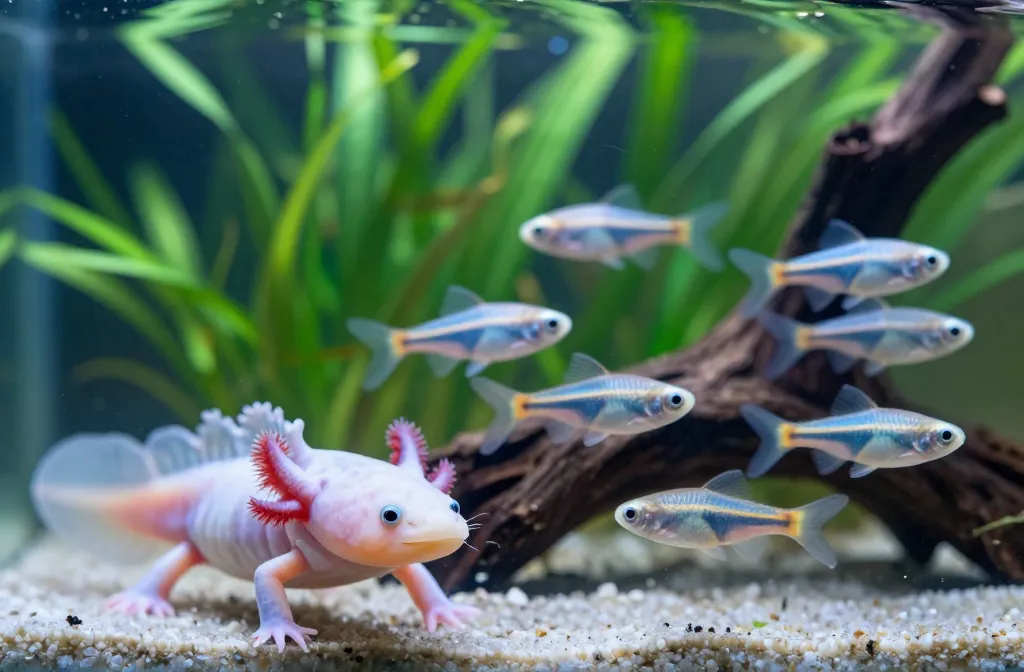
Most axolotl tank mates turn into a stress or injury problem within days, which is why credible lists of axolotl tank mates are so short. Axolotls are cool, slow, and soft-bodied with external gills — everything about their anatomy and metabolism puts them at odds with typical community fish. By the end, you will know exactly which species can share water with an axolotl, at what size, and under what parameters, plus what to measure before you even try it. This is written for cold, cycled tanks in the 55–75°F band, with low flow and a secure lid. The rule to keep in mind: if it nips, fits in a mouth, or needs warmth, it doesn’t belong.
1. White Cloud Mountain Minnows: Cold-Tolerant, But Size and Numbers Matter

Predation pressure is the limiting mechanism here: axolotls hunt by suction and will inhale anything that fits, while minnows can also harass feathery gills if crowded. You control the risk in two directions — by fish size and by group size. Choose adult White Cloud Mountain Minnows (Tanichthys albonubes) at 1.2–1.6 inches, keep them in groups of 8–12, and maintain 55–68°F, pH 6.8–7.6, and 0 ammonia/0 nitrite. Feed the axolotl well (earthworms, 3–4 times weekly) so it does not “shop,” and give the minnows dense plant cover. Expect to lose any undersized or slow fish; anything under 1 inch is a snack. If your axolotl is under 8 inches and still rapid-feeding, wait — juvenile axolotls are too predatory for this pairing.
2. Neocaridina Shrimp: Cleanup Crew That Breeds Through Losses

The reproductive surplus is the mechanism here: axolotls will eat shrimp, but a colony offsets predation by producing more than gets consumed. That makes them functional detritivores rather than permanent individuals. Start with 20–30 Neocaridina (e.g., red cherry) shrimp, provide piles of fine-leaved plants and rock crevices, and hold water at GH 6–10 dGH, KH 3–6 dKH, pH 7.0–7.6, and 60–70°F. They will reduce biofilm and uneaten food between siphons. Copper is a hard stop — any medication or pipe source that raises dissolved copper above trace will wipe them. Accept that adults get picked off; success is babies maturing faster than they’re eaten.
3. Mystery Snails: Hard Shells and Cold Tolerance, With Calcium Budgeting

Shell integrity is the governing mechanism: at lower temperatures, a snail’s metabolism slows and shell growth depends on dissolved minerals more than speed. A thick operculum and shell protect them from casual suction nips, and they stay out of the axolotl’s swim layer. Keep 1–2 Pomacea diffusa (mystery snails) per 20 gallons, maintain GH 8–12 dGH and pH 7.2–7.8, and feed 1–2 algae wafers or blanched vegetables weekly so they do not rasp live plants bare. At 60–70°F they remain active enough to scavenge without demanding warm water. The failure mode is soft water: shells pit when GH is low, and a hungry axolotl may fixate on damaged snails, causing mouth abrasions. If your axolotl routinely tests tankmates with bites, skip snails.
4. Zebra Danios: Speed Wins, But Current and Temperature Must Stay Low

Hydrodynamics is the mechanism: danios survive by outrunning suction strikes in the upper third of the tank, but they typically appreciate current that axolotls hate. The compromise is short, directional flow for the fish and dead-calm zones for the axolotl. Keep 6–10 Danio rerio at 1.5–2 inches, temperature 60–70°F, and flow under 5× turnover per hour overall, with the filter outlet aimed along the surface to spare the bottom. Use a spray bar or baffle so the lower half remains slow. The tradeoff is ethics and attrition: any slow or deformed danio gets eaten, and a surprised axolotl can still catch a healthy one at lights-out. If you cannot split your tank into calm and moving lanes, this pairing is not fair to either animal.
5. Endler’s Livebearers: Reproduction Outpaces Losses in Cooler Rooms

Population dynamics is the mechanism again: livebearers drop fry frequently, so the colony persists even when adults vanish occasionally. Endlers are more tolerant of cool rooms than guppies and stay small enough to be agile, but that same size makes them edible. Begin with 1 male and 3–4 females, expect 10–20 fry per month, and keep 64–72°F, pH 7.0–7.6, and KH 4–6 dKH. Floating plants and a dense midwater give fry places to grow. The ceiling is hardness: below GH 6 dGH livebearers struggle long term, and at the high end of 72°F your axolotl’s stress climbs. If your ambient is warm most of the year, do not use livebearers in the same water as an axolotl.
Where Can You Research Safe Axolotl Water Temperature?
| Source | What It Says |
|---|---|
| Small Pet Expert — Axolotl Water Temperature | States the ideal range as 60–68°F, with a 60–64°F sweet spot, and flags rising risk as the water climbs toward the high 60s and low 70s. |
| Axolotl Nerd — Best Water Temperature for Axolotls | Explains why sustained warmth above roughly 68°F suppresses immune function and accelerates fungal growth (Saprolegnia), which is the mechanism behind fungus risk in warmer water. |
| ExoPetGuides — Axolotl Symptoms Guide | Describes stress responses beginning around 74°F and cites veterinary sourcing for organ stress and immune suppression developing above 75°F. |
6. No Fish: Isopods and Blackworms as Non-Visual, Functional Company

Nutrient processing is the mechanism: microfauna break down leftover food before it rots, and axolotls hunt them as enrichment without introducing fins or gills to nip. Detritivore isopods stay in the substrate layers and blackworms thread through oxygenated pockets, converting waste into biomass that occasionally becomes a snack. For a 30–40 gallon, seed 30–50 Asellus aquaticus and maintain a 1–1.5 inch sand cap over a mature, aerobic substrate; for blackworms, introduce 1–2 tablespoons of Lumbriculus variegatus to established sand and feed lightly. Keep oxygen high with broad, gentle surface agitation; anaerobic zones kill worms. The limit is pesticides and salt: any trace malachite green, copper, or salt baths moved into the tank collapse these colonies. This is my single strong stance in this list: for most keepers, a microfauna clean-up crew is the only “tank mate” that consistently benefits an axolotl without adding stress.
Frequently Asked Questions
Why are axolotl tank mates so limited compared to community aquariums?
Axolotls are coldwater, slow, and soft-bodied with external gills, which makes them vulnerable to nipping and fungus at temperatures above 72°F. Most tropical fish want 74–80°F and higher flow, the exact opposite of what keeps an axolotl healthy. Anything that fits in a 1–2 inch mouth can be inhaled by suction feeding, so size and behavior disqualify most species.
What size tank do I need if I try axolotl tank mates?
Use at least 30 gallons for one axolotl with small companions, with 36 inches of length to create calm and busy zones. More water stabilizes temperature near 60–68°F and spreads out interactions. Below 20 gallons, there is no room to give the axolotl low-flow refuge while schooling fish cruise.
Can an axolotl live with snails safely?
Yes, thick-shelled species like mystery snails can work if you maintain GH 8–12 dGH and pH 7.2–7.8 so shells do not soften. Offer supplemental calcium and keep the temperature at 60–70°F. If your axolotl persistently tests or injures tankmates, remove the snails to prevent mouth and gill damage.
Which fish are absolutely unsafe with an axolotl?
Anything warmwater, nippy, or spiny: barbs, cichlids, loaches, catfish with locking spines, and bettas are poor choices. Fin nippers shred external gills within hours, and spines can lodge in the axolotl’s mouth, causing infection. Also avoid plecos — rasping mouths abrade slime coats, especially at night.
Can I add shrimp to an axolotl tank without causing stress?
Yes, in numbers and with cover: introduce 20–30 Neocaridina into a mature, planted tank and expect ongoing predation. They help process leftovers if you keep 0 ammonia/0 nitrite and avoid any copper-based treatments. Success looks like berried females and juveniles visible in the moss even as adults disappear.
How do I know if my axolotl is stressed by tank mates?
Watch for forward-curled gills, refusal to eat for >3 days, frequent surfacing, or pacing against currents. Measure temperature — anything above 70°F increases cortisol and fungus risk — and check flow by watching sand not drift on the bottom. Remove companions at the first sign of frayed gills or white fuzz and stabilize parameters before rethinking stocking.
Start With Water, Not With Fish
The number that governs almost every decision here is temperature: keep it 60–68°F and most “community” ideas fall away on their own. Tonight, take 10 minutes to log temperature at lights-on, mid-day, and lights-off, and watch the bottom for any moving current; if sand shifts or bottom plants sway, flow is too high for an axolotl to share space comfortably.
Questions about your own setup? Leave them in the comments and I will work through them. — Nate