7 Iwagumi Aquascape Rules and Layouts — Stone Roles That Govern the Scape
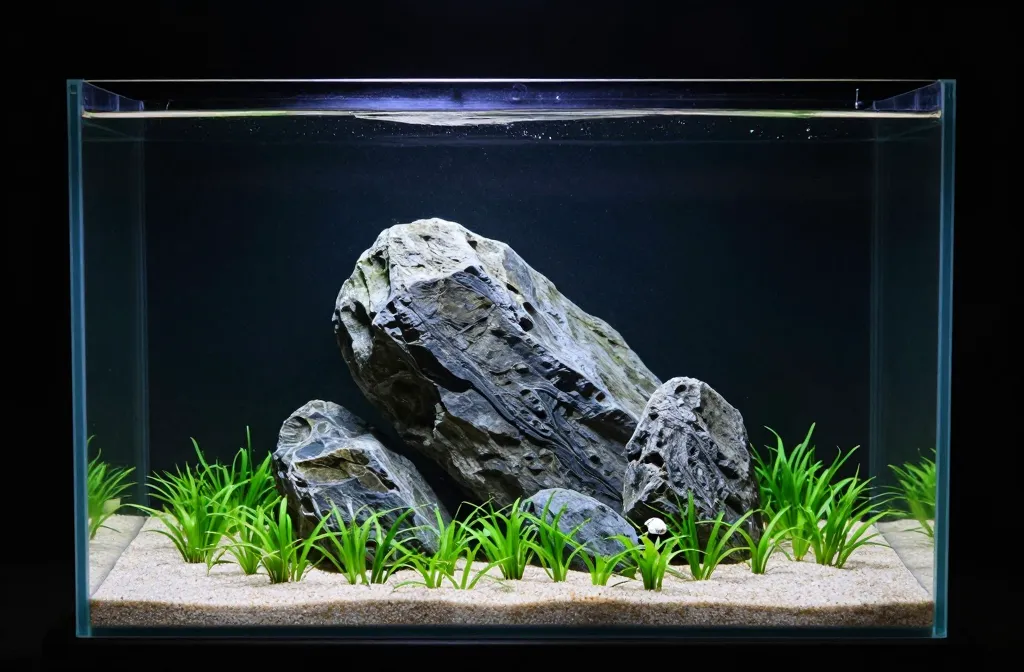
In an empty tank, three stones can feel like a promise waiting to be kept — that is the lure of iwagumi aquascape rules. These layouts are about stone roles first, plants second, and the slow confidence to leave space. By the end, you will know which stone leads, how the rest support it, and which plants respect the rockwork instead of hiding it. Choose one layout, set the proportions, and let the tank take 6 weeks to soften its edges before you judge it.
I have spent two decades learning that most failed iwagumi are not about plants at all — they are about an undecided main stone. Solve that, and the rest falls into place.
1. Classic Four-Stone Iwagumi: One Oyaishi and Three Supporting Roles
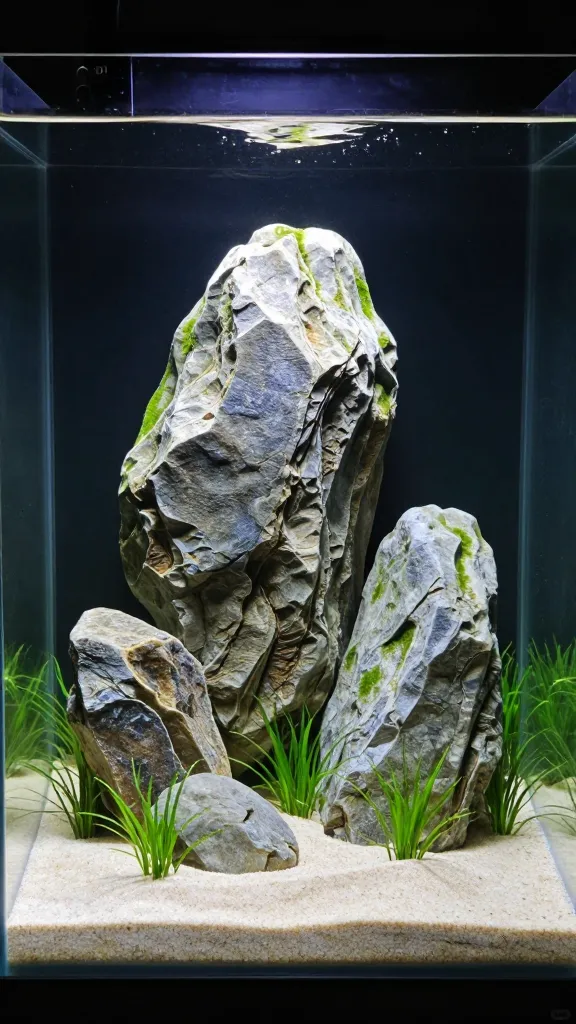
Leadership is a single decision: the eye must land on one stone and never have to argue about which. Choose an oyaishi that is 1/3 the tank height and tilt it 10–15° off vertical, leaning into the open sand. In a 20-gallon long (30 × 12 × 12 in), use Seiryu stone or Ryuoh stone for crisp lines, with two soeishi echoing the oyaishi’s grain and a smaller fukuishi tucked at its base to break scale. Plant a single carpet — Dwarf hairgrass (Eleocharis acicularis) or Micranthemum tweediei ‘Monte Carlo’ — and leave 1/3 of the foreground as bare sand or fine gravel. Let it knit for 6 weeks before the first trim; the failure state is competing heights or mismatched stone textures that spread the eye thin and break the story.
2. Left-Weighted Triad: Asymmetry and Negative Space Carry the Mood
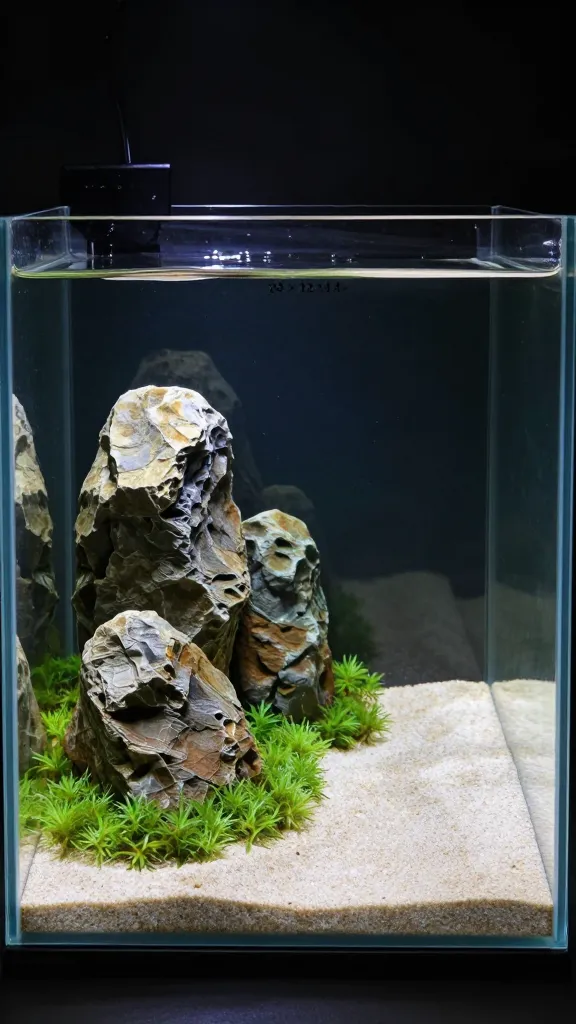
Asymmetry turns a layout into a landscape by giving one side work to do and the other side room to breathe. Stack three Dragon stone (Ohko) pieces into a left-side mass that occupies 2/5 of the tank width in a 17-gallon bookshelf tank (24 × 12 × 14 in), with the tallest piece just shy of 2/3 the waterline. Keep the right 3/5 open and low, finished with a pale sand path that tapers to the back pane. Plant only two species: Eleocharis parvula for a shorter, meadow-like carpet around the stones, and a fringe of Staurogyne repens at the base for weight. Give it moderate light and 6 weeks to settle; when this fails, the path is too wide and straight, reading like a road instead of a suggestion of distance.
3. The Single-Stone Monolith: One Focal Point, Nothing Competing
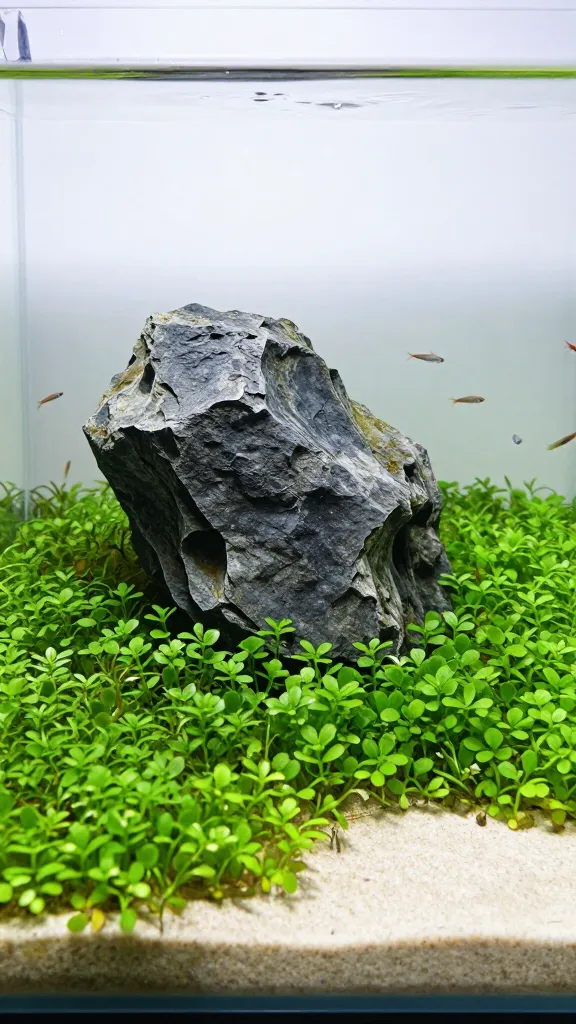
Restraint is a compositional tool; one strong gesture, cleanly made, is often enough. In a 10-gallon standard (20 × 10 × 12 in), set a single Lava rock or Gray Mountain stone slab on the 2/5 line, buried 1/3 of its mass for believability, with a 5–10° lean to imply pressure from the land. Use one low plant: a continuous carpet of Monte Carlo or a Glossostigma elatinoides lawn if you run CO2, leaving a 2-inch crescent of sand in the front corner as negative space. Keep livestock small and light-footed — Boraras brigittae or Trigonostigma hengeli — only after the cycle is mature. This goes wrong when the rock is undersized or placed dead center, turning the tank into a diorama rather than a place.
4. River Bend Iwagumi: Direction From Grain and Flow
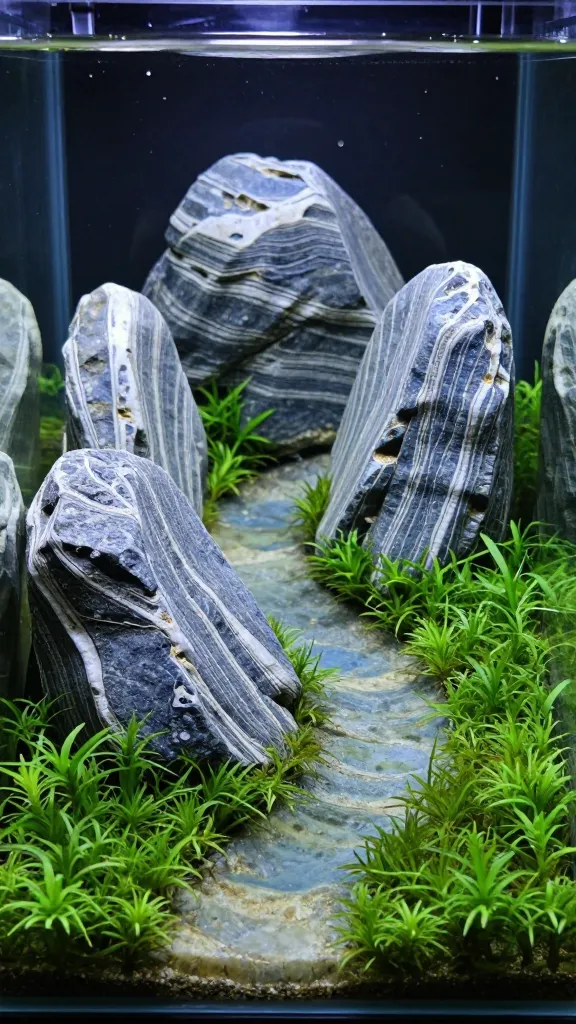
Direction is drawn from the rock’s striations; let the stone’s grain tell the current where to go. In a 29-gallon (30 × 12 × 18 in), select Seiryu pieces with strong horizontal veining and align them so the lines arc gently from left front to right rear, opening a curved channel of 3 inches at the front, narrowing to 1 inch near the back. Anchor the bends with low clumps of Cryptocoryne parva where the current would slow, and carpet the rest with Eleocharis acicularis ‘mini’. The stones should step down in height with distance to reinforce depth. Failures read as chaotic swirl: mixed grain directions or equal heights that cancel the sense of flow.
5. High Ridge and Scree: Hierarchy Through Scale and Repetition
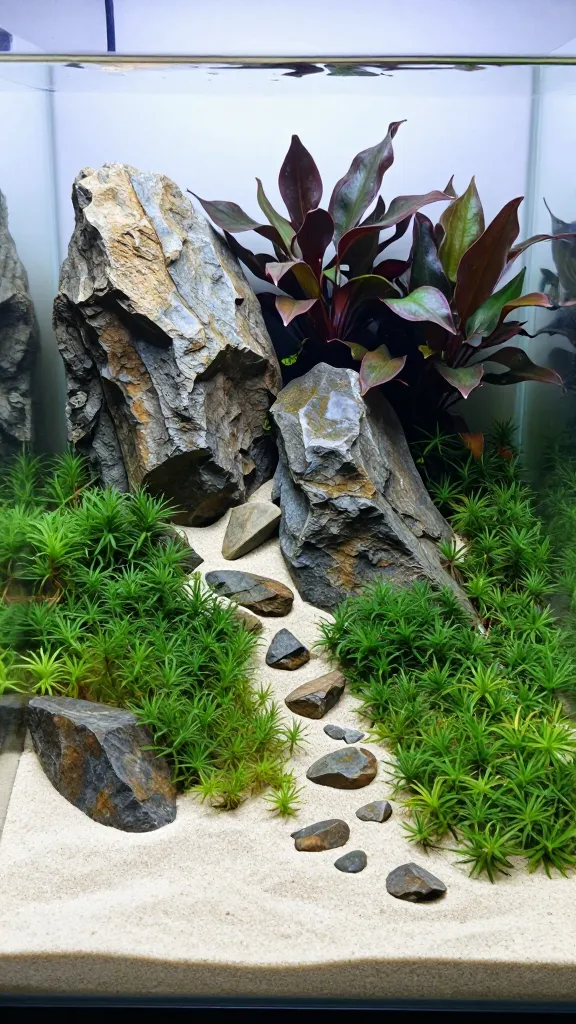
Hierarchy depends on a clear ridge line and a repeating scatter that explains it. In a 40 breeder (36 × 18 × 16 in), build a sloped substrate from back left to front right, raising the rear 3–4 inches. Set a tall Manten stone ridge at the crest, then place a dozen thumbnail to egg-sized fragments down the slope to the sand like scree. Plant the upper third with Bucephalandra sp. epiphytically in shaded crevices and the lower slope with Hemianthus micranthemoides as a soft skirt; leave the front 1/4 as open sand. Give 6 weeks for roots to secure the slope; when it fails, all stones are similar size and the scree looks sprinkled rather than fallen.
6. Dual Peaks, Unequal: Rule of Thirds Without the Grid
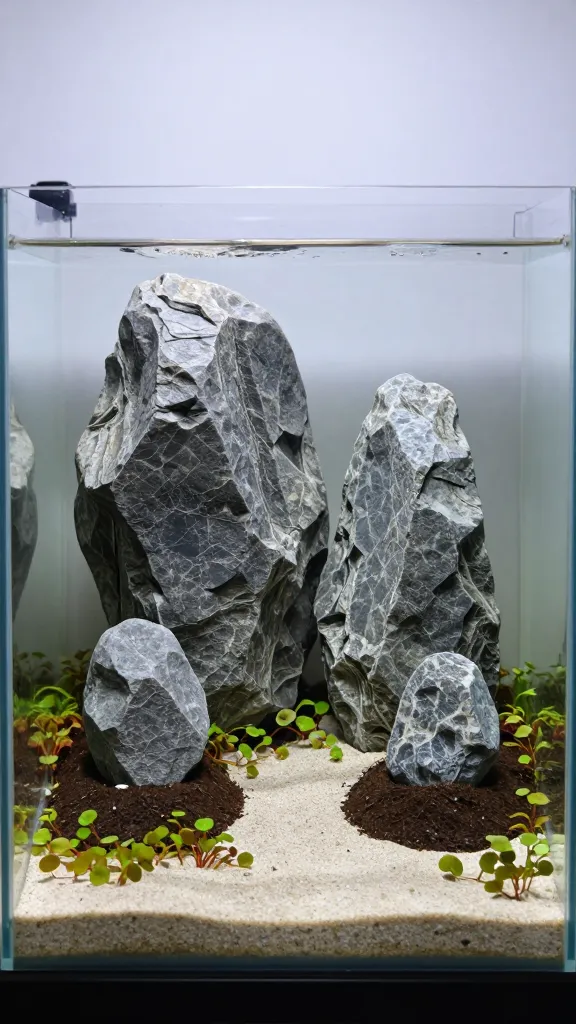
Balance comes not from symmetry but from unequal partners that agree on a horizon. Choose two primary stones for a 25-gallon (24 × 16 × 16 in): the left peak at 2/3 tank height, the right peak no taller than 1/2, separated by a shallow saddle slightly forward of center. Use Shou stone or weathered granite with similar color and texture; echo each peak with two much smaller attendants that repeat angle and face. Plant sparse tufts of Micranthemum ‘Monte Carlo’ across the saddle and a fringe of Utricularia graminifolia under stronger light if you accept more maintenance, or Hydrocotyle tripartita if you prefer a looser runner. Failure shows up as twin towers of equal height, which splits attention and flattens depth.
7. Low-Tech Meadow Iwagumi: Texture Before Speed
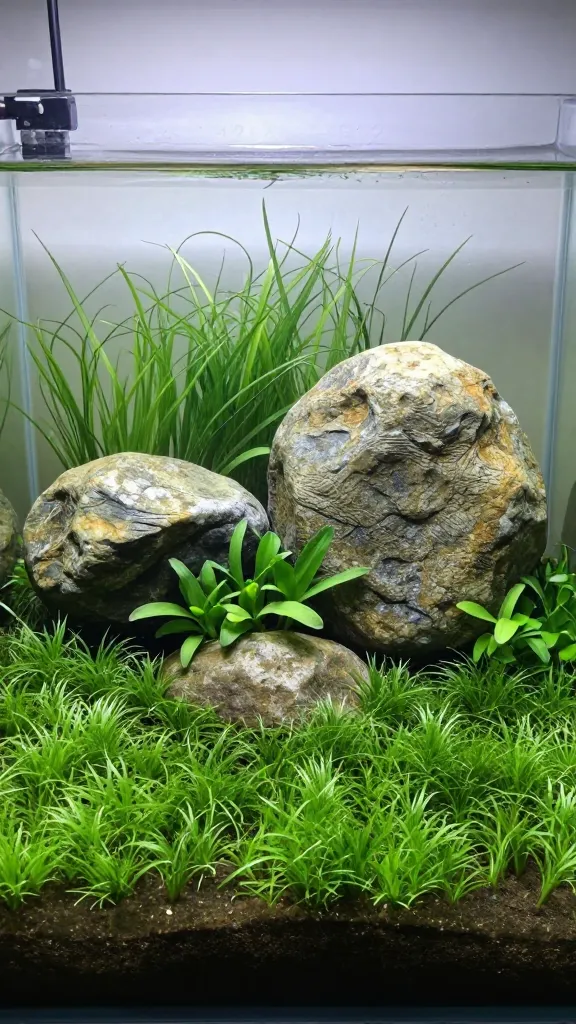
Texture is the language when you refuse to rush; choose plants that hold line at low energy. In a 15-gallon (24 × 12 × 12 in) without CO2, arrange three Dragon stone pieces low and wide, none exceeding 1/2 tank height, with the oyaishi on the right 1/3 leaning inward. Plant a mixed sward: 2/3 foreground in Helanthium tenellum ‘Green’, scattered with small groups of Cryptocoryne lucens and a touch of Juncus repens behind the stones to lift the horizon. Expect 6 weeks for coverage and slower trims every 3–4 weeks. The failure is overplanting fast stems that race past the stones; iwagumi is not a stem garden, and when the greens fill the water column, the composition is gone.
Frequently Asked Questions
How many stones do I need for an iwagumi aquascape in a 20-gallon?
Three to five is the range that reads as a landscape at that size. One clear oyaishi plus 2–4 supporting stones lets you repeat angles and grain without turning it into a rock pile. Match texture and color, and bury 1/4–1/3 of each stone for weight.
Do I need CO2 for an iwagumi layout?
No, but plant choice shifts. Low-tech iwagumi favors Eleocharis parvula, Helanthium tenellum ‘Green’, and small Cryptocoryne over faster, finicky carpets; give them 6 weeks before judging fill. With CO2, Monte Carlo and Glossostigma become viable with tighter trims.
How do I pick the oyaishi so the scape doesn’t look random?
Choose the largest stone you can place at 1/3 the tank width and 1/3 to 2/3 the water height, with a strong face and directional grain. Tilt it slightly and bury enough mass that it looks rooted; then choose attendants that echo its angle and texture. If two stones rival the oyaishi in size, reduce one or remove it.
When can I add fish to a new iwagumi tank?
Only after the filter is cycled and the plants have settled, which for these layouts is at least 6 weeks. Start with a light bioload like a small group of Trigonostigma hengeli or Boraras urophthalmoides, and add algae grazers such as Otocinclus affinis once biofilm appears. Stocking early stresses fish and destabilizes the scape.
What substrate and sand mix works best for the layout?
Use an active aquasoil under the planted zones for rooting and a separate inert cosmetic sand for the paths and front 1/4. Keep a 1-inch barrier of plastic or a buried line of small stones where they meet to prevent soil creep. Vacuum the sand lightly during weekly maintenance to keep edges crisp.
Stand Still Long Enough to See the Angles
Every stone has a face that asks for allies and for space; the scape succeeds when you honor both. Tonight, choose the oyaishi, bury 1/3 of it on the 1/3 line, and set two attendants that repeat its lean by 10–15° — then leave the front 1/4 empty and let the tank breathe.
Questions about your own scape? Leave them in the comments and I will answer them. — Julian