7 Spider Wood Layouts — Branch Structure as the Composition

Most spider wood layouts fail where the branches meet the glass: the line is unclear, the flow breaks, and plants are asked to fix what wood placement never solved. If you build spider wood layouts as branch-first compositions — a tree or a tangle directing water and light — the plants become supporting actors rather than patchwork. By the end of this piece, you’ll have chosen one structure, one plant list, and one timeframe you can live with. The tank is ordinary; the craft is in how you set the limbs and where you leave the gaps. I’ve broken down seven builds that settle in real time and hold over a year with trims, not scrubs.
1. River-Bend Thicket: Flow Lines You Can Read From the Sofa
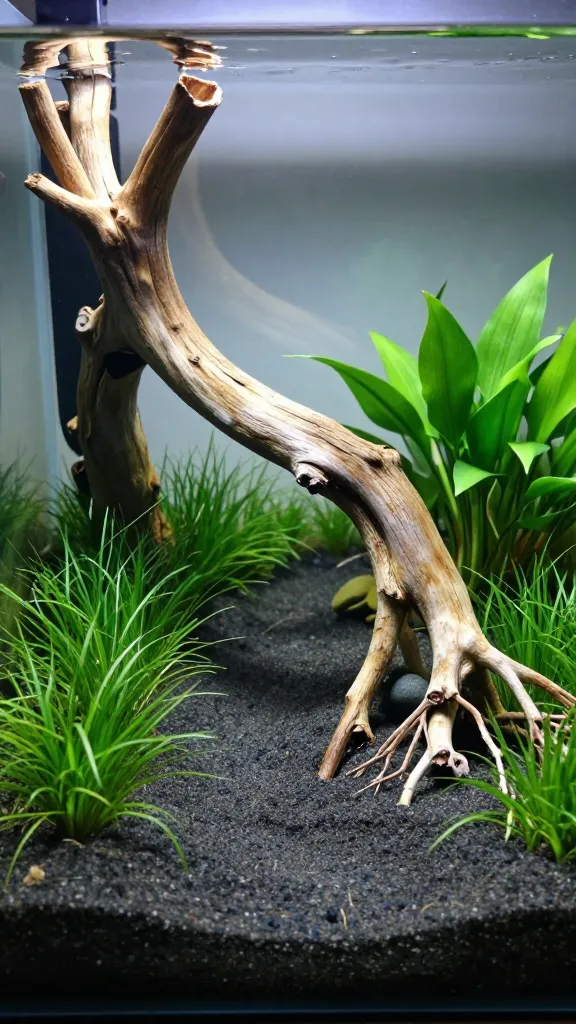
Movement is established by a single sweep the eye can follow, and every branch either supports or gets removed. Angle one main root of spider wood (Azalea root) from the back left to the front right of a 20-gallon long, with 2/3 of the branches leaning into the bend and 1/3 kicking upstream as counterpoint. Plant Eleocharis acicularis low along the inside of the bend, Cryptocoryne wendtii ‘Green’ at the outer shoulder, and tuck small stones under branch junctions to pin buoyant wood. Give it 6 weeks to read as a single gesture; earlier, it’s parts. If the bend looks like a hairpin rather than a river, you’ve kinked it — reduce the angle and thin crossing twigs.
2. Canopy-and-Glade Spider Wood: Light Above, Refuge Below

Contrast between a dark understory and a lit clearing sets mood and protects fish that like cover. Build a low arch of spider wood across the back third of a 29-gallon, with the thickest foot no higher than 1/3 of tank height and the tips feathering forward. Keep a 10-12 inch open sand lane in front (inert sand works) and mass Microsorum pteropus ‘Trident’ and Anubias barteri var. nana on the underside where light is softer. Let stems like Hygrophila polysperma rise behind the arch to catch the top light. Stock only after cycling and once the ferns have anchored, around 6 weeks, so grazing won’t unseat rhizomes. If you cram the glade with midground plants, you erase the very negative space that makes the canopy read.
3. Spider Wood Tree on a Hill: One Focal Point, Nothing Else Competes

Singularity works when one crown holds the frame and every other element lowers in altitude toward it. Build a 2/3-height mound offset to the right in a 17-gallon high, pin a single trunk of spider wood at a 10-15° lean, and prune stray twigs until the silhouette is umbrella-clear. Crown with Taxiphyllum barbieri or, for more lift, Riccardia chamedryfolia in small patches; carpet the hill with Micranthemum ‘Monte Carlo’ (M. tweediei) and keep the left side sparse with Helanthium tenellum runners. CO2 helps this read sooner, but low-tech will close the carpet in 10-14 weeks with steady trims. The failure is a forest of trees — one trunk per tank; if you add a second, you’ve made a dispute, not a focal point.
4. The Split Current: Two Masses, One Channel of Silence

Tension lives in a gap that feels intentional and passable, like water could move through it. Place two spider wood root-balls on either side of a central sand run in a 40 breeder, keeping the channel straight for 3/5 of the depth before it widens. Anchor the wood with pocketed stones and plant Bucephalandra cultivars on the inner faces; behind each mass, let Ludwigia repens rise to tint the near-surface. The channel stays unplanted other than a thin fringe of Eleocharis parvula at the edges, which you trim monthly to keep the line clear. If the two masses mirror each other, it reads as a gate; break symmetry by lowering one side by 1-2 inches and cutting away a few matching tips.
5. The Fallen Bank: Weight, Gravity, and Shelter for Bottom Dwellers

Credible weight comes from diagonals that stop abruptly against substrate, as if collapse just happened. In a 20-gallon high, lay two heavy spider wood bases from back right toward front left, with snapped ends buried and finer branches trailing like roots. Layer Cryptocoryne crispatula var. balansae behind the fall to suggest soil above, and stitch Bolbitis heudelotii along the underside for shadowed texture. Leave a 6-inch crescent of open sand at the front left for corydoras to forage; they need soft substrate and space more than your picture needs uniformity. If every branch points the same way at the same angle, the scene flattens — vary by 5-10° and interrupt one line with a stone to restore depth.
6. Spider Wood Tangle for Shrimp: Complexity Scaled to Size

At nano scale, pattern density must rise while line clarity stays readable from arm’s length. In a 10-gallon shallow, interlock three slender spider wood pieces so that 60% of the branches form a lattice in the back half and the front remains open for feeding. Thread small pads of Taxiphyllum ‘Flame’ into crotches, dust the substrate with Subwassertang (Lomariopsis lineata), and add a modest stand of Rotala rotundifolia to catch light along the rear pane. Neocaridina shrimp thrive when biofilm has surfaces to colonize; let the wood season for 6 weeks before heavy trims and feed sparingly. If you overplant the lattice with fast moss, you smother the pathways shrimp use and end up with a green pillow rather than a habitat.
7. The Horizon Break: Quiet Field, One Line of Branches Against Open Water

Restraint reads as sophistication when a single contour interrupts a wide plane. In a 36-inch tank, run a low ridge across the back third and pin a row of spider wood so the lowest tips sit at 1/2 tank height, the highest at 2/3, creating a sawtooth skyline. Keep the foreground a true field with Sagittaria subulata trimmed to 2-3 inches; add Rotala indica ‘Bonsai’ sparsely behind a few gaps to keep your horizon from hardening into a fence. Let algae settle on the upper branches in the first 6 weeks; wipe the front glass, not the line, and the water column will feel deeper than it is. My firm view after twenty years: if the wood’s silhouette doesn’t work unplanted, you aren’t ready to plant it — remove pieces until the line itself feels calm.
Frequently Asked Questions
How do I stop spider wood from floating without weighing down the composition?
Pre-soak for 1-2 weeks and still plan to pin. Wedge discreet stones beneath junctions, run cotton thread through drilled holes if needed, and let plant rhizomes take over anchoring by week 6. Avoid bulky visible weights; they fight the visual lightness that makes branches read as lines.
Do spider wood layouts need CO2 to look full?
No, but timelines change. Low-tech with Java fern (Microsorum pteropus), Anubias, Bucephalandra, and hairgrasses will knit in 6-14 weeks and hold with weekly 30-40% water changes. CO2 opens stem choices and speeds closure, but patience and selective trimming do similar compositional work.
What plants are best for attaching to spider wood without constant maintenance?
Choose slow to moderate growers with rhizomes or creeping habits. Anubias barteri var. nana, Bucephalandra forms, Microsorum pteropus ‘Trident’, Bolbitis heudelotii, and Taxiphyllum barbieri all bind reliably in 4-6 weeks and don’t demand daily trims. Fast mosses can work if you commit to monthly thinning so the branch structure remains visible.
How do I keep the negative space clear once plants start to fill in?
Decide the shape of the gap on day one and defend it in trims. Keep a sand lane at a set width (for example, 6 inches in a 40 breeder), cut runners that cross it weekly in the first 6 weeks, and lift any self-seeded stems that try to colonize the void. Negative space is a planted choice, not an absence.
How many pieces of spider wood should I use in a 20-gallon?
Start with one major piece and one support at most. Spider wood branches multiply lines quickly; two pieces can feel like five. If the silhouette reads confused from 6 feet away, remove the smaller piece and re-evaluate before adding plants.
When is it safe to add shrimp or small fish to a new spider wood scape?
After the tank is fully cycled and the wood has stopped leaching notable tannins, typically around 6 weeks. Test ammonia and nitrite at 0, and ensure biofilm is present so grazers have food from day one. Add livestock gradually and watch behavior for signs of stress rather than stocking to fill a photograph.
Work With the Line You Can Actually See
Branch-first layouts succeed when the wood draws the eye without plants apologizing for it; you are composing with line and silence, not just species lists. Tonight, set three pieces on a towel in front of the tank and trim twigs until one clean silhouette remains, then lift that into the glass and leave the gap you planned as empty as you promised yourself.
Questions about your own scape? Leave them in the comments and I will answer them. — Julian