7 Turtle Paludarium Setups — Basking Above, Filtration Below
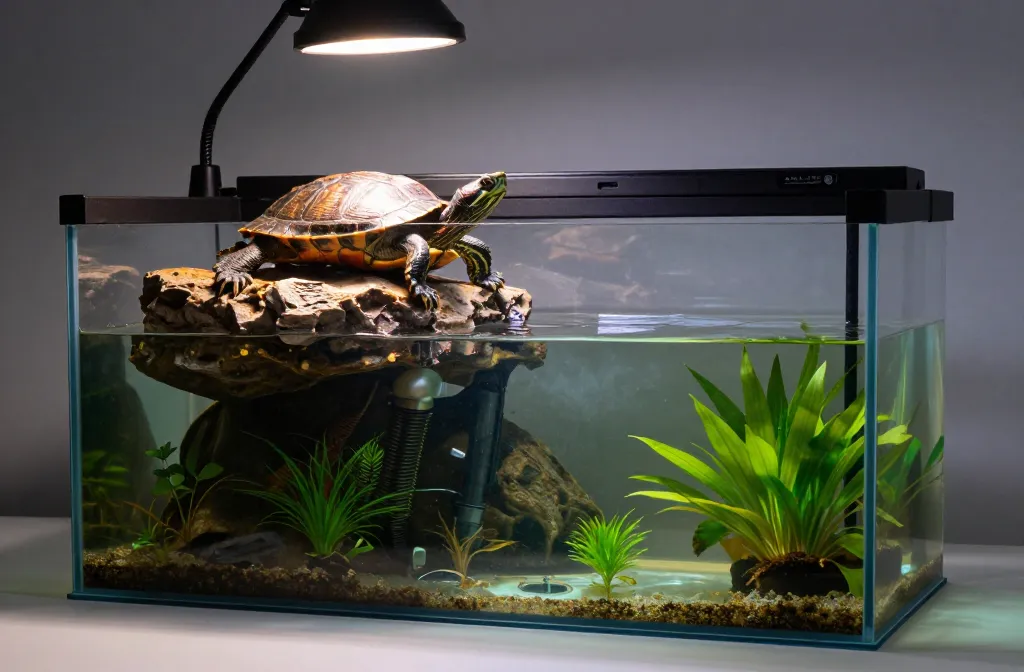
Most turtle paludarium setups fail at the handoff between dry basking heat and wet filtration: heat that dries the air cooks humidity, and filters rated for fish bioloads stall under turtle waste. These seven turtle paludarium setups will let you specify basking platforms, water depth, filtration, and lighting by the numbers, not the box art. By the end, you will know the flow rate in GPH to match your water volume, the wattage to heat the basking shelf to 90–95°F, and how to keep ammonia and fine particulate under control without uprooting your plants.
1. Elevated Basking Shelf with Dry-Dock Heat: Keep Shells Dry, Water Cool
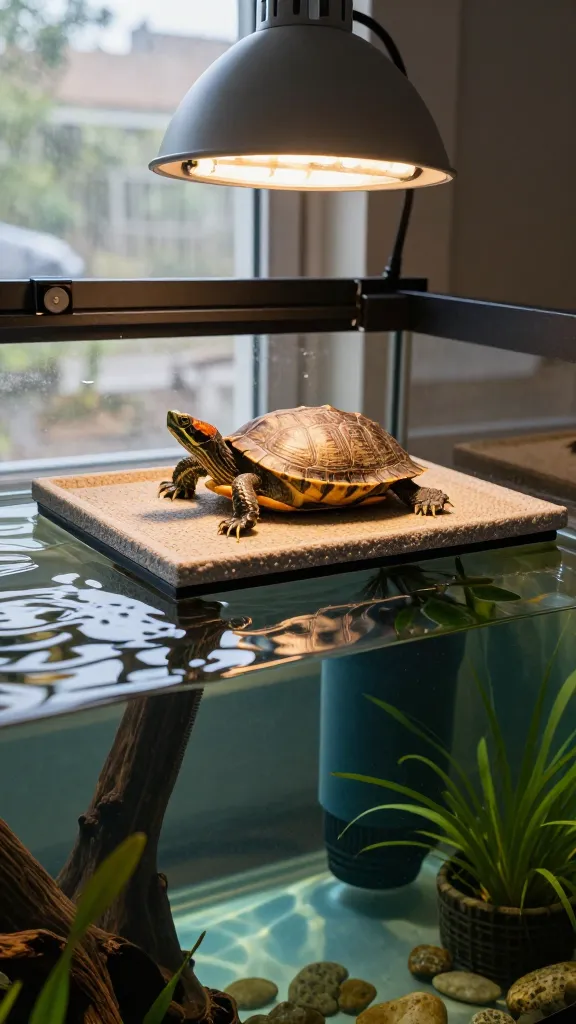
A turtle thermoregulates by moving between water and a dry, hotter surface; evaporation cools the tank while radiant heat warms the shell. Separating the basking zone from the water by at least 6 inches of air lets infrared heat a dry shell to 90–95°F while the water stays at 74–78°F for most sliders and cooters (Trachemys, Pseudemys). This temperature gradient is the mechanism that keeps digestion and shell health on track without overheating the water.
Build a rigid shelf that supports 2–3× your adult turtle’s mass (a common slider adult is 8–11 inches, 2–4 lb) and mount a heat source so its hotspot is 12–14 inches from the basking surface. Use a thermometer probe on the platform and an IR temp gun to verify the 90–95°F surface. The limit: radiant heat dries air; keep ambient humidity in the air gap at 40–60% or plant leaves above the water will scorch.
2. Canister Filter with Pre-Filter: Solids First, Bio After

Turtle waste is high in particulates that clog biomedia; if you don’t remove solids first, oxygen can’t reach nitrifiers and ammonia control lags. A pre-filter sponge on the intake traps large particles so the canister’s bio stages get clean, oxygenated water for nitrification (ammonia → nitrite → nitrate). That separation is the difference between stable 0 ppm ammonia/0 ppm nitrite and a filter that needs weekly tear-downs.
Size by flow and media volume: target 5–8× hourly turnover of the water section. For a 60-gallon water volume under a land shelf, that’s 300–480 GPH after head loss. Add a 30–40 ppi foam pre-filter, 1–2 inches thick, on the intake and rinse it every 3–7 days. The failure mode is bypass: if the intake sits near the surface skimmer, heavy waste settles untouched; place the intake 2–3 inches above the bottom with flow aimed to sweep debris toward it.
3. Paludarium Water Depth and Ramp Angle: Buoyancy That Prevents Flipped Turtles

Buoyancy reduces joint load and prevents fatigue, but shallow water removes the margin for self-righting. A turtle that flips in 6 inches of water may suffocate; in 12–16 inches, it can roll and push off. The water column also stabilizes temperature swings by adding thermal mass.
For adult basking species up to 11 inches shell length, aim for a continuous swim zone of 12–16 inches depth with a ramp at 20–30° and a surface grip (cork or textured PVC). Juveniles under 4 inches do well at 8–12 inches until they’re strong swimmers. The limit: deeper water means more pump head; confirm your filter delivers the same 5–8× turnover after a 3–4 ft head rise, not just at zero head on the box.
4. Basking Light and UVB Split: Heat by IR, Calcium by UVB
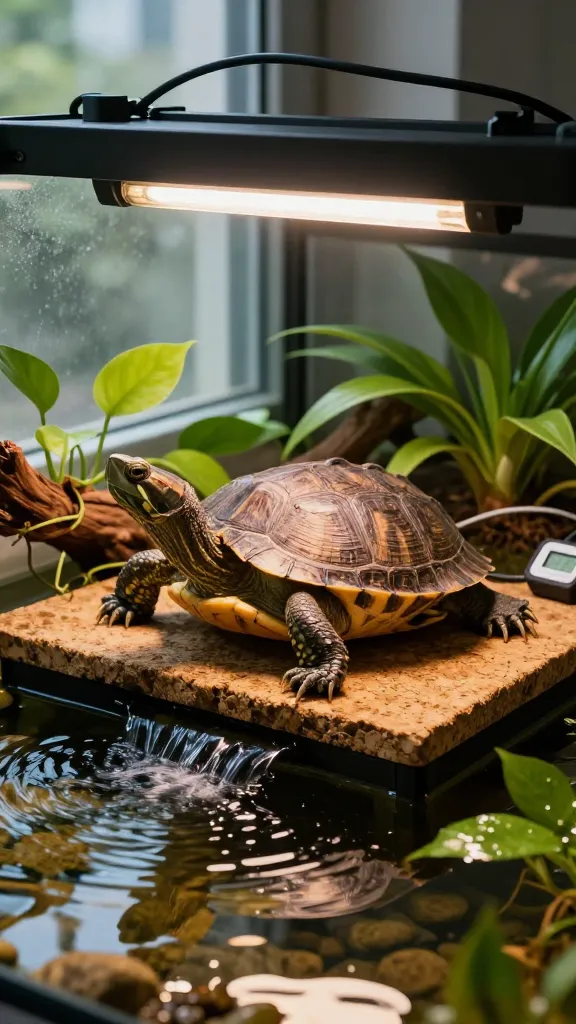
Heat and UVB are different parts of the spectrum; warmth drives activity and digestion, while UVB enables skin to synthesize vitamin D3, which lets calcium absorb into bone and shell. Conflating them leads to a warm turtle with soft shell or a bright, cool shelf that never gets used. Splitting sources lets you set each independently.
Mount a dedicated basking heat lamp to hit 90–95°F on the platform and a separate UVB source delivering UVI 2.0–3.0 at the turtle’s shell height (typical at 10–14 inches from a T5HO UVB tube with a reflector). Replace UVB tubes at 12 months of runtime; heat bulbs when output dips. The limit: glass and plastic lids block UVB; leave a UVB window or use fine mesh with ≤30% light loss directly over the basking lane.
5. Two-Stage Mechanical: Settling Box + Matten Wall for Quiet, Clear Water
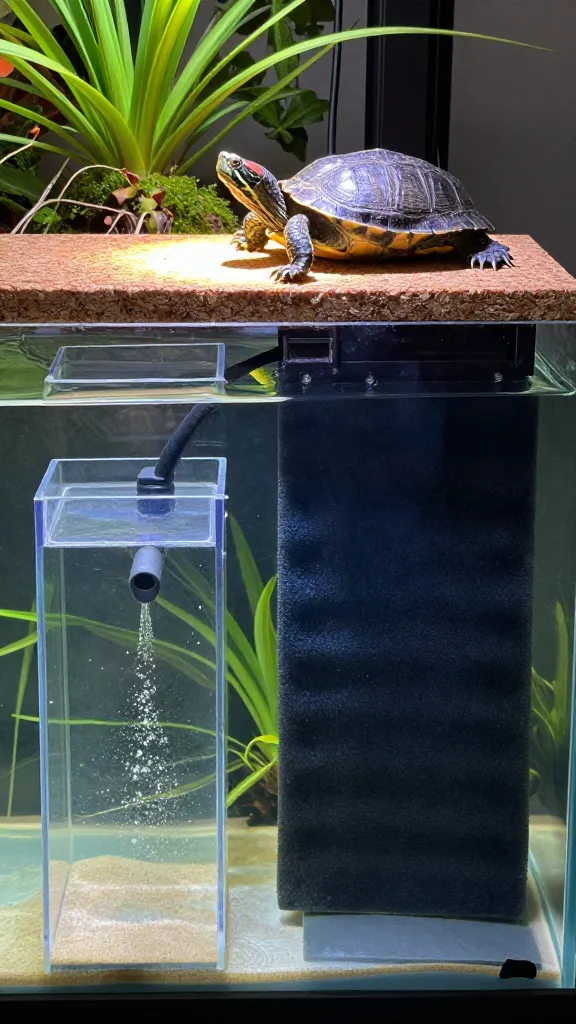
Heavy particulates settle under low velocity; biofilms thrive on slow, laminar flow over large surface area. A first-stage settling chamber lets gravity drop sand and food bits; a second-stage vertical foam wall (matten) presents square feet of surface to nitrifiers at modest velocity. This pairing keeps water clear without blasting plants or the turtle with jets.
Plumb your overflow into a chamber sized at 10–15% of water volume with flow slowed to 1–2 inches/second through the box, then across a 30–40 ppi, 1.5–2 inch-thick foam wall spanning the tank height. Drive it with a pump that returns the same 5–8× hourly turnover. The failure mode is channeling: without a full-frame seal, water shortcuts around the foam; use side rails or a snug frame so all flow goes through media.
6. Substrate Strategy Under Turtles: Bare, River Rock, or Capped Bed

Waste that falls between grains goes anoxic if water cannot percolate or be vacuumed; anoxic pockets generate hydrogen sulfide and recycle ammonia when disturbed. The substrate choice controls how solids behave and how you clean them. Bare glass is easy to vacuum; large smooth rock slows detritus capture; a capped bed supports rooted emergents with planned flow paths.
If you want plants, use a 1 inch soil or mineralized layer capped with 1–1.5 inches of 2–3 mm sand, then keep a gentle crossflow of 3–4× turnover across the bed to prevent dead zones. For low-maintenance clarity, go bare-bottom or use 2–3 inch river stones and vacuum weekly. The limit: small gravel (3–5 mm) is the worst of both worlds—traps waste and is hard to vacuum; skip it with turtles.
7. Feeding Zone and Skimmer Timing: Control Oil Films and Spikes

Proteins and fats from pellets form a surface film that blocks gas exchange; turtles gulp air at that surface, so a slick reduces oxygenation and pushes CO2 up. A surface skimmer clears the film quickly, but if it runs constantly it can starve floating plants and suck fry or shrimp. Timing skimming around feeding attacks the cause, not the symptom.
Feed in a dedicated ring or tray and run a surface skimmer at 2–4× the surface area per hour for 30–60 minutes after meals, then shut it off. If your main filter makes good ripple, you can skip a skimmer and instead increase surface agitation during the same post-feed window. The failure mode is chronic film from overfeeding: keep meals to what’s eaten in 5–7 minutes, once daily for adults, twice for juveniles, and test ammonia ≤0.25 ppm 30 minutes post-feed while you dial it in.
Frequently Asked Questions
How big should the canister filter be for a turtle paludarium?
Size for turtles by flow after head loss, not the box gallon rating. Aim for 5–8× hourly turnover of actual water volume at your real head height (often 3–4 ft from canister to return), and add a 30–40 ppi pre-filter sponge you can rinse every 3–7 days. That keeps ammonia at 0 ppm and reduces tear-down frequency.
What temperature should the basking spot and water be?
Set the basking surface to 90–95°F and the water to 74–78°F for sliders, cooters, and painted turtles; musk and mud turtles prefer 72–76°F water. Use a probe on the platform and a submersible thermometer at mid-depth, and verify with an IR gun so you see shell-level heat, not just air temperature.
Do I need UVB for a turtle paludarium or will a heat lamp do?
You need both: heat for thermoregulation and UVB for vitamin D3 synthesis. Provide a UV index of 2.0–3.0 at the shell on the basking lane and keep the heat hotspot at 90–95°F; replace UVB tubes every 12 months of runtime.
How deep should the water be under a basking platform?
Give adults a swim depth of 12–16 inches so they can self-right and exercise; juveniles under 4 inches do well at 8–12 inches. Pair with a ramp at 20–30° and textured grip so weak swimmers can exit easily.
Can I keep fish or shrimp with my turtle in a paludarium?
You can, but expect predation; turtles are opportunistic. If you try, stock fast, adult fish above 2.5–3 inches, provide dense plant thickets, and size filtration to the combined bioload at the same 5–8× turnover; test ammonia and nitrite weekly and keep both at 0 ppm.
Build the Gradient, Then the Flow
The paludarium that works hits two numbers first: a basking platform at 90–95°F and water turnover at 5–8× per hour after head loss. Tonight, measure your basking surface with an IR gun and time your filter return into a bucket for 30 seconds to calculate real GPH—then you’ll know exactly what to adjust.
Questions about your own setup? Leave them in the comments and I will work through them. — Nate