7 Vertical Paludarium Builds — Height, Misting and Root Access

Most vertical paludarium builds fail for the same reason: water delivery is sized like a fish tank while the plants are living in a tall, drying column of air. A vertical paludarium needs stable humidity gradients, reliable misting, and planned root access or the top half turns into a crispy terrarium in three days. By the end of this, you will be able to specify height, misting intervals, drainage, and planting pockets with real numbers, not vibes. I ran two 24-inch glass towers side by side for 6 weeks to quantify how often the upper epiphytes got re-wet versus how much fog simply condensed and ran off. You will know which build style matches your room humidity, maintenance appetite, and plant list.
1. Tall Glass Enclosure: Stack the Gradients with a 24–36 inch Column

Air stratifies in a tall box because warm, moist air rises and cooler, drier air settles; this creates vertical humidity and temperature bands that certain plants exploit. A 24–36 inch glass enclosure gives you enough height to maintain a high-humidity canopy zone while keeping the lower front pane clear for viewing and evaporation control. Choose a footprint you can light evenly: 18×18 inches supports a 24-inch height; 24×18 inches supports 36 inches with a single high-output fixture. Seal 80–90% of the top with glass or polycarbonate so the humidity reservoir forms; leave 10–20% for passive exchange or an exhaust fan. Too short (under 18 inches) collapses the gradient and forces constant misting to keep top epiphytes alive.
2. False Bottom and Drainage: 2–3 inches Locked, 1/2 inch Freeboard
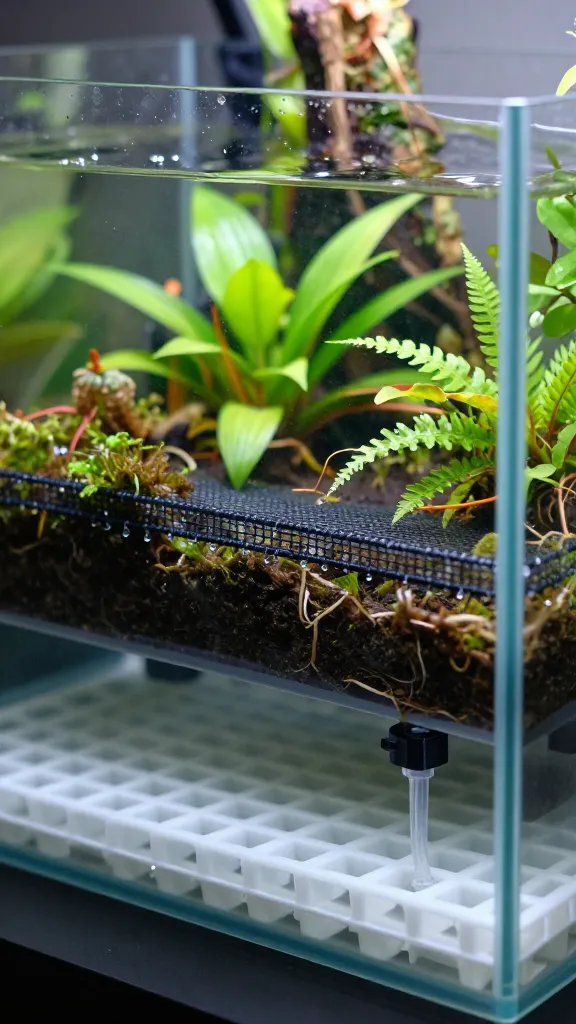
Plants decline in tall builds when capillary wicking saturates the root zone and the lower air goes stagnant; a false bottom decouples water storage from the planting layer. Use egg crate or slotted risers to create 2–3 inches of void, covered with mesh to keep substrate out, and plumb a bulkhead or a siphon tube so you can remove water without tilting the tank. Maintain 1/2 inch freeboard below the mesh so the substrate never sits in standing water; in practice this means draining when the reservoir hits 2.5 inches on a 3-inch riser. Without that void, accumulated runoff from misting will drive CO2 up and oxygen down around roots, inviting root rot and sulfur odor within two weeks.
3. Background Hardscape with Root Access: Pockets Every 6–8 inches

Epiphytic roots hunt for both moisture and anchorage; in a bare plane they desiccate, while in soaked moss they suffocate. A structured background with planting pockets sets alternating wet and airy zones so roots can choose. Build a back wall from cork, expanded PVC, or foam coated in cement, then embed cups or ledges sized 2–3 inches deep every 6–8 inches vertically, sloped at 5–10° to shed excess water into the drainage plane. Fill pockets with a coarse mix (orchid bark and pumice at 3:2) so air persists between mist cycles. Skip horizontal shelves that catch water; they turn into algae gutters and drown aerial roots. The honest limit: every pocket you create is one you must reach for trimming, so keep any single column to no more than four pockets in arm’s reach.
4. Misting vs Fogging: Wetting is GPH and PSI, Humidity is Microns

Misters throw droplets that physically wet leaves and substrate; foggers make vapor that raises relative humidity but delivers almost no water mass to a bromeliad cup or a fern rhizome. If the top third is drying, you need pressure and flow, not more mist time on a weak pump. Specify a pressure pump that can push 60–80 PSI at the nozzle and a line flow of 0.2–0.4 GPH per fine mist nozzle; run 1–2 minutes per cycle to re-wet epiphytes without flooding. Ultrasound foggers are for background humidity — think 200–400 mL/hour output into a duct for 10–20 minutes to bump the column to 85–95% RH. The failure is blending roles: relying on fog to water plants leaves xeric tips; relying on mist to maintain humidity leaves everything dripping and your drainage overwhelmed.
5. Lighting Tall Tanks: PAR at 18 and 30 inches

Photons thin out with distance and air scatter, so a fixture that grows a 12-inch terrarium can starve the lower leaves in a 30-inch paludarium. Measure at depth, not just at the top, and match plants to the lowest PAR they will receive. Aim for 60–90 µmol/m²/s at 18 inches and at least 30–50 µmol/m²/s at 30 inches for mixed tropicals (Anubias, Bucephalandra, peperomias), on a 10–12 hour photoperiod. That typically means a high-output LED spanning the tank with 0.5–0.8 watts per liter of air volume directly above the scape or a fixture with tight optics. Too much top intensity without diffusion will bleach canopy bromeliads while the understory limps along; add a diffuser panel or raise the light 2–3 inches to soften hotspots.
6. Paludarium Water Section: 10–30% Footprint, 5–10x Turnover
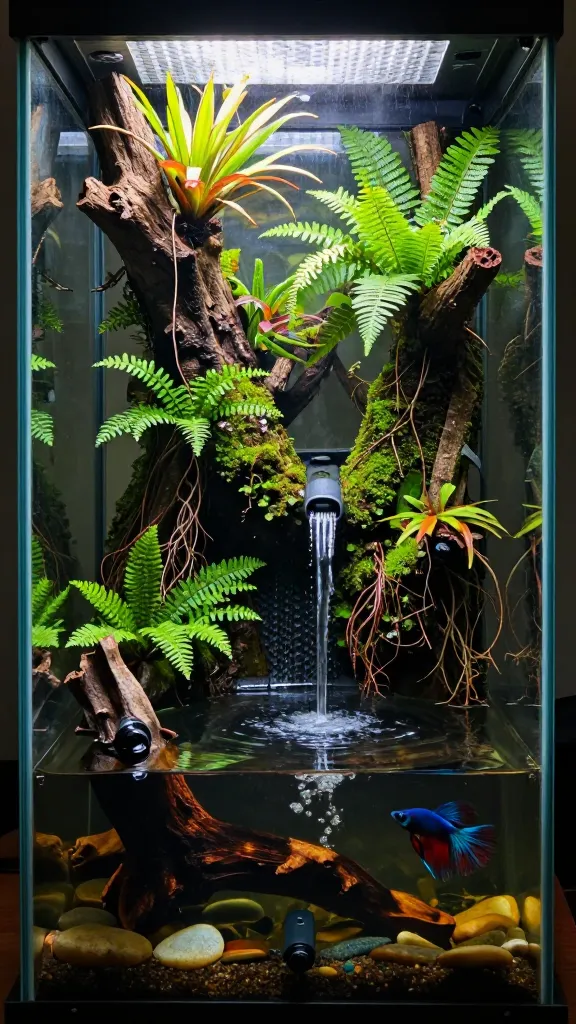
Open water stabilizes humidity through evaporation and acts as a thermal and biological buffer, but in a vertical build it also feeds runoff. Keep the pool proportionate so it supports gas exchange without stealing planting real estate. Allocate 10–30% of the footprint to water at 3–6 inches deep, circulate it at 5–10x the water volume per hour with a quiet pump, and route a spillway or drip wall to return overflows to the reservoir. Stock lightly and ethically: a single Betta splendens (adult 2.5–3 inches) or a group of micro rasboras in 8–12 gallons only after a full nitrogen cycle; keep amphibians with strict land/water needs out unless the land area meets species space requirements. Oversized pools dump humidity when cooled at night; undersized pools evaporate to zero and crash RH between mist cycles.
7. Ventilation and Dehumidifying the Glass: 1–2 Air Exchanges per Hour

Stagnant air breeds mold and keeps the viewing pane wet; a gentle exhaust pulls saturated air off the glass, draws in fresh air, and preserves the humidity gradient higher up. You are balancing removal with retention. Target 1–2 complete air exchanges per hour using a small DC fan moving 5–15 CFM, placed high on the side or lid, aimed to sweep across the front pane and out. Pair it with a rain gutter lip or drip rail inside the door to intercept condensate. Run continuously at low speed or pulse it 5 minutes on, 25 off during the light period. Too much fan (over 3–4 exchanges/hour) strips humidity and forces you to over-mist; too little leaves the glass fogged and the hardscape slick with biofilm.
Frequently Asked Questions
How tall should a vertical paludarium be for bromeliads and orchids?
Go at least 24 inches and preferably 30–36 inches if you want distinct canopy and understory zones. Height lets warm, moist air pool near the top where epiphytes thrive while the lower area stays serviceable. Pair that with mist nozzles at 60–80 PSI and lighting that still delivers 30–50 µmol/m²/s at the bottom so the rest of the plants do not stall.
Do I need both a mister and a fogger in a paludarium?
You need a mister to wet leaves and a fogger only if your room is dry or your enclosure leaks humidity. Misters deliver water mass at 0.2–0.4 GPH per nozzle, which actually fills bromeliad cups and re-wets moss; foggers add 85–95% RH but do little wetting. If your RH holds above 80% between mist cycles, skip the fogger and focus on pressure and nozzle placement.
How much water volume should the paludarium section have?
Set the water area to 10–30% of the footprint at 3–6 inches deep, then circulate it at 5–10x per hour. This provides stable evaporation for humidity without drowning the land section in runoff. A 20×18 inch base with a 5-inch-deep pool occupies about 2–3 gallons and wants 10–30 GPH of gentle flow, not a torrent that sprays the glass.
What lighting do I need for a 30-inch vertical paludarium?
Use a fixture that maintains 60–90 µmol/m²/s at 18 inches and at least 30–50 µmol/m²/s at 30 inches with a 10–12 hour photoperiod. Tall builds lose intensity with distance and scatter, so plan on 0.5–0.8 watts per liter of air volume or optics that concentrate output. Diffuse or raise the light 2–3 inches if the canopy bleaches while the bottom languishes.
How often should a paludarium mist to keep epiphytes hydrated?
Start with 1–2 minute mist cycles every 4–6 hours during the light period at 60–80 PSI and adjust so the top layer re-wets but does not drip for more than 10 minutes after. The goal is leaf wetting without saturating the substrate; if the drainage rises more than 1/4 inch per cycle, shorten duration or reduce nozzle flow. At night, drop to one short cycle or none if RH stays above 85%.
Build Tall, Then Meter the Water
Height sets your gradients; pressure and drainage decide whether those gradients are livable. Tonight, tape a cheap hygrometer probe at the top and bottom of your enclosure and log RH for 12 hours — if the top is not at least 10–15% higher than the bottom, adjust your lid coverage or fan duty before buying more mist nozzles.
Questions about your own setup? Leave them in the comments and I will work through them. — Nate