8 Frog Paludarium Setups — Land Ratios by Species

Most frog paludarium setups go wrong at the shoreline: too much water for a species that spends 90% of its life on land, or too little for one that soaks nightly. The land-to-water ratio controls temperature stability, humidity, and whether your frog can thermoregulate by choice rather than by accident. By the end of this, you will be able to specify the correct footprint split, water depth, and ventilation for the frog you actually keep. These eight builds are organized by species and the mechanism that drives the land ratio decision — moisture loss, skin absorption, breeding behavior, and escape risk. Pick the one that matches your frog’s biology, not the prettiest waterfall on your feed.
1. White’s Tree Frog: 80% Land, Vertical Height Over Water Volume
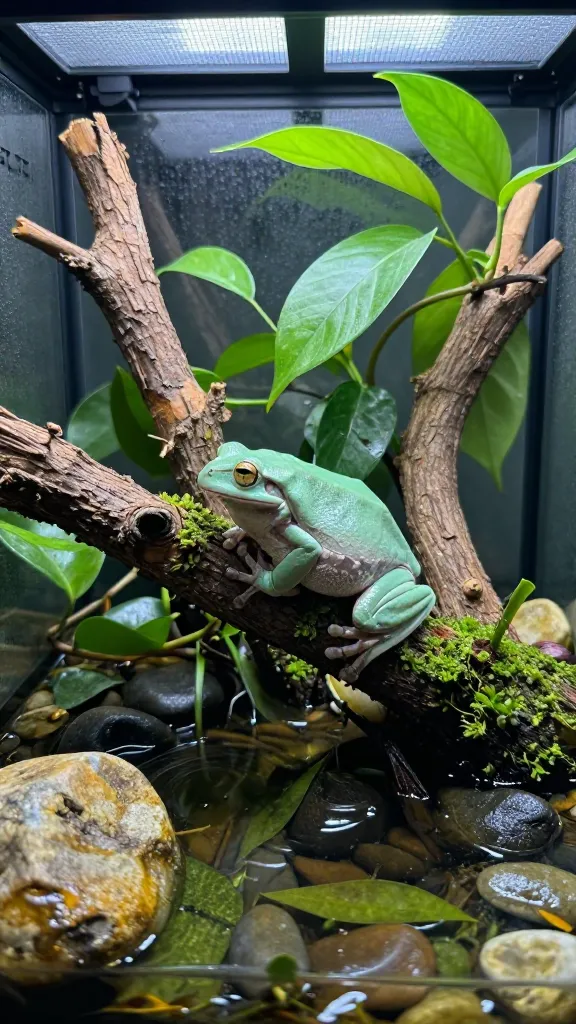
Arboreal frogs regulate moisture at leaf level, not by swimming; they absorb water through their skin and by sitting in shallow pools, but spend nights climbing. A tall enclosure with a shallow hydro section lets evaporating water humidify the air column while keeping feet dry. Specify a footprint that is at least 80% land with 20% water at 1–2 inches deep, and a total height of 24 inches for adults that reach 3–4 inches. Keep ambient humidity at 50–70% with cross-ventilation and a screened top covering at least half the lid to prevent stagnant air. Too much open water cools the tank, drops humidity swings at night, and invites bacterial film; aim for a slow trickle over slate rather than a waterfall that chills the enclosure.
2. Fire-Bellied Toads (Bombina orientalis): 50/50 Shoreline With 3–4 Inches of Water

These semi-aquatic toads forage at the water’s edge and use shallow ponds for escape and thermoregulation, not for deep swimming. A broad, gradual beach prevents trapped toes and allows quick shuttling between wetted skin and basking spots. Build a 50% land, 50% water footprint with a maximum water depth of 3–4 inches, sloped from 0.5 inch at the shore; filter the water at 5–7× hourly turnover to keep ammonia at 0 ppm. Maintain 68–74°F and moderate lighting for live plants. Going deeper than 4 inches encourages constant swimming and wasted energy, while too little land forces animals to crowd and foul shoreline hide spots, driving up skin issues.
3. Tomato Frog (Dyscophus guineti): 85–90% Land, Damp Substrate, Puddle Not Pond

Fossorial frogs retain moisture by burrowing; they need saturated contact at the skin-sediment interface more than open water. A deep, damp substrate mimics leaf litter and allows behavioral thermoregulation by moving up or down in the profile. Provide 85–90% land with 4–6 inches of coco-fiber/soil mix at field capacity (squeeze yields a few drops), and a 10–15% shallow water dish or puddle at 0.5–1 inch depth. Keep 72–78°F and humidity at 60–80%. Overbuilding the water section cools the substrate, collapses burrows, and increases stress; the failure mode shows up as animals refusing to feed and staying half-buried at the perimeter.
4. African Dwarf Frog: 0% Land, Fully Aquatic With Emergent Hardscape Only

These frogs are obligate aquatic lung-breathers; they surface to gulp air but do not use land. A land shelf wastes footprint and evaporative area that could stabilize temperature and dissolved organics. Skip the land and run a 100% water setup with emergent wood or stems breaking the surface; keep depth at 10–12 inches so they can reach air in 2–3 seconds. Filter at 5–8× hourly turnover with gentle flow and maintain 75–78°F. Any real “paludarium” land for this species becomes a hazard—escaping onto damp banks leads to desiccation within hours. If you want a shoreline look, fake it with a foam wall and keep the footprint all wet.
5. Mantella (Mantella aurantiaca): 70% Land, Cool Running Film Over Rocks

These small diurnal frogs use wet leaf litter and seepage zones; they drink via skin contact and avoid still pools that warm quickly and harbor bacteria. A thin film of moving water across textured rock supports hydration without creating a heat sink. Set 70% land with inclined slate receiving a 50–80 GPH trickle that sheets, not pours, into a 30% catch basin at 1–2 inches depth. Hold 68–74°F and humidity at 60–80%, with bright but cool lighting. Oversized basins stagnate at the edges and swing pH; if you smell sulfur or see biofilm within a week, you’ve built too much standing water for the flow rate.
6. Pacman Frog (Ceratophrys cranwelli): 95% Land, No Open Water, Just a Soak Bowl

Sit-and-wait ambush frogs rely on saturated skin contact and rarely move; open water increases drowning risk because they are poor swimmers and can aspirate when startled. A deep, uniformly damp substrate maintains skin hydration without chilling. Provide 95% land with 4–6 inches of soil/leaf litter at field capacity, plus a ceramic soak bowl covering 5% of the floor at 0.5–1 inch depth, refreshed daily. Keep 75–82°F and humidity at 60–80%. Any water area larger than the bowl becomes a trap during nocturnal lunges; the tell is abrasions on the snout and pink-tinged skin from prolonged submersion.
7. Poison Dart Frogs (Dendrobates/Azuritis group): 75–85% Land, Film-Flow, No Deep Pool

Dart frogs hydrate via skin contact and microdroplets from leaves; they avoid deep water and can drown in surprisingly shallow pools when chased. A broad land area with high leaf-litter humidity and scattered microfilms provides safe hydration and breeding sites for tads only when you choose. Build 75–85% land with multiple film-flow points (misters or driplines at 1–2 L/hr) feeding a narrow gutter that is 1 inch deep along 15–25% of the front. Maintain 70–78°F and 80–100% RH with frequent ventilation bursts to prevent mold. Large pools invite escapes, drownings, and runaway springtail crashes; the safer move is cup-spawning you can remove on purpose.
8. American Green Tree Frog (Hyla cinerea): 70% Land, Tall With Perched Water Ledge

Slender arboreals use perched leaves and bromeliad axils for water, not ground ponds. Elevating water pans into the canopy reduces commute distance for nightly hydration and uses evaporation to maintain vertical humidity gradients. Arrange 70% land by footprint with a tall build (24–30 inches), plus two elevated pans each 4–6 inches across and 0.5–1 inch deep, refreshed every 24–48 hours; keep 72–78°F and 50–70% RH with a screened top covering at least half the lid. Ground-level pools encourage bacterial growth and wasted floor space; a perched system keeps the frogs where they actually live. I ran ground-only vs. perched pans in identical 18×18×24 enclosures for 6 weeks and saw fewer nighttime falls and steadier humidity with the perched setup.
Frequently Asked Questions
How much land should a frog paludarium have for Fire-Bellied Toads?
Use a 50/50 split with water no deeper than 3–4 inches. They shuttle between shore and shallow water to regulate temperature and hydration, and deeper sections waste space and energy. Keep filtration at 5–7× hourly turnover to hold ammonia at 0 ppm.
What is the best land-to-water ratio for dart frog paludarium builds?
Aim for 75–85% land with only film-flow and a narrow 1-inch-deep gutter. Dart frogs rely on leaf-surface moisture and drown easily in pools; high land area with frequent drips at 1–2 L/hr maintains humidity without creating hazards. Temperatures of 70–78°F with 80–100% humidity are appropriate.
Can African Dwarf Frogs live in a paludarium with land?
No, run 100% water with emergent decor only. They are fully aquatic air-breathers and use the surface, not land, to breathe; a 10–12 inch depth ensures they reach air in 2–3 seconds. Provide gentle 5–8× turnover and 75–78°F.
Do tree frogs need more height or more water in a paludarium?
Height is the priority, with shallow water for soaking. Arboreals like White’s or Hyla cinerea regulate by climbing and using small pans at 0.5–1 inch depth; keep 70–80% land and at least 24 inches of vertical space. Maintain 50–70% humidity with good ventilation to prevent stagnant air.
How deep should the water be for Bombina in a mixed setup?
Keep depth at 3–4 inches with a long, shallow slope. They use near-shore water for escape and hydration, and going deeper encourages constant swimming and fatigue. Target 68–74°F water and solid mechanical filtration to prevent shoreline fouling.
The Shoreline Is the Thermostat
Land ratio isn’t decoration; it’s how your frog trades heat and water through skin contact and distance to moving air. If you change one thing tonight, measure your actual water depth with a ruler and your open-water footprint as a percent of the floor — if it’s more than 30% for a terrestrial or arboreal species, start adding land until you hit the range listed for your frog.
Questions about your own setup? Leave them in the comments and I will work through them. — Nate