8 Hardscape-Only Tank Ideas — Scapes That Never Need a Trim

Hardscape-only tank ideas are about restraint: the courage to let stone and wood carry the story while the water stays clear and still. By the end of this list, you will have chosen a layout you can build without trimming scissors, one that matures through patina and algae balance rather than growth charts. Think of an empty rectangular tank, a quiet light, three stones, and nothing else — the line between emptiness and a landscape is thinner than it looks. Each idea names what to buy, how to place it, and how long to wait before it reads as finished.
1. The Single-Stone Scape: One Focal Point, Nothing Competing
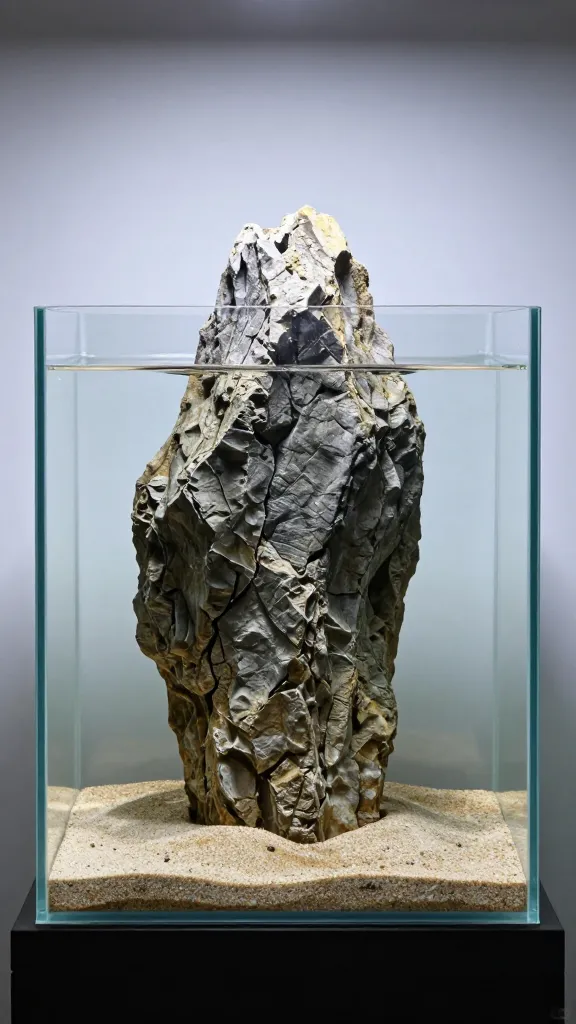
One clear focal point asks the eye to arrive, rest, and leave by the same path every time; anything that shouts around it is clutter. Choose a single, expressive rock with weathered texture — Seiryu stone for crisp planes or Ryuoh stone if you prefer deeper fissures — that stands roughly 2/3 the tank height. In a 10 to 20 gallon rectangle, place it off-center on the rule of thirds, with the stone’s mass breaking the waterline in a low-filled dry run to find its silhouette, then refill and leave the surrounding substrate clean at a gentle 5° slope front to back. Let green dust algae bloom and fade; in 6 weeks the rock will acquire a soft film that deepens the relief without needing a trim. When this fails, it’s because the stone is too small or too centered, and the tank reads as accidental rather than deliberate.
2. Driftwood Archway: Tension and Release Through a Gate

A gate frames negative space and teaches the viewer where the water is going, even when nothing moves. In a 20-gallon long, assemble two angled limbs of Pacific spider wood or manzanita into an arch that rises to 1/2 the tank height and spans no more than 2/3 the width, leaving a clear, dark corridor beneath. Anchor with river pebbles tucked invisibly where the wood meets the substrate so the arch leans slightly forward toward the front glass, and keep the sand plain — inert silica “pool filter” sand works — so the silhouette carries the load. Over 4 to 8 weeks, biofilm will pearl the undersides and shrimp will graze it clean; the arch reads older without you clipping a thing. If you cram the span to the glass, the gate becomes a wall and the scape loses its breath.
3. Classic Iwagumi Hardscape-Only: Rhythm Through Repetition
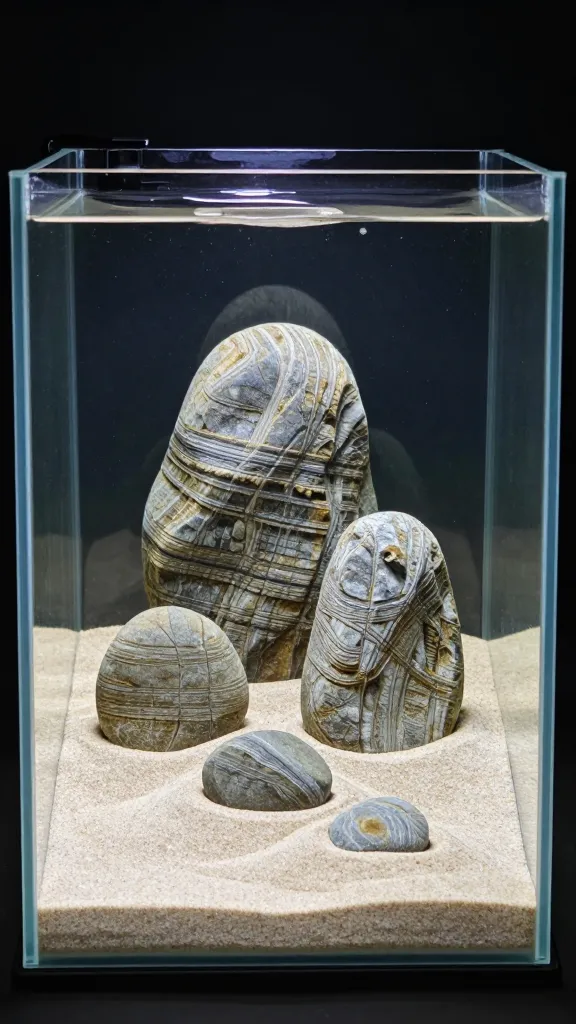
Repetition with variation creates rhythm — the same language spoken in different tones across the tank. Use a five-stone layout in a 17 to 25 gallon rectangle: one primary stone (oyaishi) at 2/3 height, a secondary (fukuishi) echoing its strata at 1/2 height across the diagonal, and three supporting stones (soeishi) stepping down in size. Keep all stones of the same family — Seiryu stone or Yamaya stone — and align their grain so the strata lean in the same direction, like a hillside. Sand-only substrate makes this truly maintenance-free; if you prefer a lived-in look, allow a fine film algae to soften the edges over 6 weeks and leave it. The miss here is mixing rocks with conflicting texture or angles, which turns rhythm into noise.
I have built more iwagumi than any other style in two decades; the ones that endure are those with stone lines that agree even before the tank is wet.
4. Canyon Pass in Sand: Depth From Converging Lines

Depth in a shallow box comes from lines that converge, not from tall stacks. In a 10-gallon standard, sculpt two low ridges of rounded river stone or weathered Ohko (dragon) stone along the left and right, leaving a 1/3-width sand path that narrows to a point at the back. Slope the sand bed from 1 inch at the front to 3 inches at the rear so the vanishing point sits just below the back pane, and keep the stones under 1/2 tank height to preserve the sky. Let brown diatoms dust the sand in the first 2 weeks; gentle weekly stir with a credit card edge restores the pale path without trimming anything. When it fails, it’s because the path is too wide or dead straight, which flattens the illusion and makes the stones feel like piles instead of cliffs.
5. Root Tangle on Blackwater: Silhouette Over Detail

Silhouette becomes the subject when detail is muted, and tannin-stained water is a gift to shape. In a 15-gallon tall, sink a lattice of fine mopani roots or thin malaysian driftwood so their tips sweep downward and converge into a shaded hollow, occupying the back 2/3 of the footprint and 2/3 of the height. Use inert sand and a few rounded alder cones to leach gentle tannins, aiming for tea-colored water; under a calm light, the wood’s branching reads like winter trees. Over 6 weeks the biofilm on the twigs turns from pearl to matte, and you adjust nothing besides a partial water change if the tint gets heavy. Overcrowding wood so every plane is busy makes the scape claustrophobic and sacrifices the quiet negative space where fish need to pass.
6. Boulder and Shore: Weight Balanced by Open Water
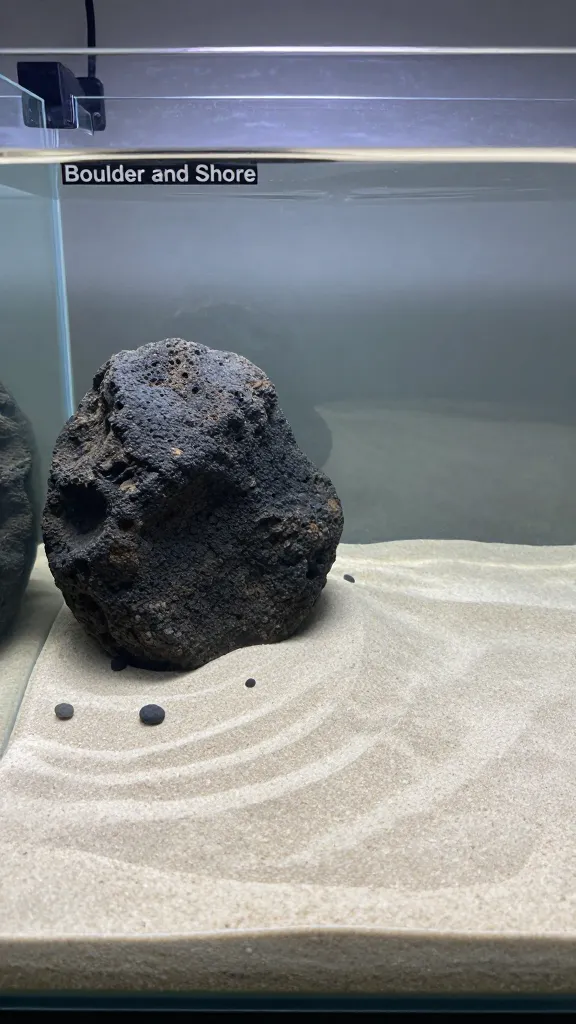
Balance is not symmetry; it is the felt equality of mass and emptiness. In a 29-gallon, choose one dominant lava rock boulder, rounded rather than sharp, roughly 1/2 tank height, and set it heavy on one third of the footprint as if it has slumped into wet sand. Counterweight it with a wide, uninterrupted “shore” of pale sand across the remaining 2/3 — no secondary stones there, only a few scattered pebbles near the boulder’s toes so the transition feels natural. Keep the waterline high to compress the scene, and let a light green film settle on the boulder over 6 weeks; the sand stays bright with occasional gentle siphon passes. This fails when you add a second big stone “for balance,” which cancels the tension and turns the layout into a pair of bookends.
7. The Fallen Trunk: Direction Through Flowing Grain

Direction is set by grain; when fibers all point one way, the water seems to move with them. In a 20-gallon high, lay a single horizontal trunk of manzanita or straight spider wood from back-left to front-right at a 30° angle, with two smaller branches resting beneath it like debris caught in flood. Bury the base subtly so the trunk feels embedded, let the front tip hover just above the sand, and leave the opposite back corner empty as “upstream.” Keep the light stronger at the upstream side and dimmer downstream to reinforce the flow; in 4 to 6 weeks the trunk will darken and blend. The mistake is crossing branches at random angles — the current disappears, and the tank looks like a stick pile.
8. Crater Bowl: Containment and a Clean Horizon

Containment gives calm — a shape that holds the eye inside it and returns it to center. In a 12-gallon long, carve a shallow crater into fine sand: a circular basin 2/3 the tank width, 1 to 1.5 inches deep at the center. Ring the rim with flat Shou stone or broken slate set barely proud of the sand, and place one smaller chip inside the bowl, off-center, as a disturbance. The surrounding sand stays unbroken to the glass, and the waterline is kept high so the horizon is a thin band; within 6 weeks the slate edges take a delicate patina and the bowl reads ancient. Failure arrives when the ring is too tall or jagged, which reads as a wall rather than a lip and makes livestock feel cornered.
Frequently Asked Questions
Do hardscape-only tank ideas work without CO2?
Yes. With no plants to drive, you are balancing light, algae, and biofilm instead of growth. Keep lighting moderate, feed livestock lightly, and accept a fine patina on stone and wood as the sign of a living system rather than a flaw. In 6 weeks, the surfaces settle into a stable look that needs nothing but routine water changes.
How do I keep algae from taking over a hardscape-only layout?
Control light and nutrients rather than scrubbing weekly. Run a steady photoperiod of 6 to 7 hours, avoid overfeeding, and add a small clean-up crew suited to your tank size — Otocinclus for mid-sized tanks, Neocaridina shrimp for smaller ones — after the cycle completes. A light green film is normal; black beard algae signals excess light and flow dead spots you can correct by repositioning outlets.
Which stones and woods are safe for these hardscape-only tanks?
Use inert, aquarium-suitable materials: Seiryu, Ohko (dragon) stone, lava rock, Yamaya, and hardwoods like manzanita, spider wood, and mopani. Avoid limestone if you keep soft-water livestock, as it can raise hardness. Always rinse thoroughly, and pre-soak wood for 1 to 2 weeks to remove tannins if you prefer clear water.
Can I add a small moss to a hardscape-only composition?
You can, but then it is not hardscape-only and it will need occasional trimming or at least cleaning. If you want the texture without maintenance, accept biofilm and controlled algae as the “plant,” or commit to a single, slow species like Taxiphyllum barbieri (Java moss) in a tiny patch placed where you can reach it. Be honest about your time before you attach anything.
How long should I wait before adding fish to a new layout like this?
Cycle the tank fully before any livestock — typically 4 to 6 weeks with a reliable source of ammonia and testing for 0 ppm ammonia and nitrite. Hardscape adds surface area for bacteria, but it doesn’t shorten the process. Stock gradually, then give another 2 weeks for the biofilm to stabilize before evaluating the look.
Are hardscape-only tank ideas good for beginners?
They are excellent because composition is clearer when nothing grows unpredictably. You learn placement, scale, and negative space without juggling plant pruning or nutrient dosing. Start with a mid-sized 15 to 20 gallon tank for more forgiving water stability and build from there.
Let the Water Do Some of the Work
Silence in a layout is made of shape, scale, and patience more than plant lists, and still water can say more than a loud carpet. Tonight, set three stones on a table, align their grain so they agree, and live with that triangle under a lamp for 10 minutes — you will know which one is the focal rock before you ever lift the glass lid.
Questions about your own scape? Leave them in the comments and I will answer them. — Julian