8 Nano Paludarium Builds — Small Volumes, Real Drainage

Nano paludarium builds fail or thrive on one thing you cannot see in the product photos: how water leaves the land. If you nail drainage and recirculation in a small volume, plants root instead of rotting and the water section stays clear. By the end of this, you will be able to specify substrate layers, pump flow, and overflows that keep a 2 to 10 gallon paludarium stable, and choose which layout matches your livestock and maintenance window. I ran two 5-gallon glass boxes with identical pumps for 8 weeks to compare saturated versus drained land zones; the drained build stabilized CO2 and DOCs and needed half the pruning. These eight builds are the ones that actually work at small scale.
1. False Bottom with Standpipe: Live Roots, Dry Rhizomes

Roots respire; they need oxygen as much as moisture. A false bottom creates a void where excess water can collect below your planting layer, so capillary action keeps roots moist while gravity prevents suffocation. In a nano volume, that air space also decouples land humidity from open water, reducing constant leaching of tannins and nutrients into the pool.
Build it with a rigid grate or stacked egg crate set on 1 to 1.5 inch risers, topped by a fine mesh, then 2 to 3 inches of planted substrate. Add a 1/2 inch standpipe that reaches from the void up to the rim so you can siphon the reservoir weekly; size the pump to cycle that undergravel water at 60–120 GPH per 10 gallons. If you omit the standpipe, the failure mode is easy: the reservoir slowly becomes anoxic within 10–14 days and you will smell sulfur when you disturb it.
2. Wicking Mat Terrace: Capillary Flow Without Pumps
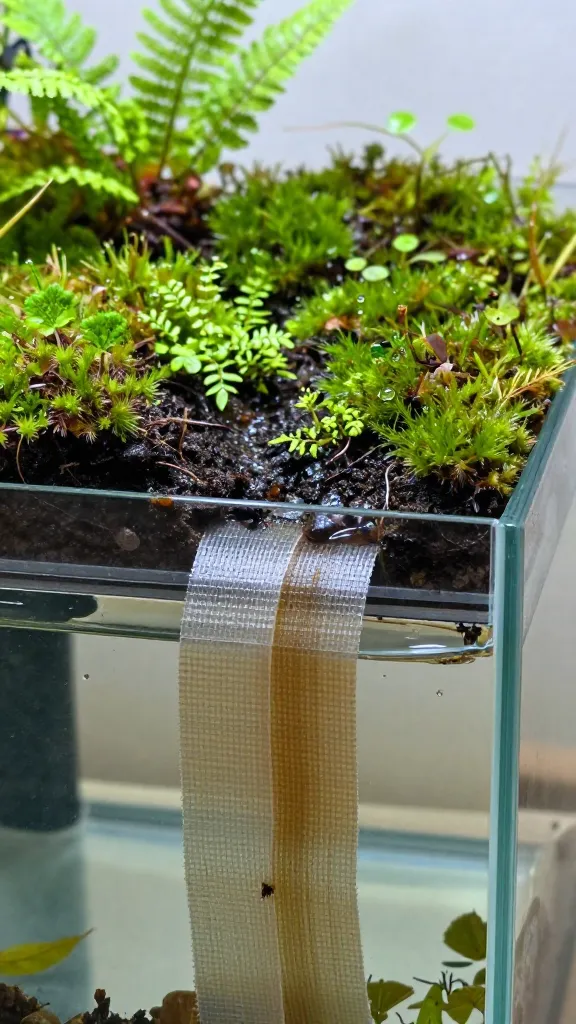
Capillary action moves water upward through fibers until gravity balances it, which you can harness to keep a raised land zone evenly moist while the pool stays clean. A synthetic wicking mat bridges from a submerged intake shelf up under your soil, so moisture is replenished silently and continuously without a spray bar atomizing nutrients into the air.
Use a nylon or polyester mat rated for horticulture, draped from a 0.5 to 1 inch deep water trough up 3 to 4 inches beneath the land. Compact soil lightly over the mat to maintain contact; top with 0.5 inch bark or gravel to slow evaporation. Check that the mat stays wet across its width; if the run is longer than 8 inches, add a second wick. The limit is plant choice: semi-aquatic species love this, but xeric mosses will algae up if the surface stays above 95% RH for days.
3. Back-Wall Weir Overflow: Quiet Level Control

Water seeks a level and will pass silently over a sharp lip; a shallow weir built into the back wall sets the pool height and skims proteins before they form biofilm. The overflow drops into a rear cavity or external box, where a small pump returns it to the land feature, closing the loop without bubbles in the display.
Cut or form a 1.5 to 2 inch wide slot at the desired waterline, with the lip square and smooth, and guard it with a 1 mm mesh to block shrimp. Size the weir depth so a return of 80–120 GPH runs a thin sheet 1–2 mm thick; too deep and it gurgles, too shallow and it stalls with leaf litter. The failure mode is detritus creep: if the mesh clogs, water backs up into the land and saturates your soil within hours.
4. Under-Substrate French Drain: Gravel Pipe That Never Clogs

Fine soils slump and migrate; wrapping perforated pipe in a coarse envelope creates a preferential path for water to leave the land without sucking in silt. In small paludariums, this “French drain” equalizes pressure across the planting area so one wet corner doesn’t quietly turn anaerobic.
Lay a perforated 1/2 inch flexible tube in a U across the land base, cover with 1 inch of 3–5 mm gravel, then add your soil. Connect one end to the pump intake through a 200–300 micron prefilter and leave the other as a cleanout you can flush. Target a draw of 1–2 tank volumes per hour through the drain; any lower and fines will settle, any higher and you desiccate the rhizospheres near the pipe. If you skip the gravel envelope, expect muddy returns and a clogged intake in 2–3 weeks.
5. Spray Shelf Waterfall: Aeration Without Mist

When a thin sheet of water runs over a wide shelf, it sheds CO2 and absorbs O2 efficiently because the surface-area-to-volume ratio is high and the contact time is controlled. In a nano paludarium, that means better oxygenation of the pool and less humidity spike than a fogger, while still watering mosses by splash rather than drench.
Build a 3 to 4 inch wide shelf at a 5–10° tilt, feed it with a return at 50–100 GPH for a 2–3 mm laminar sheet, and texture the lip so water breaks into micro-rivulets. Place sensitive plants at least 2 inches back; the near edge will stay wet, the interior will stay only humid. Push more flow and you atomize nutrients; pull less and the sheet tears into drips, losing the gas exchange and leaving dry stripes.
6. Paludarium Pump Sizing: Head Height Beats Tank Rating

Pumps lose flow with height due to gravity and friction; the published GPH is at zero head, which you never have when you lift to a waterfall or spray shelf. In small builds, a 12–18 inch lift can cut output by half, so the pool can stagnate even though the box says “120 GPH.”
Measure your vertical lift from the pool surface to the highest outlet and choose a pump that delivers your target flow at that head: aim for 6–10 turnovers per hour of the water section. If your pool is 1.5 gallons and your lift is 14 inches, you need 9–15 GPH at 14 inches, which often means a unit labeled 60–90 GPH. The miss here is noise and heat: oversizing by more than 2× your head requirement can cavitate in shallow intakes and add 1–2°F to a 78°F system.
7. Substrate Stack for Drainage: Particle Size Gradient
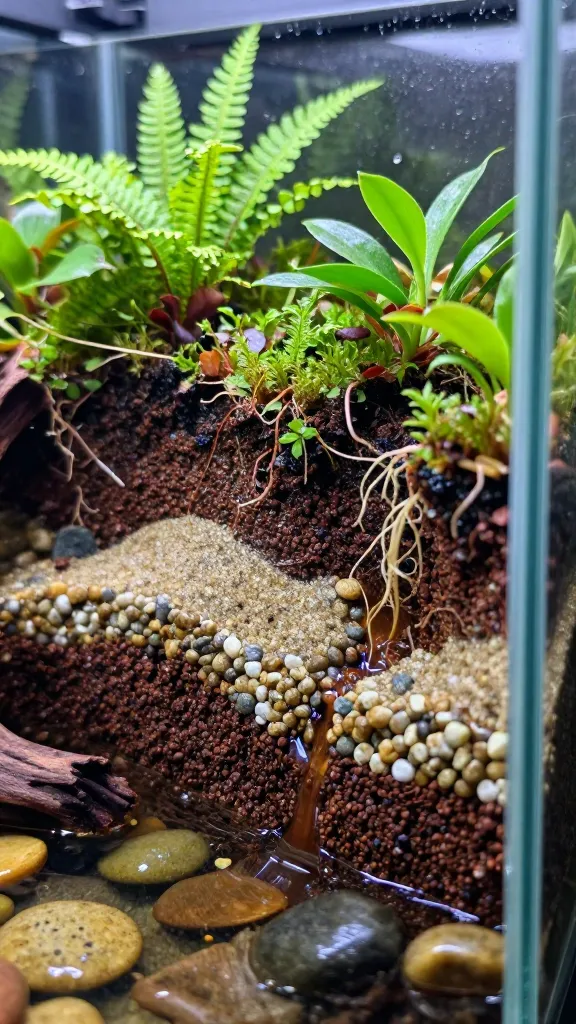
Water moves from fine to coarse layers only if capillary forces allow it; a correct gradient wicks sideways across the planting zone while letting gravity drain down. Mixing sizes randomly creates perched water tables where pores are too small to release, suffocating roots in small areas that never look waterlogged on top.
Stack from bottom to top: 0.5–1 inch of 6–10 mm lava rock, 0.5 inch of 3–5 mm gravel, 1–2 inches of 0.5–2 mm planted soil, then 0.5 inch of mulch or sand cap. Keep each layer distinct; use mesh between gravel and soil if you will replant often. Water should exit the soil at ~-1 to -3 kPa equivalent tension at this scale, which you approximate by a daily drawdown of 2–4 mm in the reservoir. Blend layers and you create perched zones that never clear below 1 inch.
8. Condensation and Humidity Control: Vent Area You Can Measure
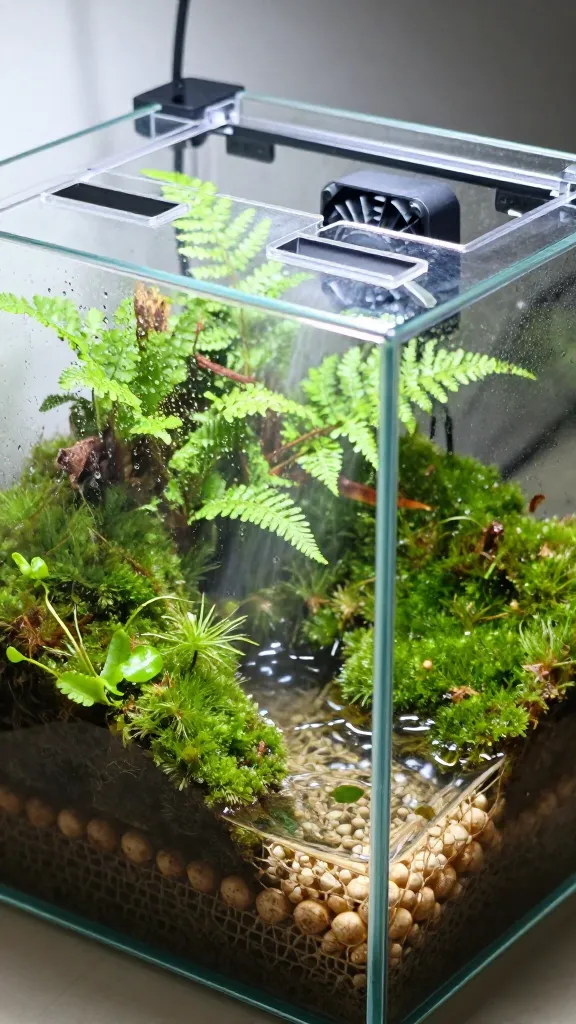
Warm water evaporates; when that vapor hits a cooler pane, it condenses and rains back onto land, re-wetting surfaces you meant to keep only humid. Ventilation trades that saturated air for room air, stabilizing the vapor pressure so you can keep moss hydrated without growing cyanobacteria on every leaf.
Provide vent openings totaling 2–4% of the lid footprint, split high and low to promote a slow stack effect. For a 12×8 inch lid, that is 2 to 4 square inches of combined vent; pair with a fan at 5–10 CFM only if you see persistent droplets after an hour. Too much vent drops RH below 80% and crispy-tips your ferns; too little drips nutrient-laden condensate back into the pool and kicks up film algae within a week.
Frequently Asked Questions
How big should the water section be in a nano paludarium?
Keep at least 25–40% of the footprint as open water in the 2–10 gallon range. That volume buffers temperature and nutrients, and gives your pump a stable intake so it does not vortex or suck air at low levels. For a 10×10 inch base, a 4×10 inch pool at 3 inches depth gives roughly 0.5 gallons, which you should turn over 6–10 times per hour.
What pump flow is best for a nano paludarium waterfall?
Target 50–120 GPH depending on lift and lip width, not the tank’s “rating” on the box. You want a 1–3 mm continuous sheet over the fall; measure your head height and choose a pump that delivers your target at that head. If the flow shreds into droplets, increase by 10–20 GPH; if it mists, reduce or widen the lip.
Can I keep shrimp in the paludarium water section?
Yes, but only if the water area is at least 1 gallon, filtered, and stable at 72–78°F with GH 4–8 dGH, KH 2–5 dKH, and 0 ppm ammonia and nitrite. Guard every intake and weir with 1 mm mesh and cycle the system fully before stocking. Adult Neocaridina reach 1–1.25 inches; give dense cover and avoid fish that can access the pool.
How do I fertilize plants in a nano paludarium without fouling the pool?
Use slow-release granules in the soil at 1–2 grams per liter of substrate and foliar-mist chelated micronutrients at label-low once weekly with the pump off. Nutrients move by diffusion and runoff; cutting the water features for 10–15 minutes keeps most fertilizer in the land zone. If you see nitrate rising over 20 ppm, reduce frequency or dose.
Do I need a filter, or is the paludarium pump enough?
The pump is just the mover; you need media contact time to process waste. In nanos, a small rear chamber with 50–100 cm² of sponge or ceramic per gallon, turned over 6–10×/hr, is sufficient for snails and shrimp. If you rely on bare circulation, expect biofilm and measurable ammonia after 7–10 days when the land is fertilized.
Start With Where the Water Goes
The governing number here is flow at head: move 6–10 pool volumes per hour reliably, and give that water an easy exit from the land through a graded substrate or drain. Tonight, measure your actual lift in inches and the vent area in square inches; if your sheet tears or your panes drip, you already know which item to fix first.
Questions about your own setup? Leave them in the comments and I will work through them. — Nate