9 5-Gallon Aquascape Ideas — Depth in a Very Small Footprint

Most 5-gallon aquascape ideas fail at the same hurdle: depth. In a shallow front-to-back space, the eye needs help to travel. These nine layouts use line, grading, and negative space to make a small tank read as a landscape and not a planter. By the end you will have chosen one direction, a plant list that matches it, and a pace to let it settle. None requires CO2 or special gear — only attention, proportion, and time.
1. Iwagumi Triangle: A Sloped Horizon and One Stone to Lead

A single dominant line pulls the gaze across a small tank; in this layout the slope sets it. Build a left-to-right grade rising to 2/3 of the tank height at the back corner, with one seiryu stone as the focal point and two supporting stones echoing its grain. Plant the open front in dwarf hairgrass (Eleocharis acicularis ‘mini’), and stitch the slope with Micranthemum ‘Monte Carlo’ (M. tweediei) to lock it. In 6 to 8 weeks the carpet will close and the slope will read as hillside. If it fails, it’s because every stone is the same size and energy — the eye stalls and the line dies.
2. The Thin River Path: Negative Space as the Subject
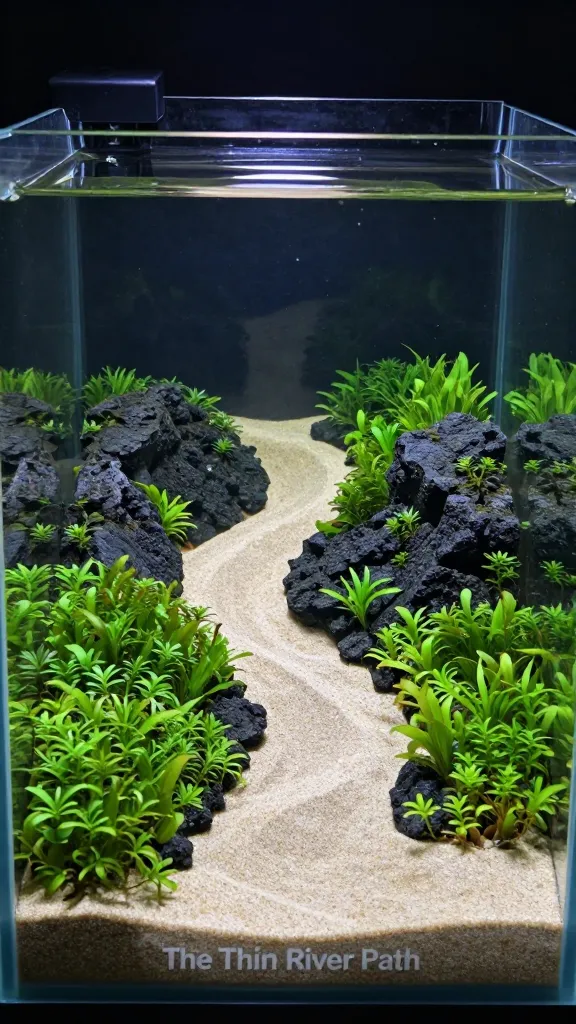
Empty space is not background; in a 5-gallon, it is the shape you are composing. Create a 1 to 1.5 inch sand path of natural cosmetic sand from the front-left corner to the back-center, tightening as it recedes, with dark substrate on both sides retained by small lava rock. Plant the banks with Cryptocoryne parva low and Staurogyne repens mid, and keep the path clean with a weekly turkey-baster puff. Depth comes when the path narrows convincingly by week 6; when it fails, the path is too wide at the back and looks like a road to nowhere.
3. Overhanging Roots: Vertical Drop to Break the Box

Verticals make a shallow tank taller by giving the eye a fall to follow. Fix a piece of red moor root so it arcs from the back wall to 1/3 into the tank, with finer branches hanging toward the substrate. Tuck Epiphyte clumps—Java fern ‘Trident’ (Microsorum pteropus) and Anubias barteri var. nana ‘Petite’—into crevices, and feather the base with Cryptocoryne lucens. Allow 8 weeks for ferns to harden and new roots to cling. Failure shows as a tangle: too many branches at one level flattens the drop and the root reads as clutter, not canopy.
4. Sand Spit Island: Foreground Light, Background Weight
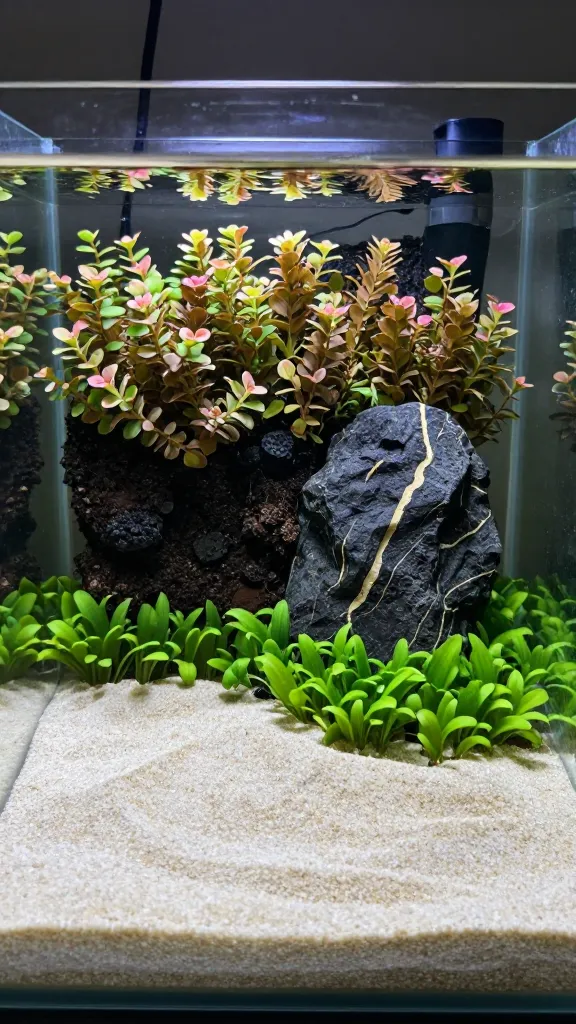
Contrast in value separates planes when distance is scarce. Shape a pale sand “spit” occupying the front 1/3 and tapering to the midline; bank a dark soil mound behind it to 1/2 tank height with black lava and a single ohko (dragon) boulder as anchor. Keep the sand unplanted; mass the mound with Hygrophila pinnatifida on rock and a ring of Cryptocoryne wendtii ‘Green’, then a back screen of Rotala rotundifolia for a soft horizon. Trim every 2 weeks to keep the horizon low and rolling. It fails when the sand is dotted with pebbles and moss—your light plane becomes mottled and the depth vanishes.
5. Mossy Ravine: Converging Lines to a Vanishing Point
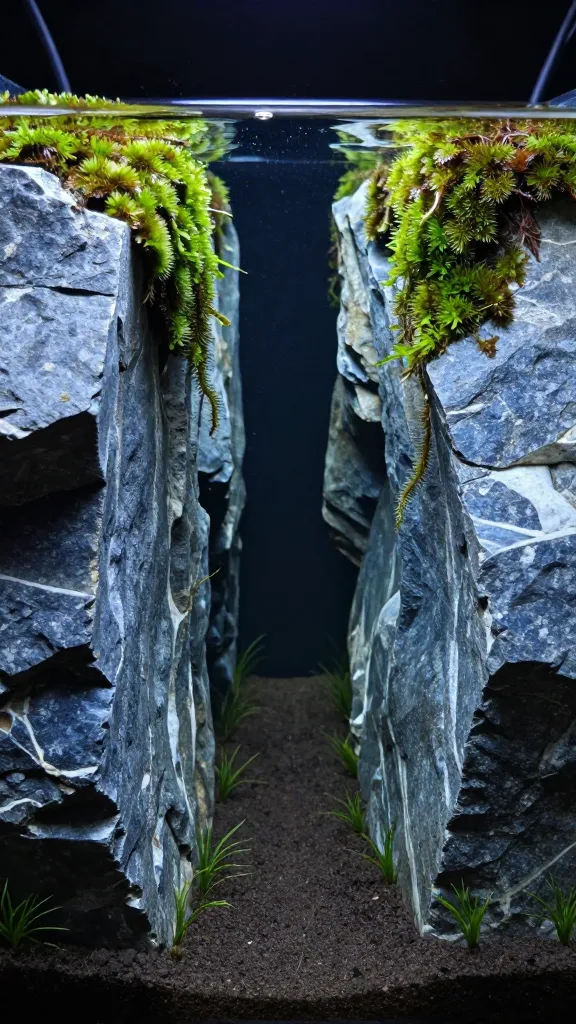
Convergence tricks scale; two lines leaning inward make distance where there is none. Stand two sawed faces of seiryu stone as opposing cliffs, 2 inches apart at the front, narrowing to 1/2 inch at the back; pin Taxiphyllum barbieri (Java moss) in broken patches along their upper edges. Keep the ravine floor dark with soil and a thin sprinkle of crushed stone; plant sparse tufts of Eleocharis pusilla to imply scrappy life on a harsh floor. Allow 6 weeks for the moss to knit and soften the geometry. It fails when the gap is constant—parallel cliffs read as a slot, not a place.
6. Two-Plane Terrace: Step the Land, Not the Plants
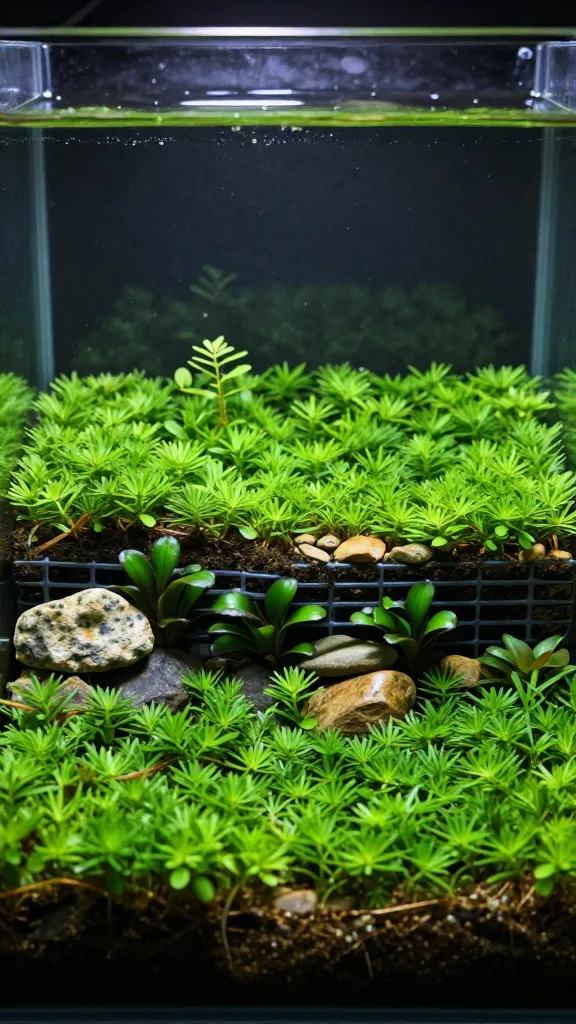
Stepping the substrate into planes creates depth even with uniform greenery. Build a rear terrace 1.5 inches higher than the front using plastic mesh under soil or flat shale pieces; hide the face with low Bucephalandra sp. attached to stones. Plant both planes in Micranthemum ‘Monte Carlo’ for continuity and add a micro-stand of Helanthium tenellum ‘Green’ on the rear plane only to read as distant grass. In 8 weeks, the step will disappear under growth and leave only the sense of plateau beyond meadow. It fails when the riser is exposed and vertical—if you can see the step’s wall, the trick is revealed.
7. Crescent Jungle: Enclosure with a Clear Center

Framing the center with mass makes the empty middle feel deeper than any planted expanse. Build a crescent of wood and rock around the back and sides, leaving a clear oval in the front-center footprint. Plant the frame densely: Cryptocoryne wendtii ‘Tropica’ and Bolbitis heudelotii on wood, with Anubias barteri var. nana at the base; keep the oval clean sand or sparse Sagittaria subulata runners trimmed low. Give it 8 to 10 weeks to fill; the enclosure is for small fish and shrimp, never the other way around. It fails when the oval closes—if runners cross it, the window into depth is gone.
8. High-Foreground Bank: Near Field Dominance, Far Field Whisper
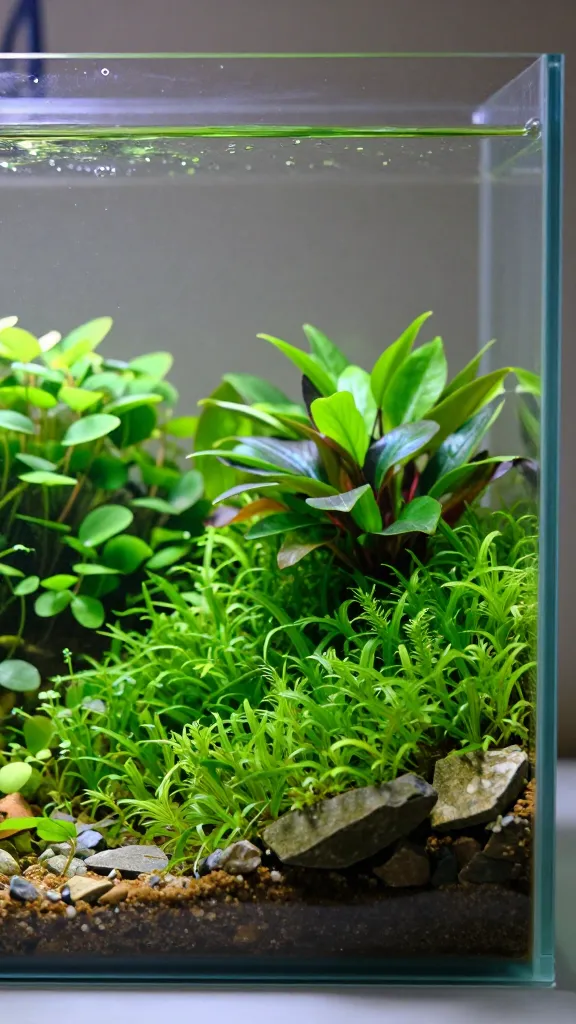
When the foreground rises, the brain reads what’s behind as miles away. Mound soil to 1/3 tank height in the front-right, falling gently to the back-left; brace it with small dragon stone shards to hold form. Plant the high front in Staurogyne repens and a few Bucephalandra clumps; keep the back-left delicate with a thinned stand of Hydrocotyle tripartita ‘Japan’ clipped low, no higher than 2 inches. At 6 to 8 weeks the near bank should look weighty and the back like a distant glade. It fails when the back is busier than the front—attention snaps to the wrong place and the illusion breaks.
9. Blackwater Grove: Tone Unifies, Light Picks the Path

Limited color depth relies on tone: when the water is tea-stained, contrast shifts from green to light. Lay a sparse matrix of cholla wood and Catappa (Indian almond) leaves, sink a twisting manzanita branch off-center, and use only epiphytes: Bucephalandra ‘Green Wavy’, Anubias barteri var. nana ‘Petite’, and Java fern ‘Narrow’ tied lightly. Run the light dimmer and warm; let biofilm and tannins deepen for 6 weeks before judging. The only strong opinion I’ll hold for a small tank is this: limit species to five or fewer and repeat them—repetition is order, and order is what makes a small space feel grand. It fails when gravel, bright sand, and too many greens fight the water’s tone; pick the mood and commit.
Frequently Asked Questions
How long should I let a 5-gallon aquascape settle before trimming hard?
Wait 6 to 8 weeks before any structural trim. Early cuts remove the mass that anchors slopes and terraces, and carpets like Monte Carlo need that time to root into the substrate and stabilize the grade. Light shaping is fine, but defer resets until after the first full grow-in.
Do I need CO2 for these 5-gallon aquascape ideas?
No. Every layout here is built to work without CO2 using hardy species like Anubias, Java fern, Cryptocoryne, and Staurogyne repens. Keep light moderate, feed the water column weekly, and accept a slower 6 to 10 week timeline for full form.
What fish or shrimp suit a small layout without overcrowding the design?
Choose livestock that respect the proportions: a single small group like six Chili rasbora (Boraras brigittae) or one betta splendens in a heated, filtered, cycled tank, plus a colony of Neocaridina shrimp if the betta is not included. Stock only after the scape is stable and you can maintain water at 72-78°F with 0 ammonia and nitrite.
How do I keep a sand path clean in a tiny tank?
Use a turkey baster to puff debris off weekly and siphon lightly; resist vacuuming deep and collapsing edges. A border of small lava rock or flat pebbles keeps soil out, and a few Malaysian trumpet snails help turn detritus without disturbing the path.
Can I scale these 5-gallon aquascape ideas to a 10-gallon?
Yes, keep the proportions and double the spacing. A river path narrows the same way, a terrace still steps 1.5 inches higher, and stone hierarchies stay one main, two support. The extra depth simply buys you more negative space and gentler slopes.
Choose Depth First, Plants Second
Depth comes from line, contrast, and restraint more than from any single plant. Tonight, lay three stones on a towel at your tank’s footprint and decide where the eye should travel; when that line is clear on the table, it will hold in glass after 6 weeks of growth.
Questions about your own scape? Leave them in the comments and I will answer them. — Julian