9 Dragon Stone Aquascape Layouts — Texture Without Clutter

Dragon stone aquascape layouts reward restraint: the stone already carries intricate texture, so your work is to give it space and a reason to be noticed. If you choose the line of sight and the plant community with care, dragon stone (Ohko) reads as weathered earth instead of a pile of chips, and the tank settles into itself over 6 to 8 weeks. By the end, you’ll know which layout to build, what plants to pair with it, and how much stone to leave out. Every idea here fits a rectangular glass box on ordinary tap water, and none demands daily fussing.
Across two decades of planted tanks, the most convincing dragon stone scapes I’ve kept are the ones that treat rock as terrain and plants as neighbors that make sense beside it. That is the measure I’m teaching you to use.
1. The Single-Stone Ridge: One Focal Point, Nothing Competing

One clear focal point calms the whole field — the eye rests, then explores. Choose a single large dragon stone with a strong striation and set it off-center at the 2/5 mark, tilting 10–15° so the layers catch light. In a 20-gallon long, give the stone 60% of the footprint’s width in front of it as open sand; plant a low ring behind with Cryptocoryne parva and a thin lane of Helanthium tenellum ‘parvulum’ to divide the negative space. Let Taxiphyllum barbieri (Java moss) feather into crevices sparingly. This reads in 6 weeks; by 8 the crypts knit. When it fails, it’s because a second “helper” rock starts arguing with the main stone — remove it and keep the silence.
2. Dragon Stone Valley: Depth From Converging Banks
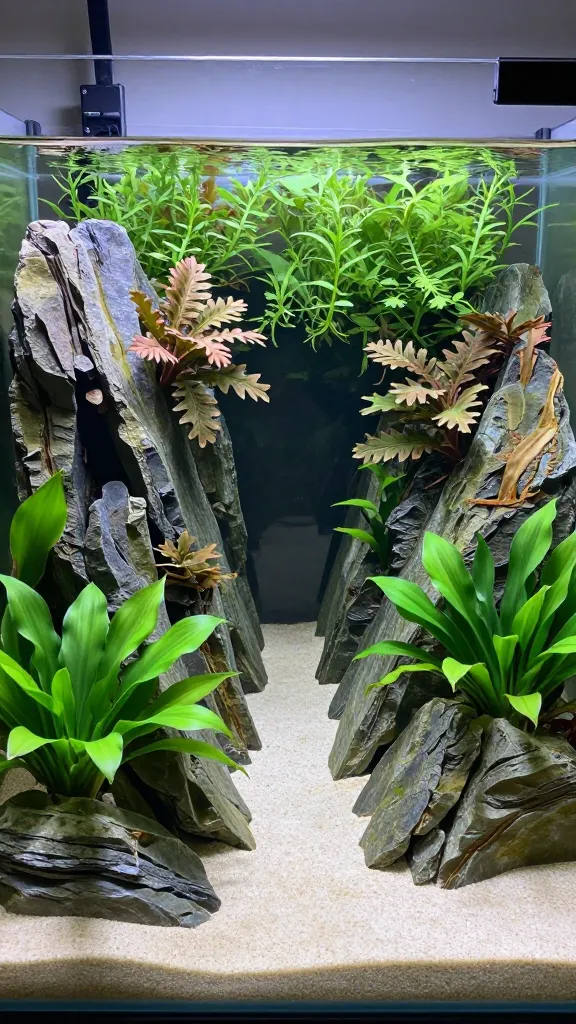
Forced perspective turns a short tank into a landscape by narrowing the floor toward a vanishing point. In a 29-gallon, build two low banks of dragon stone, each no higher than 2/3 of the tank height, with strata leaning toward the center line; leave a 3–4 inch sand path that narrows to 1 inch at the back. Plant the banks heavy to light from front to rear: Cryptocoryne wendtii ‘Green’ at the knees, then Hygrophila pinnatifida mid-bank, and Rotala rotundifolia trimmed fine behind. Keep the path clean and run Eleocharis acicularis mini as a soft fringe. Depth appears by week 6 as stems refine. The miss is parallel banks at equal height — break one ridge and drop three stones on the left to avoid symmetry.
3. The Low-Tech Meadow: Texture Carried by Light and Height, Not CO2

Layered plant heights allow dragon stone texture to stay legible at low energy. In a 15-gallon, set three modest stones — one primary, two subordinates no more than 2/3 its height — and keep them 1 stone’s width apart. Plant a carpet of Micranthemum ‘Monte Carlo’ (M. tweediei) in front, then a mid of Staurogyne repens, with a rear veil of Ludwigia repens pruned to 4–6 inches. No pressurized CO2: rely on consistent light and weekly 30–40% changes. The carpet closes at 8–10 weeks; do not overplant moss on every crevice or the rock reads as fuzzy and the texture you paid for disappears.
4. Dragon Stone Archway: A Gate for Current and Fish Safety
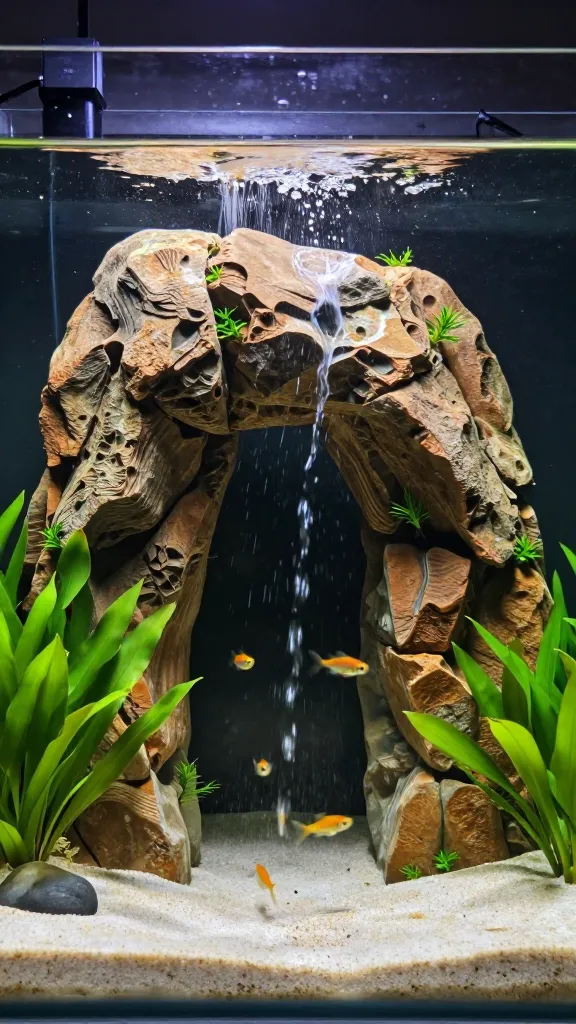
A single passage gives purpose to flow and movement — fish use it, and the layout gains a narrative line. In a 40-gallon breeder, brace two flat-backed dragon stones and cap them with a third to form an arch 1/3 of the tank width; epoxy only if needed for stability and to protect livestock. Keep the floor under the arch open sand; flank with low Cryptocoryne lucens and tuck Anubias barteri var. nana ‘Petite’ into shaded ledges. Aim the filter outflow through the arch to loft particulates and keep the gate clean. If it goes wrong, it’s because the arch is too small and reads as décor — scale it large enough for your largest fish to pass with body length to spare.
5. The Right-Leaning Triad: Direction From Angle, Not Quantity
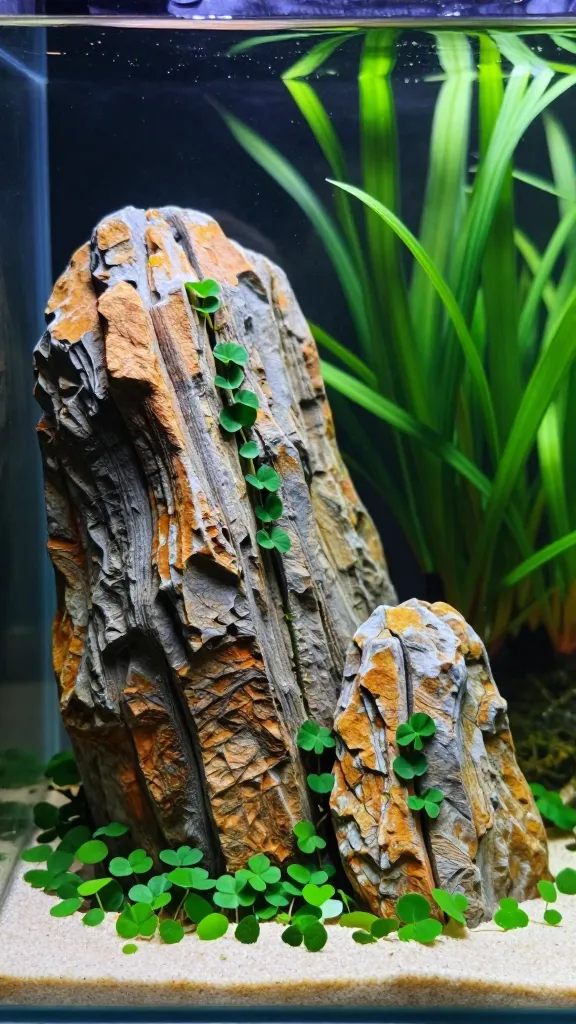
A shared tilt knits separate stones into one gesture. In a 10-gallon standard, use three dragon stones, all strata leaning 10–20° to the right; the main stone 3/4 height, the seconds at 1/2 and 1/3. Bank aquasoil to 2/3 of tank height behind the main stone to set the slope. Plant a light foreground of Hydrocotyle tripartita ‘Japan’ trained low, thread Bucephalandra ‘Green Wavy’ into two fissures, and let Heteranthera zosterifolia run as a movable soft curtain to the rear right. This stabilizes in 6–7 weeks with two trims. Failure shows up as one stone leaning left — reorient it, don’t add a fourth to “fix” the discord.
6. Negative Space Crescent: The Empty Curve That Holds the Eye

A deliberate void is not blankness; it is the form that makes every texture breathe. Shape a crescent of open substrate from front left to rear center in a 20-gallon high; pile dragon stone fragments to trace the outer arc, keeping the inner edge clean and unbroken. Keep plants low and fine: a scatter of Cryptocoryne pygmaea, a perimeter of Hemianthus micranthemoides, and a shaded tuck of Bolbitis heudelotii behind the tallest stone. Vacuum the crescent each water change so it stays a curve, not a blot. When it fails, the curve is interrupted by a token twig or stray stone — remove intruders and honor the empty shape.
7. Dragon Stone Terrace: Steps That Break Vertical Monotony
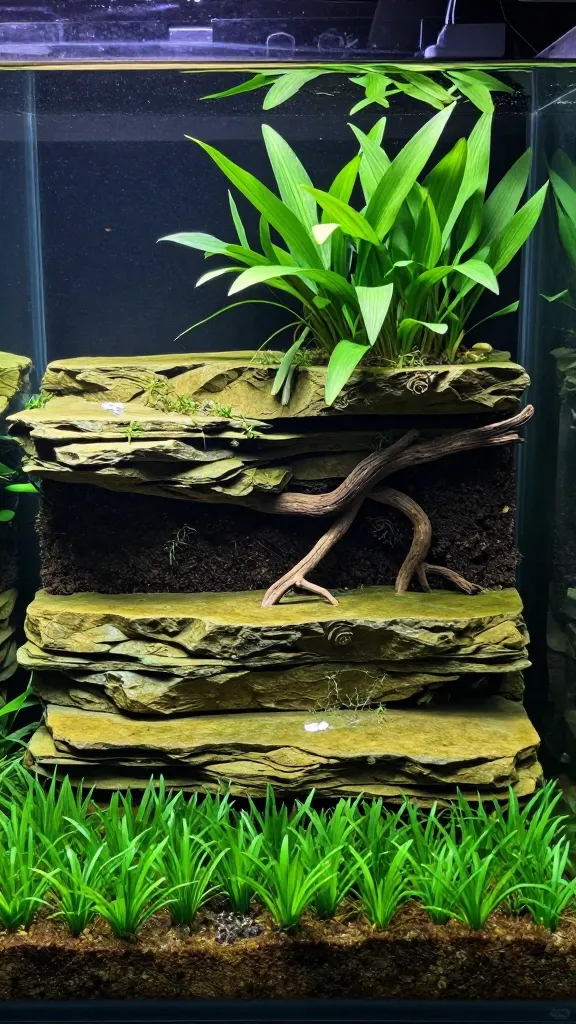
Stepped planes make a short tank read as hillside and give roots a place to live. In a 55-gallon, build 3 terraces from flat dragon stone plates, each step about 2 inches high, the rear tallest at 1/2 tank height; pack aquasoil behind each riser and compact firmly. Plant each level with a distinct leaf size: Sagittaria subulata on the lowest; Cryptocoryne balansae mid; Hygrophila corymbosa ‘Siamensis’ up top. Edge cracks with a thread of Riccardia chamedryfolia to soften but not blanket. Give it 8 weeks to root and resist slumps; skip bottom-feeding diggers until the terraces are set. If it reads like stairs in an office lobby, your risers are too regular — offset heights and break one tread with a wedge.
8. The Sand-and-Soil Border: Clean Foreground Without Sterility
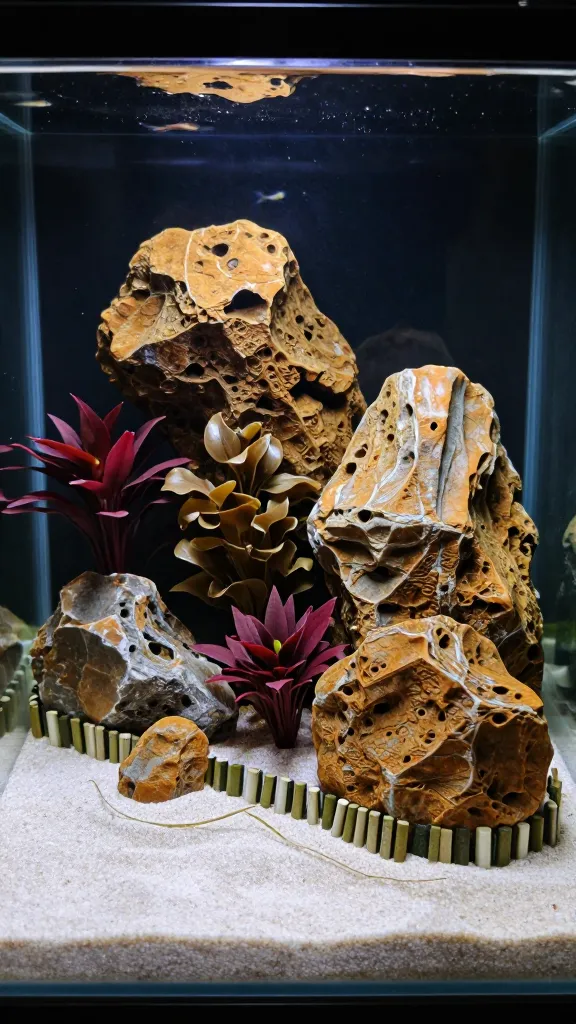
A crisp interface separates texture from softness and keeps the composition legible at a glance. In a 17-gallon, run a 3–4 inch front belt of inert sand; behind it, a slightly mounded aquasoil bed retaining with thin dragon stone slivers set on edge. Plant the soil with Alternanthera reineckii ‘Mini’ in 3–5 stem groups and Cryptocoryne undulata for mid height; let the sand stay unplanted except for a few Vallisneria nana runners artfully allowed over the border. Maintain the border by pinching escapees weekly for the first 6 weeks. The failure is a blurred edge after two trims — reset the slivers and recommit to the line.
9. Fissure Forest: Moss as Patina, Not Carpet
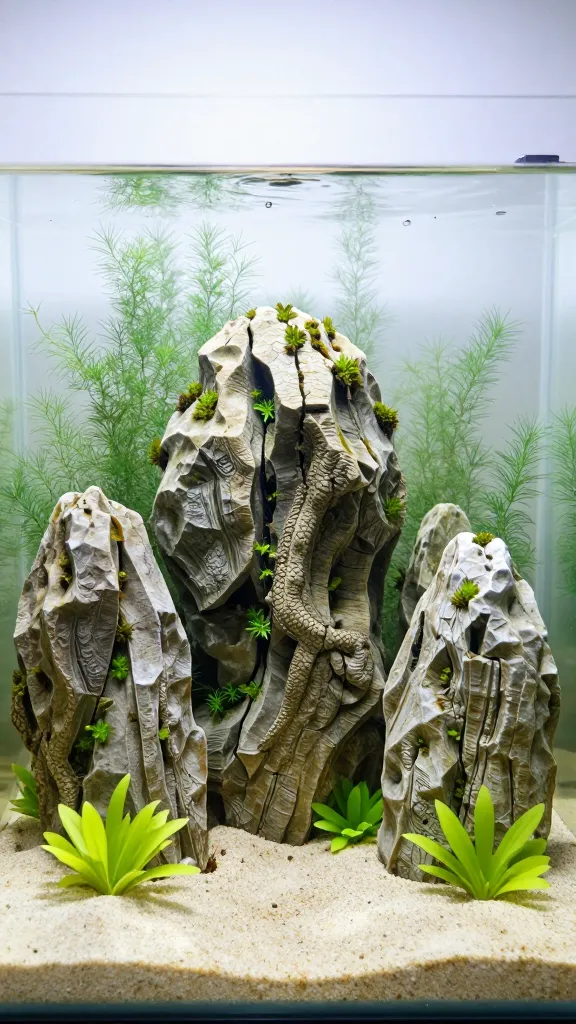
Texture wants a whisper, not a coat — moss should read as age, not upholstery. In a 12-gallon long, pick stones with deep cracks and lodge pea-sized pinches of Taxiphyllum ‘Spiky’ and Riccardia chamedryfolia only into sheltered fissures, leaving 70% of rock bare. Frame with sparse clumps of Cryptocoryne lutea ‘Hobbit’ and a back veil of Myriophyllum mattogrossense trimmed to stay filigree. Mist moss during the first 2 weeks and reduce photoperiod if algae tries the rock. When this goes wrong, everything is green felt — harvest half the moss, expose the stone again, and the scape breathes.
Frequently Asked Questions
How do I keep a dragon stone aquascape from looking messy over time?
Limit textures and keep your negative space deliberate. Use one groundcover, one mid, and one stem group, and defend open sand or path areas with a weekly siphon pass for the first 6 weeks. Trim stems shallow rather than beheading half the tank at once.
Do I need CO2 for these dragon stone layouts?
No, several here are built to run low-tech, though growth and polish arrive slower. Choose forgiving plants like Cryptocoryne parva, Staurogyne repens, and Micranthemum ‘Monte Carlo’, and accept 8–10 weeks for fill-in. Consistent light and 30–40% weekly changes are the lever you control.
How much dragon stone should I buy for a 20-gallon aquascape?
Plan on 1 to 1.5 times the visual volume you expect to use so you can choose shapes, then return or repurpose surplus. For a 20-gallon long, that’s usually 20–30 pounds of mixed sizes, with at least one piece 8–10 inches long for a focal. Lay it out dry and reject anything that creates symmetry you don’t want.
Can I keep shrimp in a dragon stone aquascape?
Yes, the crevices are excellent cover for Neocaridina davidi and other dwarf shrimp. Cycle the tank fully and let biofilm develop 6 weeks before adding them, and avoid sharp tool marks or unstable stacks that could shift. Fine-leaved plants like Hemianthus micranthemoides provide grazing without trapping them.
What’s the best substrate layout under a dragon stone valley?
Use aquasoil for planted banks and an inert sand path for the channel. Retain the soil with thin dragon stone slivers set on edge, backfilled and compacted so the slope holds through maintenance. Keep the sand 3–4 inches wide at the front and narrowing to 1 inch in back to sell depth.
Build the Scene, Then Let It Settle
One focal gesture is enough — every other decision should support, not compete. Tonight, place your largest dragon stone on a towel in the empty tank, tilt it until the strata catch light from your room, and trace with tape the open space you will refuse to fill; the plants and the rest of the rock will answer that line.
Questions about your own scape? Leave them in the comments and I will answer them. — Julian