9 Forest Aquascape Ideas — Scale, Canopy and the Trick of Distance
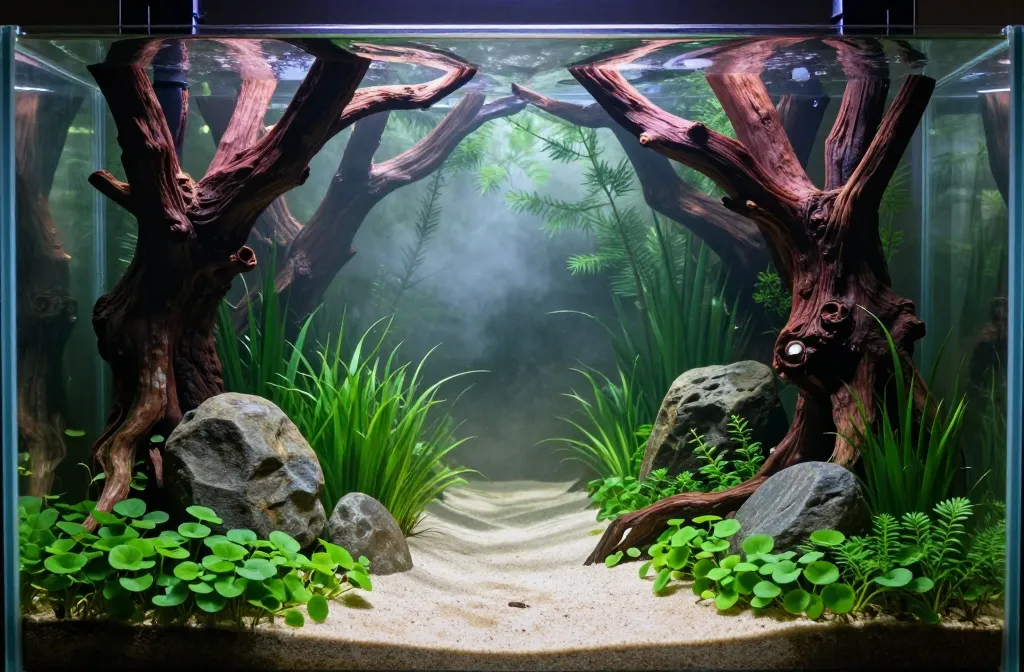
Most forest aquascape ideas fail where scale collapses: stems as thick as trunks, moss too coarse for the “leaf.” The forest aquascape is a study of proportion and negative space that makes 24 inches read like a hillside you could walk into. These nine layouts build depth with canopy, undergrowth, and a believable path for water and fish. By the end you will have chosen a direction, a plant list, and the distances that make your tank feel larger than it is. You will also know how long to let it settle before you judge it.
1. Path Through the Thicket: Depth by Converging Lines
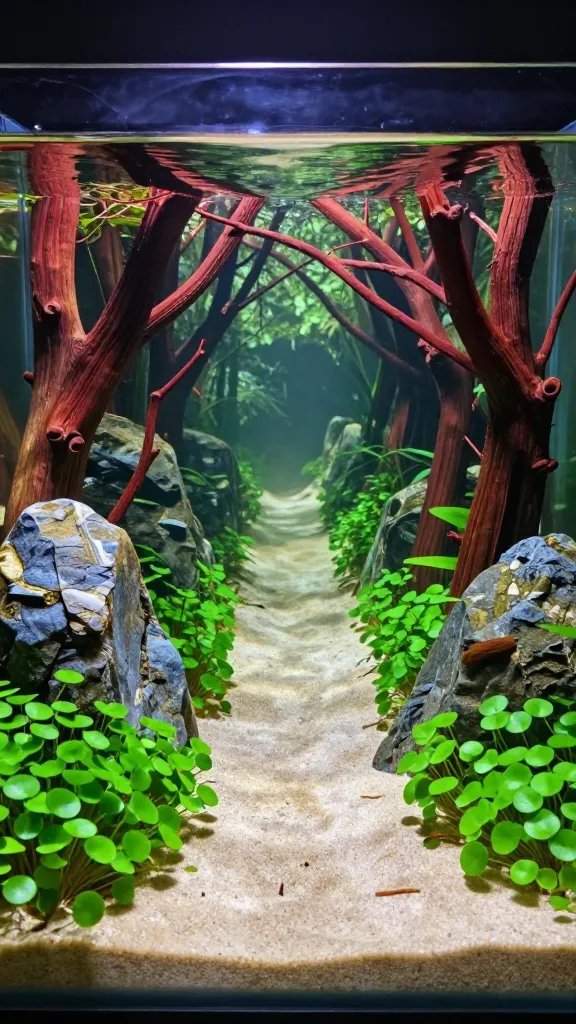
Depth is a trick of lines that narrow as they recede, giving the eye something to follow and a reason to believe the back is far away. Create a sand path that starts at 1/3 of the front width and pinches to less than 1/10 at the rear, with banks of stone and root on either side pulling inward. In a 20-gallon long, use river sand, small Seiryu stone in fist-sized pieces, and a tangle of Red Moor wood. Plant the foreground with Hydrocotyle tripartita clipped low and edge the banks with Staurogyne repens; send the background up with Limnophila sessiliflora trimmed to a fine “cypress” texture. Give it 6 weeks for the banks to knit and the path to stop shedding particles. When this goes wrong, the path runs dead straight and wide, reading as a road instead of a forest track.
2. The Staggered Canopy: Layering Three Heights Without a Wall
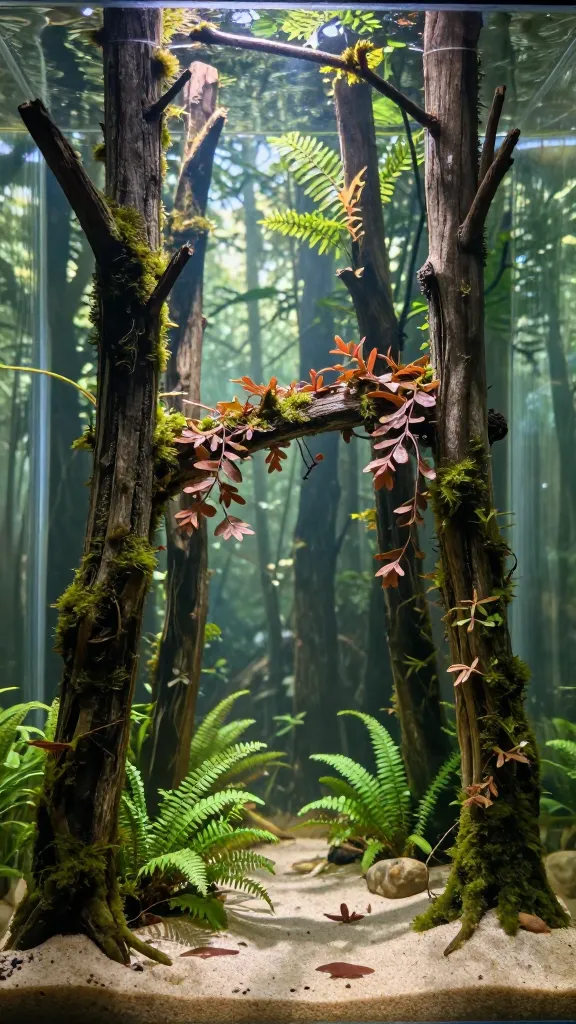
A believable canopy has at least three distinct heights stepping up, with gaps between “trees” where light can fall. In a 29-gallon, set driftwood uprights that top at 2/3 of the water line, then mid-branches at 1/2, with low twigs at 1/3; leave open sky above the tallest by a palm’s width. Grow the trunks with Taxiphyllum barbieri (Java moss) or Taxiphyllum ‘Flame’ tied thinly, and build mid-height with Hygrophila pinnatifida on wood and Microsorum pteropus ‘Trident’ at the base. Background “crowns” are Rotala rotundifolia or Ludwigia repens kept fine by frequent tip trims. Expect 6 weeks before the moss looks like bark rather than tinsel. The failure here is one even hedge of stems at the back — a curtain, not a canopy.
3. Root Spines and Pockets: Framing with Negative Space
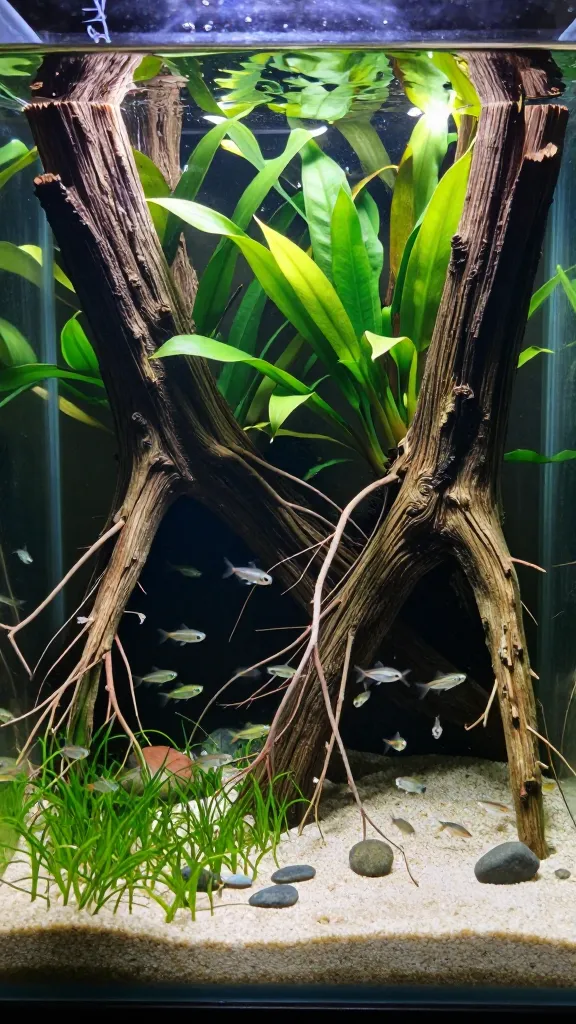
Negative space is not empty; it is the breath between forms that makes the forms legible. Choose two root spines that angle from rear corners toward the front center in a shallow V, leaving a triangular void in front of each root so fish have clear runs. In a 17-gallon, anchor Spider wood so its smallest branches sweep forward, and build planting “pockets” behind the spines with Cryptocoryne wendtii ‘Green’ and Cryptocoryne lutea, then soften the front voids with a sparse lawn of Helanthium tenellum. Keep the negative space at least 1/5 of the footprint unplanted. Give it 6 weeks for crypts to root and stop melting. When it fails, every pocket gets filled and the scape turns into a hedge where fish can’t move or be seen.
4. Micro-Leaf Palette: Scale the “Leaves” to the Tank

Scale is carried by leaf size more than by color; small leaves read as distant foliage and keep trunks feeling tall. In a 10- to 15-gallon low-tech tank, choose only small-texture plants: Hemianthus micranthemoides (Pearl weed) for soft shrubs, Gratiola viscidula or Bacopa caroliniana ‘Baby’ for slightly broader “saplings,” and Taxiphyllum ‘Christmas’ tied thin on twigs for boughs. Use Eleocharis acicularis (dwarf hairgrass) in a 3-inch-deep swale as the ground layer, broken by two thumbnail-sized Ohko stone clusters. With weekly trims, this reads as an airy glade in 6 weeks. The failure is the temptation to add a single large-leaf Anubias barteri, which collapses the illusion by shouting its true scale.
5. The Dry Riverbed: Flow Direction Without Current
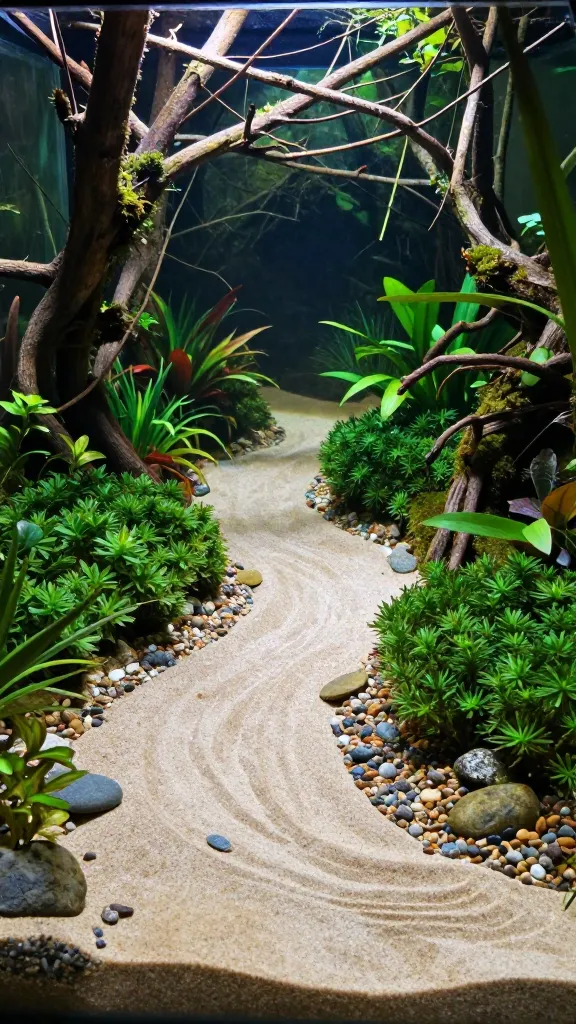
Movement is composed with diagonals and repeated texture, letting the viewer sense where water would go even when the filter is off. Lay a “dry” riverbed of light sand that cuts from a back corner to the front opposite, curving in an S and narrowing by 2/3 as it recedes. Line it with mixed pea gravel and thumb-sized Dragon stone, and plant drifts of Bolbitis heudelotii and Cryptocoryne papua ‘Hobbit’ leaning toward the flow. On the outer bends, use Hygrophila corymbosa ‘Compact’ trimmed low like storm-bent shrubs. Let fine sand settle for 6 weeks before adding any digging fish. When this misses, the river is centered and symmetrical, killing the sense of direction.
6. Shadowed Understory: Contrast by Light and Density

Forests read as layered because some places are dense and shaded while others are sparse and bright; contrast is the editor that tells the story. In a 40-gallon breeder, build one heavy, shaded quarter using intertwined Manzanita and dense mats of Vesicularia montagnei (Christmas moss), then keep the opposing front quarter open with just a skim of Marsilea hirsuta. Midground “bushes” of Cryptocoryne nurii and a lacy stand of Myriophyllum mattogrossense rise into the bright zone. Run light for 7 hours and resist filling the open area; in 6 weeks the plants will tell you where the shadow lives. Overplanting the bright side is the common failure — you end up with even light and no forest mood.
7. Trunks First, Plants Follow: Hardscape Sets the Story

Composition that starts with structure and invites plants to serve it will stay legible after six months of growth. In a 60-gallon, commit to five to seven primary “trunks” of Asia root or Red Moor set at varying tilts, all pointing to a single vanishing point 3/4 up the back panel. Only once the trunks are stable do you add epiphytes: sparse pads of Bucephalandra ‘Green Wavy’, tips of Hygrophila pinnatifida on the shaded wood, and Microsorum pteropus ‘Narrow’ at the bases. Ground is a quiet mix: Cryptocoryne parva and Littorella uniflora. Expect 6 weeks for root biofilm to settle and epiphytes to throw new leaves. Overgrown or collapsing scapes usually started with plants trying to create structure they cannot hold.
8. Forest Aquascape On Tap Water: Low-Tech, Stable, Lived-In

Stability is an aesthetic; slow-grown textures and patient trims read as a mature woodland more convincingly than fast red stems under high gas. Use inert sand-and-gravel substrate with root tabs, moderate light, and no CO2 in a 20- to 40-gallon. Choose tough species that thrive in ordinary tap: Java fern (Microsorum pteropus), Anubias barteri var. nana, Cryptocoryne wendtii, Vallisneria spiralis as distant reeds, and Taxiphyllum barbieri for bark. Add shrimp and small schooling fish only after the tank is cycled and 6 weeks of plant growth have steadied nutrients. The failure is chasing bright colors with demanding stems that stunt, forcing you into weekly rescapes rather than slow editing.
9. The Far Ridge: Forced Perspective with Scale Shift
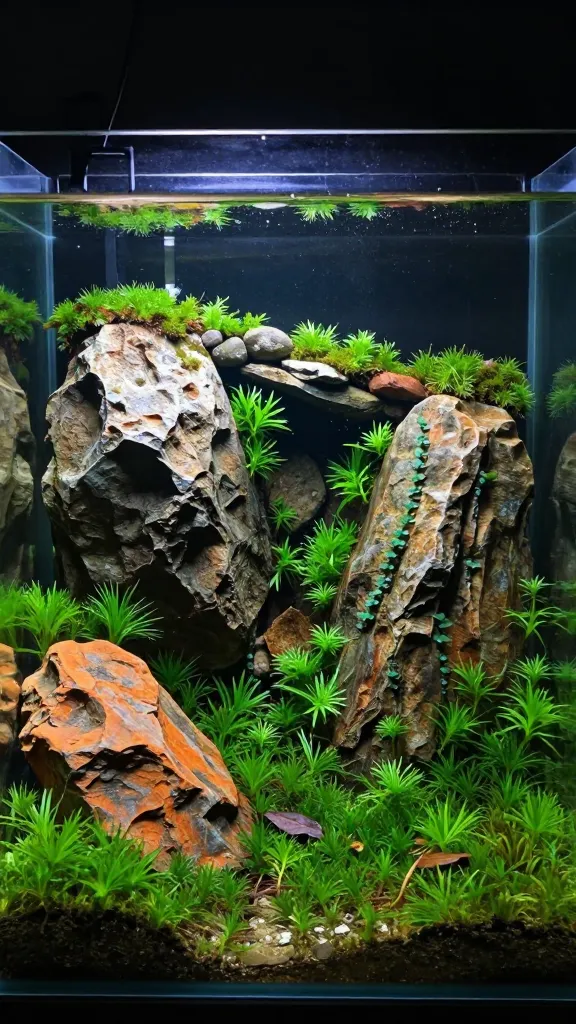
Forced perspective asks the back to be smaller in every way — shorter hardscape, finer texture, and tighter spacing — so the brain reads distance. In a 30-inch tank, keep front “boulders” at orange size, then halve stone size each 8 inches toward the rear until the last are grape-sized; mirror that with plant choice: Staurogyne repens in front, then Hemianthus micranthemoides, and finally a combed line of Riccardia chamedryfolia glued to the smallest stones. Cap it with a low ridge of Dragon stone 2/3 height at the back. Give yourself 6 weeks of trims to keep the back the tightest texture in the tank. If the rear grows coarser than the front, the illusion collapses and the tank feels shorter than it is.
Frequently Asked Questions
How long does a forest aquascape take to look settled?
Plan on 6 weeks before judging the layout. Moss needs that time to anchor, crypts to root, and fine stems to respond to the first trims that shape them. During that period, keep light consistent and resist filling empty spaces just because they are empty.
Can I build these layouts without CO2?
Yes, several of these are written for low-tech tanks, provided you choose species that thrive without gas. Use Microsorum pteropus, Anubias barteri var. nana, Cryptocoryne wendtii, and Taxiphyllum barbieri, and keep photoperiods near 7 hours. Growth will be slower, which suits a forest mood.
What fish suit a forest layout and its paths?
Pick small, calm schooling species that won’t uproot the banks or churn the sand. Trigonostigma heteromorpha (harlequin rasbora), Hyphessobrycon amandae (ember tetra), and Boraras brigittae (chili rasbora) move beautifully along narrow runs; add shrimp only after cycling and algae balance has stabilized for 6 weeks. Avoid large corydoras or loaches if your path is fine sand you want to keep crisp.
How do I choose stone and wood for a forest aquascape?
Choose wood with natural taper and branching that suggests trunks and boughs, then stone with textures that can pass as outcrops or banks. Red Moor or Manzanita give you height and twig detail; Dragon stone and Seiryu stone read as weathered rock. Keep stone sizes scaled—largest up front, grape-sized at the back—for the trick of distance.
Why does my layout still look flat after planting?
Flatness usually comes from even heights and identical textures front to back. Reintroduce contrast: drop one front zone to 1/3 tank height, trim a bright “window” through the stems, and thin moss on the rear wood so the finest textures are at the distance. Maintain the narrowing of paths and reduce rear plant spacing to 1 inch.
The Patience That Makes Distance Real
Depth is earned by restraint: smaller leaves at the back, open space where the eye can rest, and a canopy that lets light fall where life moves. Tonight, stand at the glass and choose one thing to remove — a path widened by 1/2 inch, a hedge broken into two clumps, or a rear stem trimmed finer — and then give it 6 weeks to tell you what the next cut should be.
Questions about your own scape? Leave them in the comments and I will answer them. — Julian