9 Mini Paludarium Ideas — Land and Water Under 10 Gallons

Mini paludarium ideas live or die on physical limits: under 10 gallons, every inch of land displaces water and every feature changes humidity and flow. These mini paludarium ideas will help you specify water depth, flow rate, lighting, and safe livestock before you buy a single part. By the end, you will know what volume you need for a shallow stream versus a still pool, how to size a tiny pump without blasting shrimp, and which plants thrive at 90–100% humidity versus 70–80%. I ran a 6-gallon and an 8-gallon side by side for 8 weeks to compare flow paths and humidity retention with and without a lid. The patterns are consistent and worth your planning.
1. Shelf-and-Runoff: Gravity Makes a Creek in 6–8 Gallons

Water falling over a lip oxygenates because it breaks into thin films and droplets, massively increasing surface area for gas exchange before it re-collects. A simple foam-clay or lava rock shelf at 3–4 inches above the water line lets you run a shallow rill across the land and back into the pool. Target 20–40 GPH on a micro pump with a 1/4-inch return, and choke it with a valve until the stream just barely sheets over the ledge. This gives enough circulation to avoid stale corners without battering shrimp or small fish. The limit is splash loss: with an open top you can lose 150–250 mL/day; use a fitted lid or raise the lip to reduce wicking down the glass.
2. Wabi-Kusa Dome: Humidity-Loving Stems, Still Water at 2–3 Inches
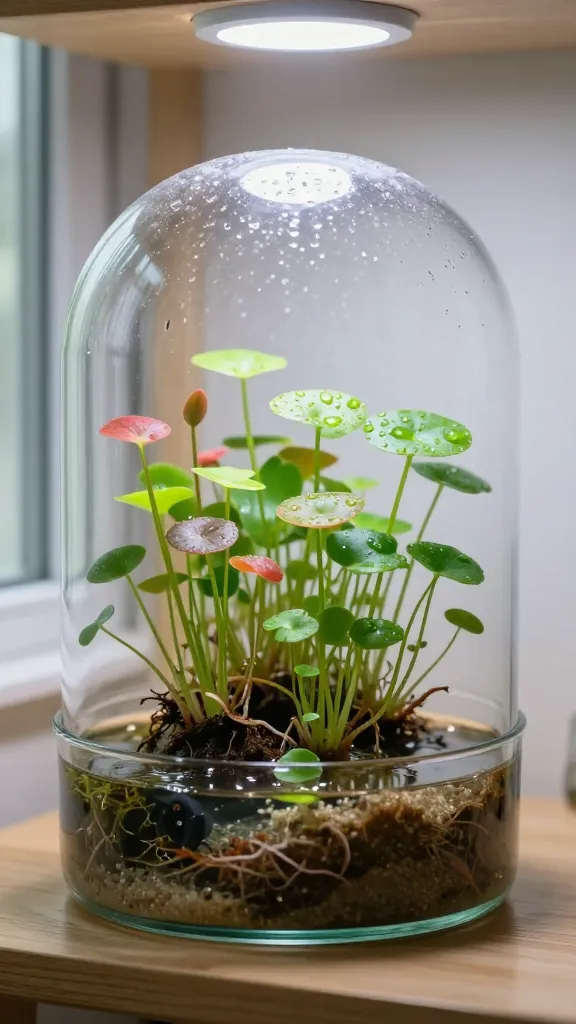
Emergent stems transpire, and in a small volume that moisture saturates a closed airspace, stabilizing humidity near the plants while the pool below stays calm. A shallow water plate at 2–3 inches depth with a hemispherical plastic dome or tight lid builds a warm fog layer plants can use to root and leaf above water. Run no pump or a micro-circulation wheel at 5–10 GPH to keep the pool from going anoxic; you’ll see film if you’re too still. This layout shines for Hygrophila, Rotala, and Hydrocotyle clumps pressed into a moss ball. The constraint is gas build-up: crack the lid daily for 30 seconds or CO2 can accumulate and stall growth in low-light hours.
3. Vertical Backwall with Matala or Egg Crate: Capillary Wicking, Not Waterfalls

Capillary action pulls water upward through porous sheets, distributing moisture evenly without the turbulent drop of a fall. A 1/2-inch foam mat or egg crate wrapped in polyester mesh set against the back wall will wick from a raised pickup and weir, keeping mosses and Selaginella uniformly damp. Feed the wall with 15–25 GPH through a spray bar pointed into the sheet; the water returns as a thin veil that barely disturbs the pool. This keeps humidity high at the wall face and deters algae by avoiding splash-lit droplets. The failure mode is channeling: if the sheet tilts, water finds one path and dries the rest — shim it level and clean biofilm monthly in old tank water.
4. Sandbar Estuary: Diffusion Wins in 3–5 Inches with Gentle Crossflow

Fine sand slows water penetration so nutrients diffuse upward slowly, mimicking tidal flats where roots can breathe at the surface while toes stay moist. Build a 1–1.5 inch sand tongue into 3–5 inches of water, with a 1/2-inch underlay of coarse gravel on the pool side so water can circulate around it. Aim a micro pump across the front glass at 15–20 GPH to skim the surface without carving the bar. This creates a stable, low-shear edge for Cryptocoryne, dwarf Sagittaria, and emersed Echinodorus runners. The limit is compaction: stir the outer 1/4 inch monthly with a chopstick or you’ll trap pockets that go sulfide and stain the sand black.
5. Foam Island Rafts: Buoyancy Keeps Roots Wet, Leaves Dry
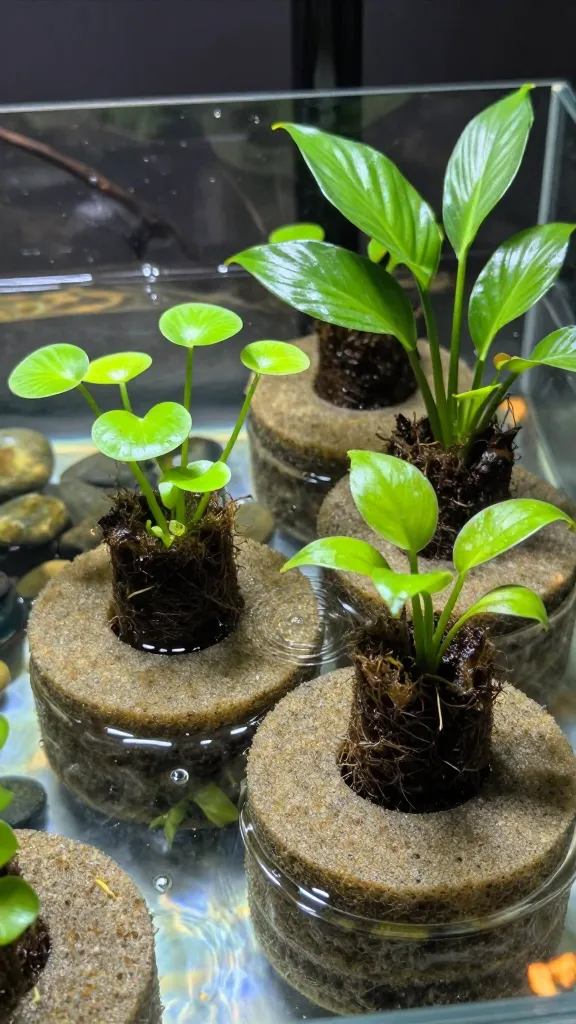
Closed-cell foam floats because it displaces water with trapped air, keeping the planting medium perched at the air–water interface where gas exchange is constant. Cut 1/2–3/4 inch foam discs and bore 1–1.25 inch sockets for rockwool or coir plugs; the plugs wick from beneath while crowns stay out of splash. In 5–8 gallons, a slow circular current at 10–15 GPH keeps rafts from parking in corners and ensures even nutrient exposure. This is perfect for Pistia dwarf rosettes, baby peace lilies, and Pilea. The drawback is shading: more than 50% coverage will starve submergent plants — keep raft area under 40% of the surface or increase light accordingly.
6. Micro Paludarium Filter Choice: Air-Lift vs. Micro-Pump

Air-lift filters move water by buoyant air columns, which are gentle and oxygenate well; micro-pumps move by impeller, which is directed and stronger per watt but can shred small fauna if un-screened. In volumes under 10 gallons with partial land, an air-driven sponge sized for 2× the remaining water volume gives robust biofiltration without point jets, while a micro-pump provides placement flexibility for rills and walls. I ran both on identical 6-gallon water sections for 6 weeks; the air-lift held higher dissolved oxygen at the same turnover. My view: for mixed-life mini paludaria, the air-lift as the primary biofilter plus a throttled micro-pump for features is the most forgiving balance. The limit is head pressure — air-lifts won’t push water up a backwall; use the pump only for that duty and guard its intake with 40–60 PPI foam.
7. Lighting the Split World: PAR Targets for Emergent and Submerged Zones
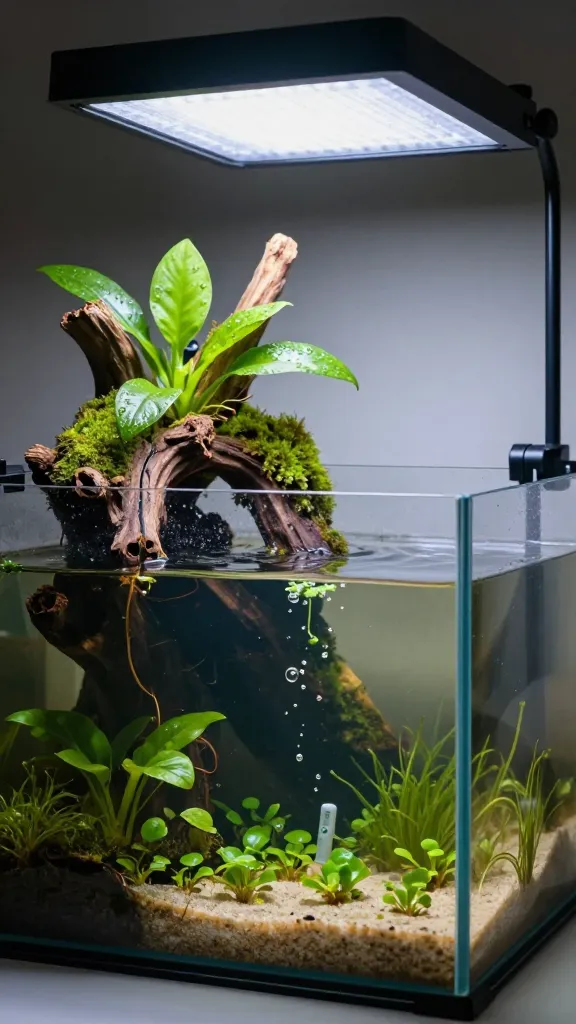
Light attenuates in water exponentially, so a beam strong enough for carpet plants at depth can bleach moss 2 inches from the diode when emersed. In a mini paludarium, set emergent targets at 50–100 µmol m⁻² s⁻¹ PAR at the leaf surface and submerged targets at the substrate between 30–60 µmol m⁻² s⁻¹. That typically means a 6–12 inch mount height and 6–8 hour photoperiod to start, with a diffuser or frosted lid to soften hotspots near the land. This supports Bucephalandra, Anubias, and mosses creeping from water to land without algae explosions. The constraint is spectrum heat on a closed top: check temperature — you want 72–78°F stable; raise the fixture if you gain more than 2°F during the light cycle.
8. Stocking Under 10 Gallons: Bioload vs. Gas Exchange, Not Just Inches

In split habitats, land reduces water surface area, and gas exchange scales with that surface, not just with total gallons. A tank that’s “8 gallons” on paper may have only 5–6 gallons of water and 60% of the open surface after hardscape. Keep permanent swimmers modest: a single Betta splendens, or a group of 8–10 Neocaridina shrimp, or 10–12 Endler’s livebearers if the water section is a full 8–10 gallons with strong surface movement. All must go into a fully cycled system with 0 ppm ammonia and nitrite and <0.25 ppm nitrate spikes during the first week after any change. The honest limit: frogs and tiny geckos add terrestrial waste the filter still must process — do not mix them with fish in under 10 gallons; pick aquatic life or a single small terrestrial species with springtails and isopods.
9. Substrate Stack for Land Sections: Wicking Layer, Barrier, Plant Mix

Water climbs via capillarity through fine pores until gravity counters it; stacking layers lets you control how high and how wet the land stays. Start with a 1–1.5 inch base of LECA or coarse lava for drainage, add a non-woven geotextile to stop fines, then 1.5–2 inches of a 1:1 mix of sifted coco and mineral soil. This holds a perched water table at roughly 0.5–1 inch above the barrier, keeping fern and moss roots damp without turning the surface anaerobic. In a small build, keep the land footprint under 60% of the floor area or you will starve the water section of circulation paths. The failure mode is seepage through the front seam — slope the topsoil back 5–10° and face edges with rock to break capillary creep on the glass.
Frequently Asked Questions
How many fish can a mini paludarium under 10 gallons safely hold?
Think in water volume and surface area, not the display’s total size. If hardscape and land leave you 6 gallons of water with 70% open surface, cap it at a single Betta or a small group of 8–10 shrimp, or skip fish entirely and enjoy inverts and snails. You need visible surface agitation and 0 ppm ammonia and nitrite before stocking; test daily the first week after adding life.
Do I need a filter in a mini paludarium, or will plants handle it?
You still need biological filtration because plant uptake is slower than the rate ammonia becomes toxic. A small air-driven sponge or a micro-pump feeding a biomedia chamber turning the water section 4–6× per hour is appropriate; throttle flow for gentle features. Plants and moss help, but they do not replace nitrifying bacteria in the first 4–6 weeks.
What lighting is best for mini paludariums with both land and water?
Use a light that can deliver about 50–100 µmol m⁻² s⁻¹ PAR over emergent leaves and 30–60 µmol m⁻² s⁻¹ at the submerged substrate. Mount it 6–12 inches above the highest land and run 6–8 hours at first to avoid algae, adjusting by plant response. A diffuser or a frosted lid evens out hotspots near the land edge.
How do I keep humidity high without fogging the glass constantly?
Seal the top and control air exchange rather than spraying more water. A tight lid with a 2–4 mm vent gap and a gentle internal flow of 10–20 GPH keeps vapor circulating and reduces condensation streaks on the viewing pane. Warm room air on the outside and slightly cooler water inside causes fog; matching temperatures within 1–2°F helps clear the view.
Can a mini paludarium house frogs or reptiles with fish?
Not safely in under 10 gallons. Terrestrial animals produce waste that still ends up in the water, and the small volume cannot buffer sudden spikes; mixing also risks predation or stress. If you keep a micro frog or a tiny gecko, skip fish and support cleanup crews (springtails, isopods) and maintain water at 72–78°F for plant health without inviting aquatic stock.
Measure Flow, Then Shape the Land
Under 10 gallons, the governing number is gentle turnover: set total water movement at 4–6× per hour, then build your land to suit that path instead of fighting it. Tonight, time your return: with a measuring cup, catch the outflow for 30 seconds and double it — if you are under spec, throttle features or upsize the pump before you add life.
Questions about your own setup? Leave them in the comments and I will work through them. — Nate