9 Paludarium Waterfall Builds — Pumps, Head Height and Splash Control
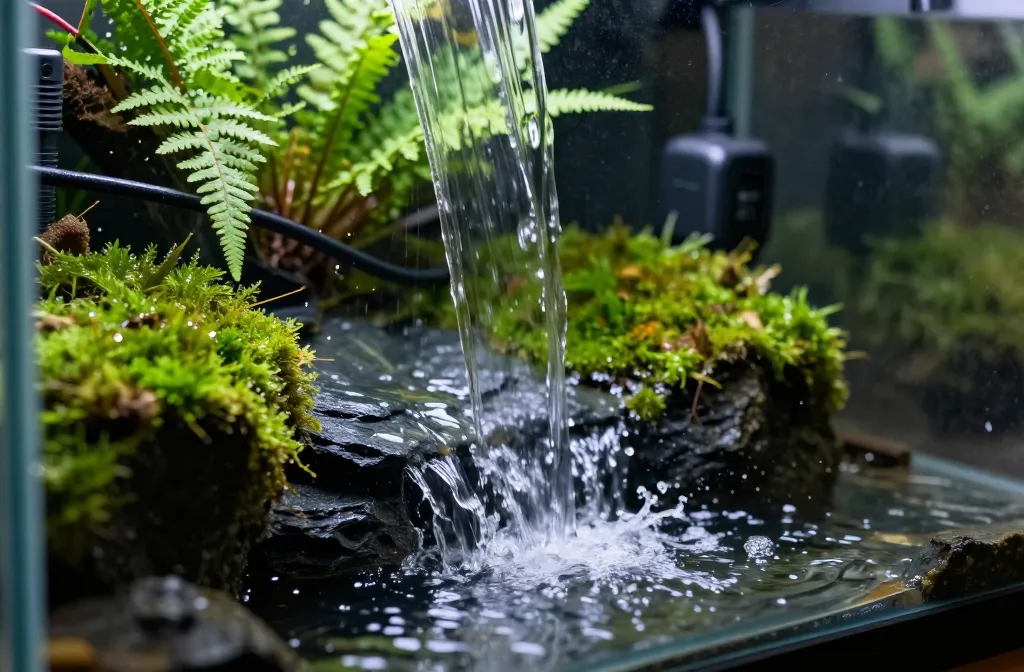
Most paludarium waterfall builds fail on head height: the pump that looks strong in a bucket collapses once it has to push water up 24 inches. The right pump, tubing, and return path make the difference between a gentle sheet and a noisy splash zone. By the end of this guide you will be able to specify pump flow at your actual head height, match tubing to that flow, set intake and spillway geometry, and keep water inside the glass. I ran two waterfalls on identical 20-gallon talls for 6 weeks to measure loss from head and elbows, and the quiet build moved less water on paper but delivered more to the top.
1. Pump Sizing by Head Curve: Flow at 24–36 Inches, Not on the Box
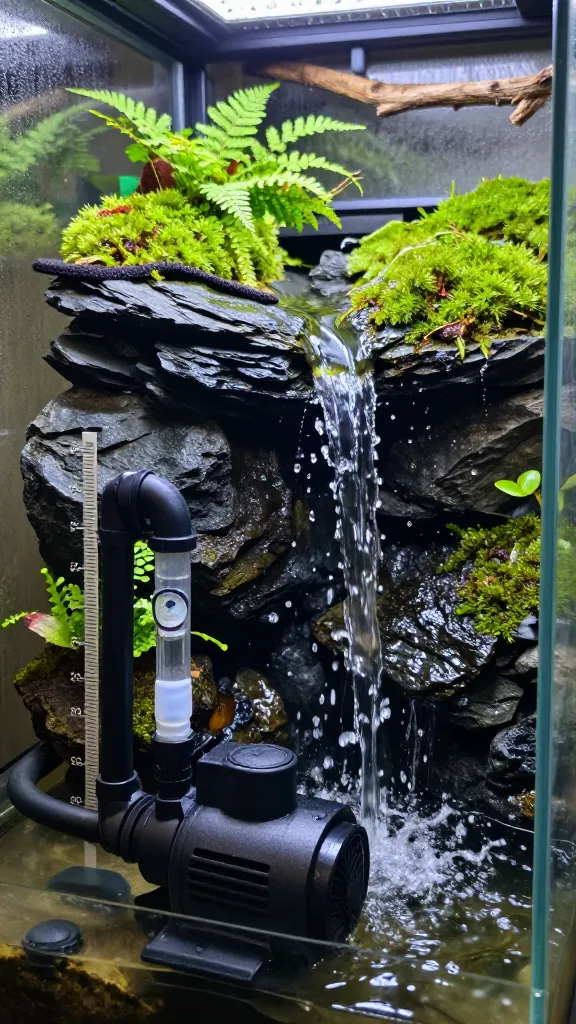
As water rises, pressure increases linearly with height, and a centrifugal pump’s flow falls along its head curve until it reaches zero at the shutoff head. That is why a “200 GPH” pond pump may deliver under 90 GPH at 30 inches once you add tubing and elbows. Choose by the flow you need at your real lift: for a small sheet waterfall, target 80–150 GPH at 24–36 inches; for a trickle over moss, 30–60 GPH at 18–24 inches. Read the pump’s chart and pick a model whose curve shows that flow at your measured head. Oversizing and throttling with a valve is fine; undersizing gives air-gulping noise and dry patches within a day as evaporation raises the head slightly.
2. Tubing Diameter and Losses: Friction Eats Flow Long Before Gravity Does

Water loses pressure to friction along tubing walls, and the loss increases sharply as the bore gets smaller and as flow rises. A 90 GPH stream through 3/8-inch ID tubing can lose more than half its pressure over 4 feet, while 1/2-inch ID drops only a fraction over the same run. Match tubing to the target flow and length: for under 60 GPH, 3/8-inch ID works to 3 feet; for 60–180 GPH, 1/2-inch ID is safer up to 5 feet. Use gentle sweeps instead of hard 90° elbows, which can act like several feet of extra pipe. Too-narrow lines create hiss, microbubbles, and a starving top spillway that breaks into droplets.
3. Paludarium Return Path: Sheet Falls Need a Lip; Trickle Falls Need Texture

Water clings to surfaces via cohesion and adhesion. A clean, thin lip encourages a continuous sheet; a rough, irregular face breaks flow into rivulets that soak moss and ferns. For a quiet sheet, build a level weir with a 2–4 mm sharp lip set back 1/8 inch from the facade, then lead onto a smooth slate. For a trickle, stack porous rock or lava with 3–6 mm gaps and overhangs to split the stream. Mix both and you get both sounds, but also more splash; decide first, then shape the spillway. If the lip is rounded or the rock face is angled out, water will leap and atomize, wetting glass and lights.
4. Intake Strainers and Sumps: Keep the Pump Wet Through Evaporation Swings

Pumps cool and lubricate themselves with the water they move; when the intake starves, they overheat and cavitate, making rattly bubbles that shred impellers over weeks. In a paludarium, evaporation changes water level faster than aquaria—especially with fans or warm lights. Place the pump in the lowest basin or a rear sump that remains submerged as the display drops, and add a coarse 20–30 ppi foam block over the intake to catch leaves. Design the reservoir so the pump still has at least 1 inch of water over its intake at your worst daily drop. A shallow pocket or tight corner turns a normal 2-day top-off lapse into a burnt pump.
5. Flow Control Valves and Bypass Loops: Dial Down Without Straining the Motor
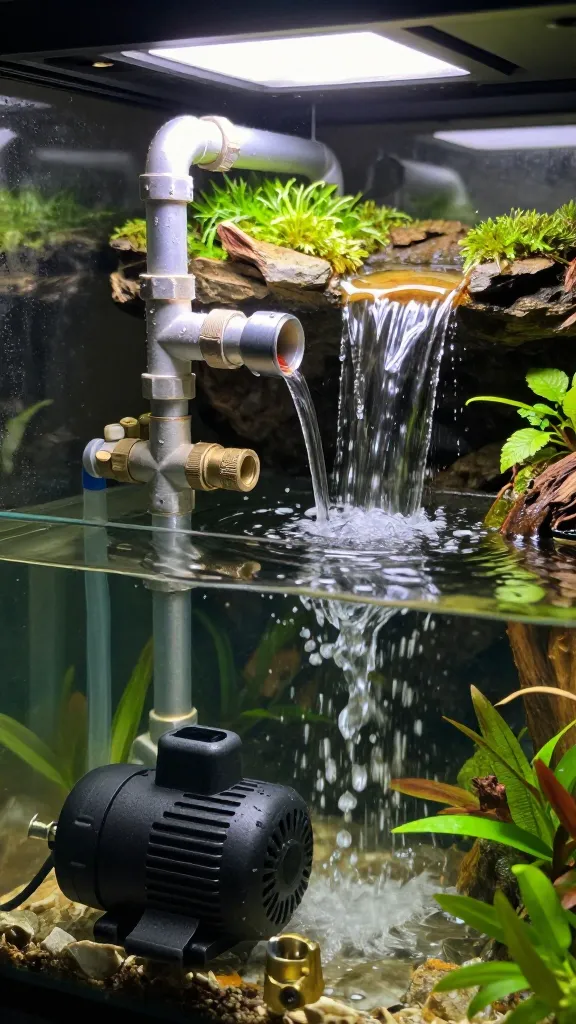
Restricting the outlet raises backpressure; most small centrifugal pumps tolerate this, but the flow‑pressure balance shifts, and heat goes up slightly. A bypass loop sends excess flow back to the basin, which maintains the pump near its efficient point while setting display flow precisely. Install a tee and a ball valve near the pump, with the bypass returning below the waterline, and use a second valve on the feed to the falls. Set the display to your target sheet and crack the bypass until the pump runs quiet. Closing a valve on the only outlet to “make it gentle” can push you near shutoff head, encouraging cavitation if the intake clogs by even 20%.
6. Splash Management With Drop Height and Catch Width: Keep Water Inside the Glass
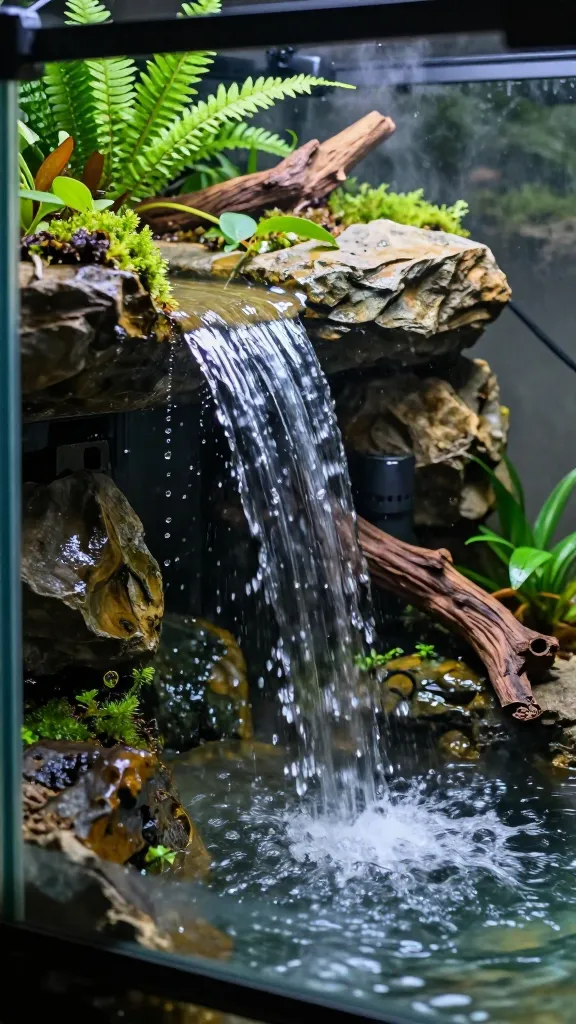
Falling water accelerates under gravity, and impact energy increases with height, so droplets rebound further as the drop grows. Airflow from fans and warm rising air pushes mist sideways. Limit the free fall: for a sheet, keep the air gap to under 2 inches before it meets the next ledge; for a trickle, let it contact rock within 1 inch. Make the catch pool or ledge at least 1.5× the width of the fall with a slight inward tilt. Place plants 1–2 inches back from the edge to intercept stray droplets. Taller, open plunges are beautiful but will wet front glass, wick down cords, and drop tank volume by cups per day in evaporation.
7. Biofilm, Tannins, and Flow Decay: Expect 10–30% Slower Water After 2–3 Weeks

Microbial biofilm builds on every wet surface, increasing surface roughness and narrowing channels; plant exudates and wood tannins add viscosity and stain foam. That friction steals flow even if the pump is unchanged. Plan maintenance into the build: rinse the intake foam and spillway lip every 2 weeks and flush tubing every 4–6 weeks. Size your pump so that a 20% loss still gives your minimum acceptable look. Ignoring this drift is why a sheet that started full becomes stringy by day 21, and why a borderline pump seems to “wear out” when the plumbing is the real throttle.
8. Electrical and Heat: Watts Become Warmth in a Closed Cabinet
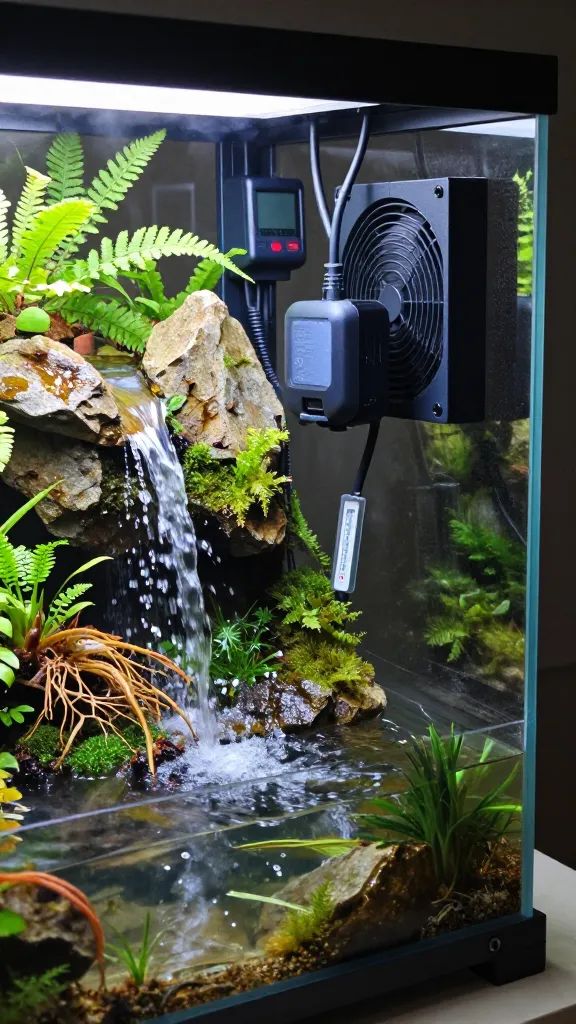
All the electrical power a submersible pump draws ends up as heat in the water and nearby air. In a tight paludarium stand, even a small increase in watts can raise water temperature several degrees over 24 hours. For temperate builds, cap pump draw at 3–5 watts per 10 gallons of total circulating volume; for tropical species tolerating warmer water, up to 7 watts per 10 gallons is usually safe if ventilation is good. Check the nameplate for wattage and verify with a plug-in meter if you’re packing multiple devices. Overheating shows up first as plants wilting near the splash and animals hugging the lowest, coolest water.
9. Auto Top-Off and Makeup Water: Stability Beats Big Refills

As water evaporates, salinity isn’t a concern in fresh paludaria, but head height and pump submergence change, altering both noise and flow. Small, frequent additions keep the display consistent. Use an optical or float-style top-off to add 0.1–0.3 gallons at a time, or mark a daily manual top-off line and add the same volume each evening. Always use dechlorinated water at room temperature within ±2°F of the system to avoid stressing amphibians and fish that use the pool. Big, weekly dumps swing levels, raise splash, and can flood the bypass return if it’s set close to the rim.
Frequently Asked Questions
How do I size a paludarium waterfall pump for 30 inches of head?
Find the pump’s flow at 30 inches on its head curve and pick the model that delivers your target there, not the free-flow number. For a narrow sheet, aim for 80–120 GPH at 30 inches; for a light trickle over moss, 30–60 GPH at 24–30 inches. Add a bypass loop so you can fine-tune without stressing the pump.
What tubing size should I use for a 100 GPH paludarium waterfall?
Use 1/2-inch ID tubing for 100 GPH over a 3–5 foot run to keep friction losses low. Smaller 3/8-inch ID will choke the line and can cut effective flow by more than a third once elbows and biofilm add resistance. Gentle bends beat hard 90° fittings for preserving pressure.
Why is my waterfall getting weaker after a few weeks?
Biofilm and debris increase friction in tubing and across the spillway, trimming flow by 10–30% in 2–3 weeks. Rinse the intake foam and wipe the lip every 2 weeks, and flush tubing monthly. Also check the water level; another inch of head from evaporation can push a marginal pump below your target flow.
How do I stop splash from hitting the paludarium glass and lights?
Shorten the free-fall distance and widen the catch. Keep sheets within 2 inches of the next surface, set a sharp lip, and make the catch ledge at least 1.5× the fall width with a slight inward tilt. Reduce cross-breeze from fans near the drop, which blows mist sideways.
Can I run fish or shrimp in the pool under a paludarium waterfall?
Yes, but match species to flow and temperature, and cycle first. Small fish like white cloud mountain minnows (Tanichthys albonubes, adult 1.5 inches) and Neocaridina shrimp handle moderate flow if areas of under 3 inches/second velocity exist and temperature stays within their range. Cover intakes with 20–30 ppi foam to prevent entrainment.
Build to the Head You Actually Have
Your governing number is the flow at your measured head, not the free-flow on the box; everything else—tubing, lip, and catch—serves that. Tonight, measure from the pump intake to the spillway lip in inches, note the tubing diameter you’re using, and watch how far droplets travel beyond the catch ledge for 10 seconds.
Questions about your own setup? Leave them in the comments and I will work through them. — Nate