8 Desktop Mini Aquascapes — Scapes Built for Eye Level

Most desktop mini aquascapes fail at eye level because the forms are fussy up close and unreadable from where you sit. These eight desktop mini aquascapes keep scale, growth, and viewing height in mind so you can choose a layout that stays legible at 12 to 24 inches. By the end, you’ll know which composition belongs on your desk, what lives in it, and how long it needs to settle before you judge it. You will build for the animals first, and the shape will follow from that choice.
1. The Island Mound: A Quiet Center With Negative Space Around It

The eye needs a place to rest, and on a desk that place should sit just off-center with a generous belt of open water around it. In a 5 to 10 gallon (16 to 20 inches long) tank, build a low mound from dark lava rock and inert sand so that the island occupies 2/3 of the length and 1/2 the depth, leaving a clear perimeter. Plant the mound with small-leaf textures: Anubias barteri var. nana ‘Petite’, Bucephalandra varieties, and a skirt of Cryptocoryne parva; keep the sand plain. Give it 6 weeks for the roots to knit and for the perimeter to read as calm water. When this goes wrong it’s because the island touches the glass or the sand is dotted with pebbles and trimmings — the negative space disappears and the scape feels crowded.
2. Iwagumi at Eye Level: Three Stones, One Leader

Hierarchy keeps minimalism from becoming bland: one stone leads, the others agree. Choose real seiryu stone or another calcareous grey; set a tall primary stone at 1/3 of the tank length, leaning slightly forward so its face meets your gaze, then tuck two subordinates at its base to point toward it. In a 6 to 9 gallon low tank, plant Eleocharis acicularis ‘mini’ or Micranthemum tweediei (Monte Carlo) as the sole groundcover; trim back to 1 inch every 2 weeks for the first 6 weeks to thicken. Keep livestock small and gentle — Neocaridina davidi shrimp or a group of Boraras brigittae in a fully cycled tank. Failure shows up as equal-sized stones or a carpet creeping up the rock faces; both erase the focal order.
3. Blackwater Desktop: Light Through Tea and One Bold Silhouette

Contrast at eye level can be tonal rather than bright; in tinted water, form and negative space matter more than color. In a 5 to 8 gallon tank, create a simple arch or root tangle from Malaysian driftwood, add a leaf litter bed of Terminalia catappa (Indian almond) and Quercus oak, and let the water steep to a light amber. Attach small clumps of Bucephalandra and Taxiphyllum barbieri (Java moss) to the wood where light strikes; these tolerate lower pH without CO2. After 6 weeks, biofilms subside and the tannin mellows; stock soft-water species that enjoy shelter, like Hyphessobrycon amandae or a small colony of Parosphromenus if your tank has a lid and stable warmth. This fails when the hardscape is fussy or symmetric — the water darkens and the shapes vanish into noise.
4. Windowed Valleys: Depth From a Clear Foreground Corridor

Depth on a short tank comes from an unbroken line that pulls the eye inward. Build two sloped banks of stone and substrate that leave a 2- to 3-inch sand “path” from the front glass to the back; keep the path straight for simplicity and reserve curves for larger volumes. For a 10 gallon, use Dragon stone (Ohko) with planted slopes of Staurogyne repens, Cryptocoryne wendtii ‘Green’, and a low rim of Sagittaria subulata runners. The open path must stay open: vacuum it lightly weekly for the first 6 weeks and replant any escapee. When it fails, the path narrows to a trickle of sand and your valley becomes a uniform hedge.
5. The Moss-Ledge Terrarium Tank: Vertical Texture, Minimal Footprint

At desk distance, vertical texture reads better than fine color gradations. In a 4 to 6 gallon tall nano, build a stepped wall from thin slate pieces or cholla slivers against one back corner, forming ledges at 1, 2, and 3 inches up the glass. Thread and glue a single species — Taxiphyllum ‘Flame’ or Vesicularia montagnei (Christmas moss) — along the edges, then plant a spare base of Cryptocoryne lutea ‘Hobbit’ and an empty sand panel. With moderate light, the moss knits into sheets in 6 weeks and needs a monthly pinch. If you mix three mosses or over-plant the floor, the ledges blur and the design loses its relief.
6. Dutch-Style Ribbon: One Color Band Through Calm Greens
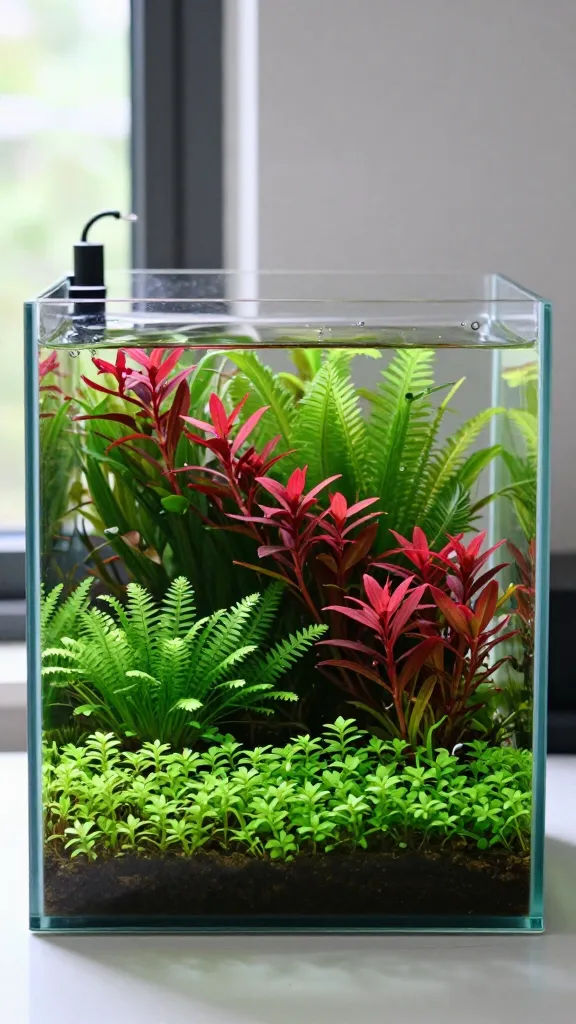
Order tames color: a single band of height and hue through restrained foliage gives you rhythm without chaos. In a 9 to 12 gallon desktop, compose a gentle diagonal ribbon of a red stem like Ludwigia repens or Alternanthera reineckii ‘Mini’ from back left to mid-right, framed by medium greens: Hygrophila polysperma ‘Rosanervig’ kept trimmed green, Rotala rotundifolia green form, and a low front of Helanthium tenellum ‘Green’. Keep the ribbon 2 to 3 stems thick and re-top weekly once established so the line stays crisp; allow 6 weeks for stems to root and respond to trimming. When it goes wrong, the red spreads into clumps across the tank or mixes with too many leaf shapes, and the band dissolves into patchwork.
7. Roots Over Sand: Shade for Shrimps, Light for Algae Eaters
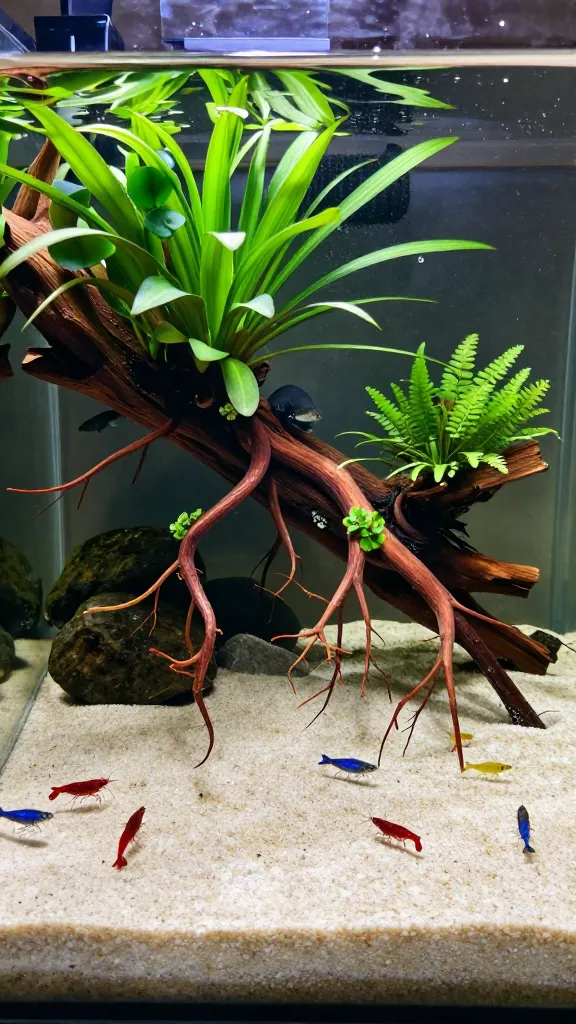
Inhabitants need structure first; composition can honor that by lifting cover overhead and leaving the floor clear for grazing. Suspend a fan of Redmoor wood or spider wood so its roots hover 1 to 2 inches above a pale sand bed in a 5 to 8 gallon tank; weight the base with rock and keep 2/3 of the footprint open. Tie in Anubias barteri var. nana, Bucephalandra ‘Kedagang’, and tufts of Microsorum pteropus ‘Trident’ where the roots cross. After 6 weeks, biofilm is grazed clean by Neocaridina and the floating roots cast dappled shade that calms small fish like Trigonostigma espei. The miss here is planting the sand or lowering the wood until it sits on the substrate — both kill the canopy effect and crowd your grazers.
8. Low-Tech Jungle Corner: Asymmetry From Leaf Size, Not Stone
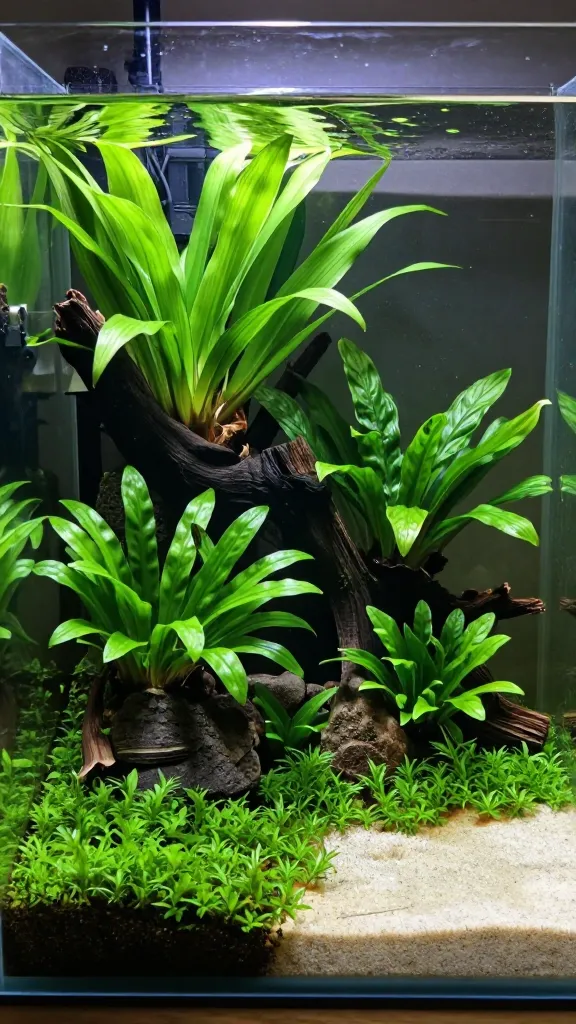
At eye level, big leaves and repeating masses are easier to read than a tangle of micro-stems. In a 10 gallon, claim one back corner with tall, slow growers — a clump of Cryptocoryne usteriana and a fan of Microsorum pteropus (Java fern) — then step down with Bucephalandra ‘Wavy Green’ and a front apron of Cryptocoryne parva; leave the opposite front corner open. Run moderate light and no CO2, dose lightly once or twice a week, and give 6 weeks for the crypts to settle before moving them. This fails when you evenly plant all four corners or pepper the scene with too many species — asymmetry fades and trimming becomes a chore rather than a rhythm.
Frequently Asked Questions
How do I choose between these desktop mini aquascapes for a 5 gallon tank?
Pick the layout that leaves the most open water visible from your chair. For 5 gallons, the island mound, roots over sand, or a simple iwagumi read cleanly and keep maintenance light. Choose small-leaf plants like Anubias ‘Petite’ and Monte Carlo so the scale holds up at 12 inches.
Do desktop mini aquascapes require CO2?
No. All of these layouts work without CO2 if you choose slow growers and keep light moderate. Expect 6 weeks for mosses and crypts to anchor and a weekly trim for carpets like Monte Carlo to prevent lifting. If you add CO2 later, shorten photoperiods at first to avoid algae blooms.
What livestock suit a desktop scape at eye level?
Stock small, peaceful species that thrive in the tank’s real volume. Shrimp (Neocaridina), micro rasboras (Boraras brigittae), or ember tetras are appropriate for 6 to 10 gallons once the tank is cycled and plants are rooted for 6 weeks. Avoid large or high-activity fish that need more length.
How do I keep the sand path in a valley layout clean?
Siphon lightly each week and use a narrow tube to lift debris without collapsing the banks. Replant any runners that cross the path and top up sand if slopes slump over 6 weeks. Keeping the path 2 to 3 inches wide from front to back preserves the depth cue.
Which plants stay compact enough for a desktop iwagumi?
Choose Monte Carlo, Eleocharis ‘mini’, and very small rosettes like Cryptocoryne parva. These stay in scale under moderate light and low CO2, and can be trimmed to 1 inch to keep the rock faces clear. Avoid tall hairgrass and fast stems that outgrow 6 to 9 gallon proportions.
Begin With What You Can See From Your Chair
Design for the viewpoint you actually live with: shapes that read at eye level, open water that breathes, and plants that grow to the size of the tank you have. Tonight, set your empty tank where it will live, place the tallest stone or root at 1/3 of the length, and step back to your chair; if the silhouette holds at that distance, you’re on the right track.
Questions about your own scape? Leave them in the comments and I will answer them. — Julian