10 Simple Aquascape Ideas — Few Materials, One Clear Decision

Most simple aquascape ideas fail because the tank is asked to do three things at once; one clear decision keeps the layout calm and alive. By the end of this list you will have chosen a single gesture — a slope, a void, a line of sight — and the materials and plants that serve it. Light will fall across stone, wood, and leaves for a reason you can name, and the negative space will be doing real work. Each idea names plants, proportions, and the weeks it takes to settle so you can build it in a standard rectangular tank with ordinary water, with or without CO2.
1. The Single-Stone Scape: One Focal Point, Nothing Competing
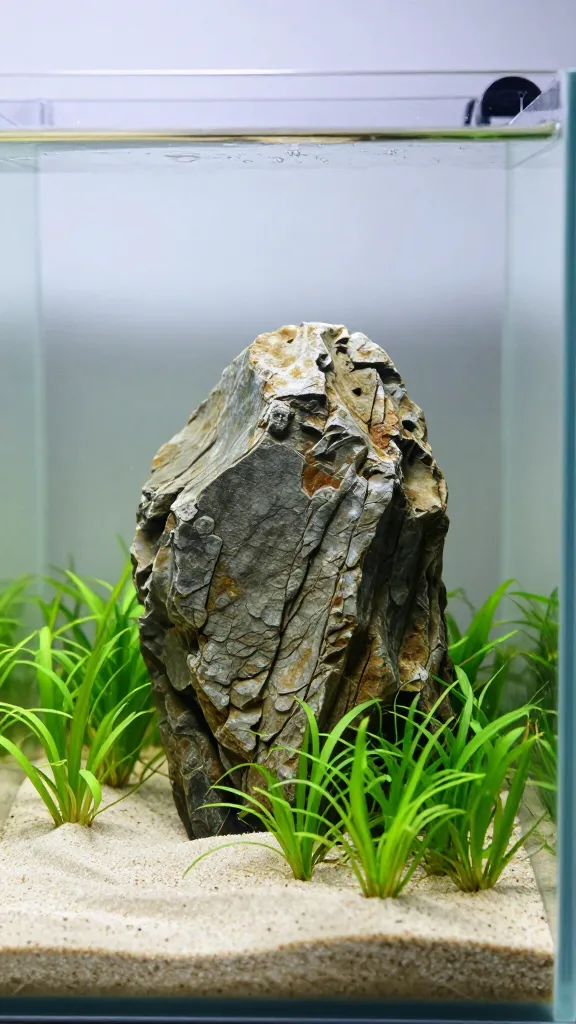
The eye rests when there is exactly one place to land. Place one large stone — Seiryu or dragon stone — at a 2/3 position along the length in a 10 to 20 gallon tank, leaning slightly forward so its strata catch light. Keep the base buried 1/3 into the substrate to read as grounded, then carpet with pygmy chain sword (Helanthium tenellum) or dwarf sag (Sagittaria subulata) for low-tech, trimming every 3 to 4 weeks. Leave 1/2 of the footprint as open sand or fine gravel to give scale. When this goes wrong it’s because you added helper rocks the same size — remove them; the hero needs supporting chips no larger than 1/5 of its height.
2. The River Path: Negative Space That Leads Somewhere

A path is not a stripe; it is an invitation that narrows and pulls you in. Build two low banks with river stones no larger than a fist, leaving a 3 to 4 inch winding channel of pale sand in a 20 gallon long. Plant the banks with Cryptocoryne wendtii ‘Green’ and small groups of Hygrophila pinnatifida on pebbles, keeping stems back from the sand so the curve reads clean. Let the sand pinch to 1 inch near the back to force perspective, and vacuum the channel weekly for the first 6 weeks while roots knit. The failure is symmetry: a centered “S” looks contrived; offset the tightest bend at 1/3 of the depth, not the middle.
3. The Wood Arch: Framing the Midwater, Not the Glass

A frame directs attention to what passes through it — fish, flow, and light — rather than to itself. Choose two pieces of spider wood or manzanita that meet high, forming an arch at 1/2 tank height in a 15 to 25 gallon, with the gap wider at the base than the top. Anchor epiphytes — Java fern (Microsorum pteropus ‘Trident’) and Bolbitis heudelotii — on the uprights with cotton thread, and tuck Anubias barteri var. nana ‘Petite’ near the feet to weight the form. Keep the center of the arch clear for midwater swimmers and flow; 6 weeks sees roots grip and wood stop floating. Overfilling the arch with moss is the trap — leave 1/3 of each branch bare so the silhouette stays legible.
4. The Low Meadow: One Height, Many Edges
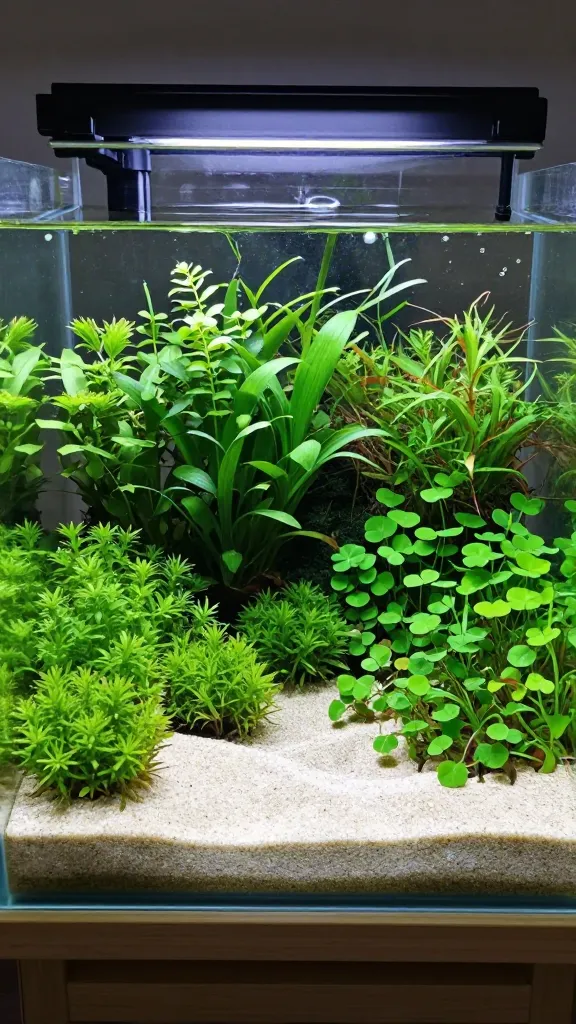
Harmony comes when everything hovers near one plane and the interest lives in leaf shape, not tiers. In a shallow 12 to 20 inch-long tank, plant the full footprint with a mosaic of low species: clusters of Staurogyne repens, patches of Hydrocotyle tripartita ‘Japan’, and a drift of Micranthemum ‘Monte Carlo’ (M. tweediei). Keep all plants trimmed to 1 to 2 inches, allowing scalloped edges where species meet, and leave a 3 inch strip of open sand along the front as breath. Without pressurized CO2, allow 8 to 10 weeks to close; with CO2, 4 to 6. This fails when one taller stem sneaks in — resist the urge; one outlier breaks the meadow plane and the spell is gone.
5. The Rooted Bank: Weight Low, Growth Forward

Weight is credible when mass sits low and leans into the current. Build a right- or left-handed bank that climbs to 2/3 tank height across the final 1/3 of a 20 gallon high, using river gravel and oak roots that thrust toward the front pane. Plant the slope with Cryptocoryne lutea in twos and threes, allowing runners to stitch the bank over 6 weeks, and lace the wood with Taxiphyllum barbieri (Java moss) only near the shaded undersides. Leave the opposing 2/3 of the footprint open with low Helanthium tenellum. The failure here is an upright wall; tilt stones and roots at 30–45° so the bank presses forward, not vertical like a barricade.
6. The Dark Wood, Light Leaf Contrast: Tone Before Color

Contrast that reads from across a room depends more on tone than on hue. Pair dark azalea root or aged manzanita with pale, fine-textured leaves in a 10 to 15 gallon. Plant Hygrophila polysperma ‘Rosanervig’ or Limnophila sessiliflora as a loose thicket behind and between the wood, and keep a front belt of Hydrocotyle leucocephala trained low. Maintain a strong top light for open, bright foliage and let wood surfaces remain un-mossed so the tonal gap holds. This falls apart when you add another dark-leaf species; too many midtones flatten the scene and the wood loses presence.
7. The Sandbar and Two Clumps: Restraint as Scale
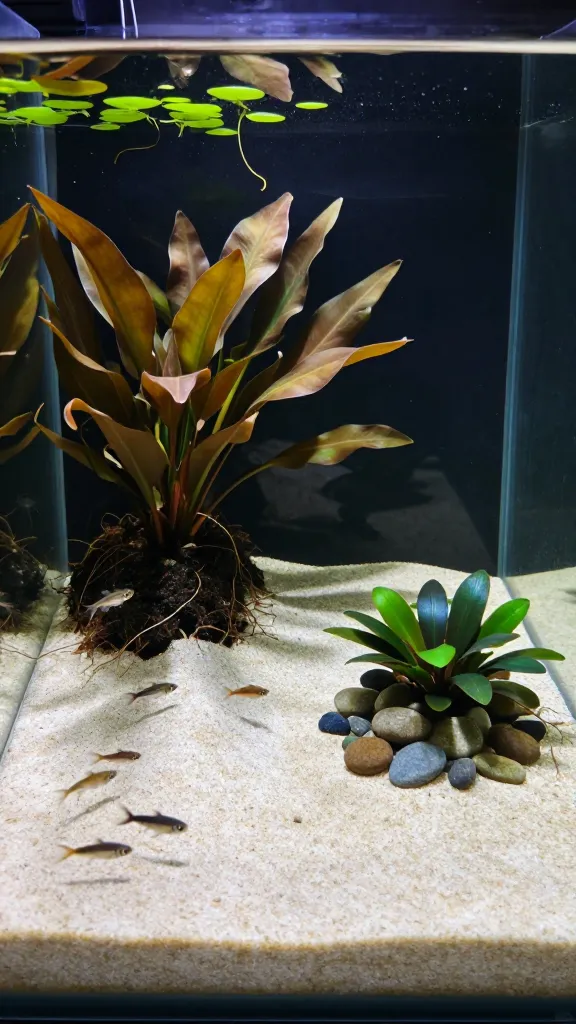
Two masses separated by emptiness feel larger than one continuous hedge. In a 20 gallon long, pour a 5 to 6 inch central bar of pale sand front to back, then plant only two islands: one larger rear-left mound of Cryptocoryne wendtii ‘Tropica’ and a smaller front-right tuft of Bucephalandra on pebbles. Keep the sandbar clear as a corridor; siphon detritus weekly for 6 weeks until roots bind the edges. Stock lightly with small fish that appreciate open ground, and add floating Salvinia if light is strong. The failure is drift — if runners bridge the sand, pull them; the bar must read as uninterrupted to sell the scale.
8. The Triangle of Quiet: One Slope, One Horizon

Diagonal energy calms when it resolves into a stable base and a quiet top line. Build a left- or right-shouldered triangle in a 15 to 25 gallon: substrate rising from 1 inch at one end to 4 inches under the apex, capped with Seiryu stone fragments that echo the slope. Plant the high end densely with Rotala rotundifolia and Ludwigia repens for a soft, waving canopy, then grade down to Staurogyne repens and finally a bare 1 inch ribbon of sand along the low end. Trim stems to maintain a straight horizon just below the waterline; in 6 weeks you will have a stable silhouette. This fails when the apex sits dead-center — slide it to 1/3 of the length and the triangle breathes.
9. The Moss and Rock Shore: Texture Over Variety

At small scales, texture carries farther than mixed species. In a 10 gallon, stack a low shore of lava rock no more than 2 inches high across 2/3 of the back, with gaps and pockets. Wrap select faces — not every surface — with Taxiphyllum ‘Christmas’ (Vesicularia montagnei), leaving rough stone exposed to contrast the fronds. Plant the foreground sparsely with Eleocharis acicularis ‘Mini’ to read as reeds, and keep the remaining front-right corner open gravel as a “beach.” Give moss 6 weeks to anchor before strong trims. This goes wrong when you smother the rock; a fully mossed wall looks like a hedgehog and loses the shoreline feel.
10. The Shadowed Back: Light as a Compositional Element
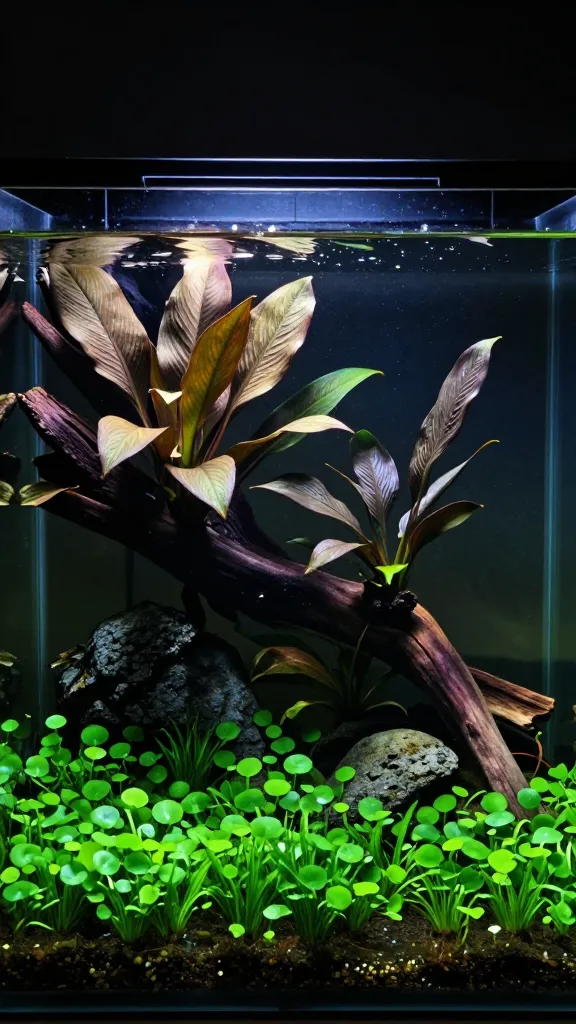
Depth comes from withholding as much as from adding — let the back third fall into shade and the front breathe. In a 20 gallon high, mount a simple shade baffle along the rear top rim (black card or a raised light) so intensity falls by roughly 30% across the back 1/3, then plant shade-lovers there: Cryptocoryne affinis and Anubias barteri var. coffeefolia. Keep the foreground in brighter light with Micranthemum ‘Monte Carlo’ or Staurogyne repens pruned low, and resist midground clutter. This balance settles in 6 weeks as slower back plants claim their space. When this fails, it’s because you filled the dim with fast stems; they race for the light and erase the gradient.
Frequently Asked Questions
What makes a simple aquascape work without CO2?
Stable light, modest plant choice, and patience do the heavy lifting. Choose hardy species like Cryptocoryne wendtii, Staurogyne repens, and Anubias nana ‘Petite’, keep photoperiod around 7 to 8 hours, and let the layout run 6 weeks before judgment. Trim lightly rather than often to avoid shocking slow growers.
How long should I wait before adding fish to a new layout?
Wait until the tank is fully cycled and plants have rooted — plan for 6 weeks. That window lets beneficial bacteria establish and holds the substrate in place so foragers do not uproot fresh stems. Start with small, compatible species suited to the tank size and swimming space your layout leaves.
Which stones and wood are best for simple aquascape ideas?
Use inert, aquarium-safe materials that read clearly at your tank’s scale. Seiryu, dragon stone, and lava rock are reliable, while manzanita, spider wood, and azalea root offer expressive lines. Rinse thoroughly, test layout proportions dry, then submerge and give 6 weeks for biofilm and plants to settle the look.
Can I follow these layouts in a small 10 gallon tank?
Yes — choose ideas that respect scale and maintenance time. The single-stone scape, the moss and rock shore, and the low meadow adapt well to 10 gallons if you keep focal elements within 1/2 tank height and leave genuine open ground. Stock lightly and trim on a 3 to 4 week rhythm.
How do I keep the sand path or bar from getting dirty?
Siphon the surface during weekly water changes and limit flow that blasts detritus into the channel. Edge the path with low plants rooted 1 inch back from the sand so they do not creep in, and top up clean sand as needed during the first 6 weeks while the layout stabilizes. A gentle turkey baster helps lift debris without collapsing edges.
Begin With the Gesture, Then Let It Breathe
One decision unlocks simplicity: make a single gesture and remove anything that argues with it. Tonight, stand at the glass, pick the place your eye should land, and mark it with painter’s tape at 1/3 of the length — everything you add tomorrow either serves that mark or stays out of its way.
Questions about your own scape? Leave them in the comments and I will answer them. — Julian