10 Driftwood Aquascape Ideas — Shape, Placement and What to Plant on It
Most driftwood aquascape ideas fail at the same quiet point: a beautiful branch dropped into a tank with no thought for flow, scale, or what will live on it. Driftwood aquascape layouts work when the wood’s line decides where the eye travels and which plants can live along that line. By the end of this list you will have chosen a shape, a placement, and the plants that belong on the wood you can actually buy — and you will know what it will look like in 6 weeks, not just on day one. All ten are buildable in a rectangular tank on tap water, with or without CO2. Take your time; these are gardens, not arrangements.
1. The Arching Branch: Directional Flow, One Clear Path for the Eye

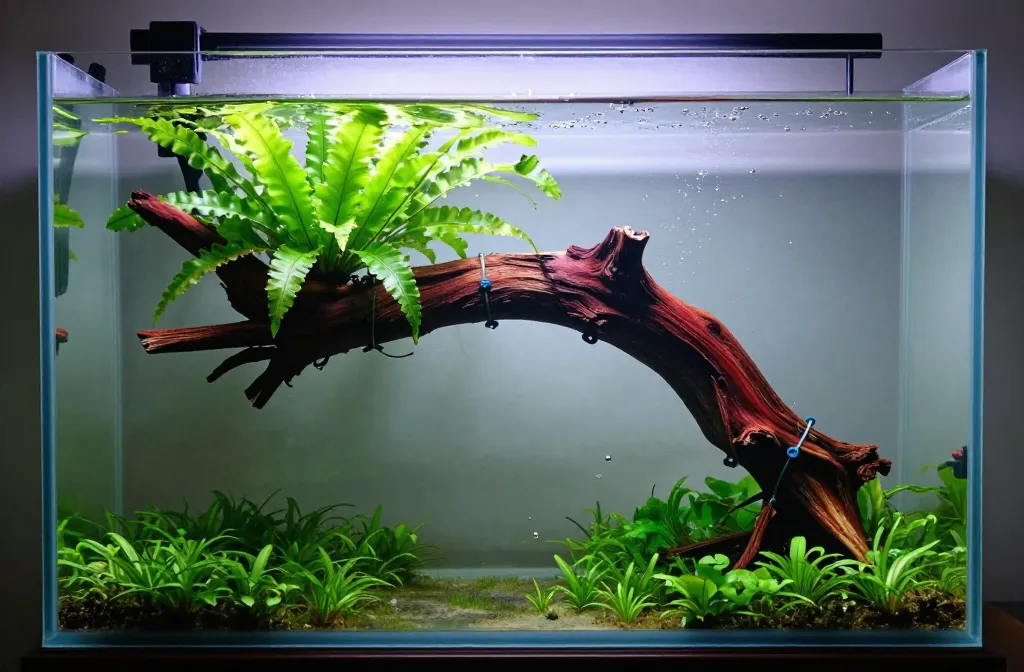
A single strong curve gives the layout a sentence to speak — the eye enters at the low end, follows the arc, and rests where the branch meets the substrate. Place a slender piece of redmoor root or manzanita so it rises from the back corner to the opposite front third, with 2/3 of its length above midline in a 20- to 40-gallon tank. Plant Java fern (Microsorum pteropus ‘Trident’) at the elbow where the curve is tightest, and tuck Anubias barteri var. nana ‘Petite’ along the underside, tied with cotton and spaced 2 inches apart. Let the front open: a low carpet of Cryptocoryne parva will knit to the base in 6 to 8 weeks under moderate light. When this fails, it’s because the branch is dead-center and horizontal — the eye stalls and the water reads flat.
2. The Root Tangle: Vertical Weight, Light Plants at the Tips
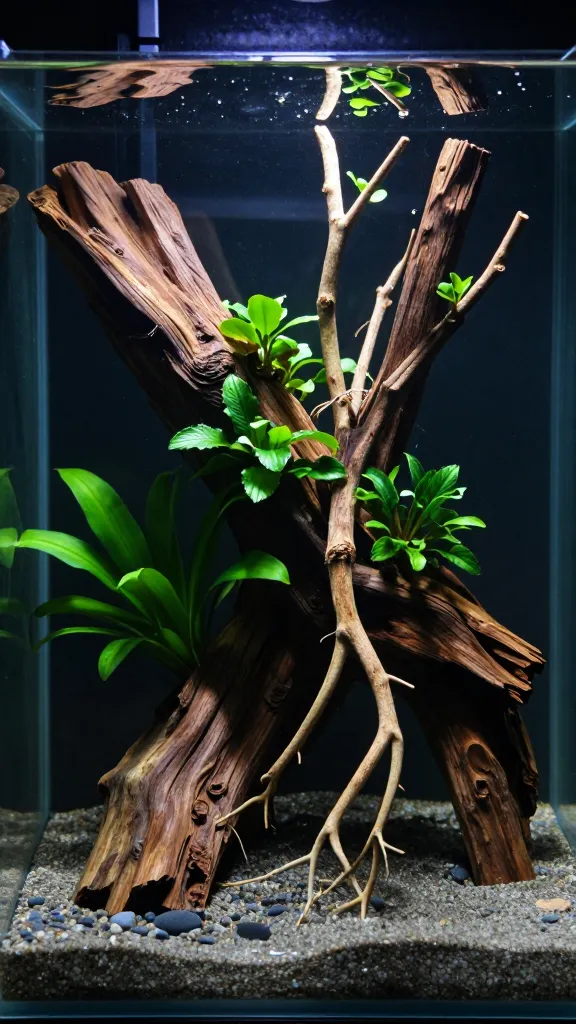
Weight belongs low in a composition; when mass floats, the scape feels top-heavy and tiring. Build a base from the thicker ends of mopani wood interlocked in the rear third of a 29-gallon, with 1/3 of each piece buried for stability and to protect livestock from shifting. Thread finer spider wood roots upward and forward so the tips stop at midwater, then attach Bolbitis heudelotii only to the lower, shaded sections and dot the upper twigs with Bucephalandra ‘Green Wavy’ in 1-inch clumps. Leave 3 to 4 inches of open water above the highest tip for fish to move. The miss here is blanketing the whole tangle with epiphytes — when every inch is green, there’s no relief and detritus chokes growth.
3. The Fallen Trunk: Foreground Negative Space, Shadow as Habitat
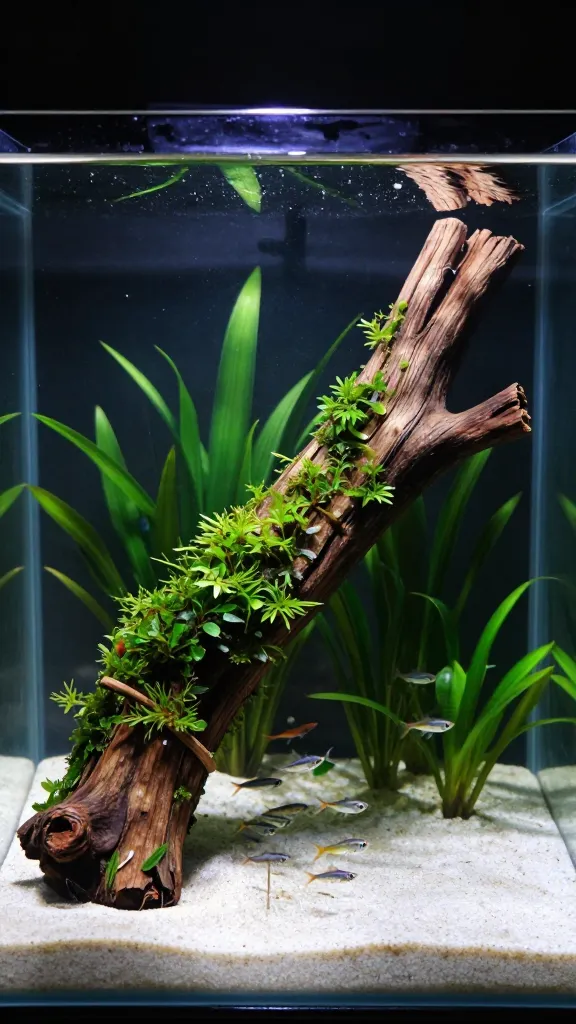
Empty foreground is not wasted; it is where scale is read and fish breathe. Lay a single, bark-textured malaysian driftwood trunk diagonally from front-left to back-right in a 20-long, with the front end 1 inch from the glass and the rear end touching the back pane at the golden section. Tie Taxiphyllum barbieri (Java moss) under the lower half only, letting it overhang to cast shade on a sand foreground, and plant Cryptocoryne wendtii ‘Green’ in small groups behind the trunk to create depth. Stock only after the tank is cycled and the moss has gripped — around 6 weeks — so you can vacuum the front sand without tearing roots. Overplanting the front turns the trunk into a barrier; keep the leading edge clean or the whole idea collapses.
4. The Twin Spires: Asymmetry Between Sisters, Not Twins
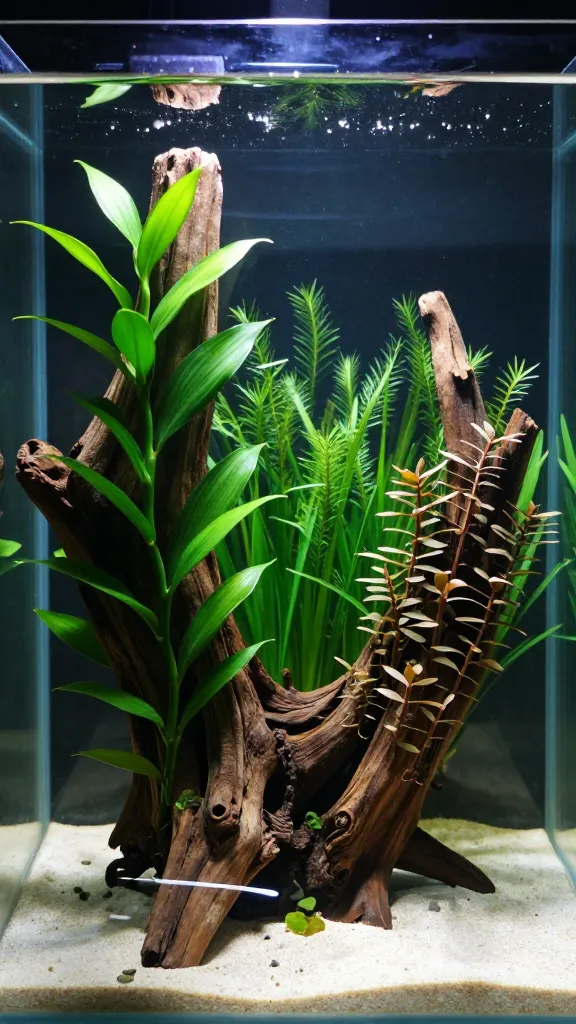
Pairs that match become static; pairs that differ by clear amounts create rhythm. Choose two upright manzanita spires for a 40 breeder, one 1.5× the height of the other, and plant them on the left and right thirds with the taller forward and the shorter recessed. Lace the taller with a single species — Anubias barteri var. coffeefolia — and the shorter with a lighter texture — Hygrophila pinnatifida attached by thread at its mid-height. Fill the rear middle with Limnophila sessiliflora to suggest distance and leave a sand channel between the spires at least 3 inches wide. If you put both spires at equal height and distance, the tank splits in half and you’ve built a fence, not a landscape.
5. The Overhang: Shadow as Focal Point, Not the Wood Itself

The most interesting part of an overhang is the shade it casts; build for that pocket, not for the pose. In a 17- to 25-gallon, mount a flat piece of redmoor root horizontally off a vertical support so its lip projects 3 to 4 inches over an open sand cove. Underneath, tie Bucephalandra ‘Kedagang’ in singles so each has flow, and on top use a sparse line of Microsorum pteropus ‘Narrow’ so the upper surface does not smother what’s below. Add a fine-leaved midground like Helanthium tenellum to soften the transition, and wait 8 weeks before any aggressive trim so the undergrowth roots into its crevices. When the overhang is covered on both faces, light and current die under it and the cove goes stale.
6. The Branch-and-Stem Dialogue: Fast Growing Backdrop, Anchored Wood

Hardscape that argues with stems becomes noise; stems set behind a clear gesture give movement without confusion. Anchor a single forward-leaning manzanita branch on the right third of a 20-high and plant a dense left-rear thicket of Rotala rotundifolia and Ludwigia repens in alternating 3-inch groups. Keep epiphytes on the wood minimal — three to five tufts of Anubias nana ‘Petite’ spaced 2 inches — and let the stem colors be the variety. Trim the stems weekly once established to keep them 1 inch below the surface and sloped down toward the branch. The common failure is wrapping the branch in moss while also running colorful stems; texture fights color and neither wins.
7. The River Root: Current Lines, Fish Movement First

Water movement should be legible; wood that follows the flow lets fish use the layout as a route rather than an obstacle. In a 55-gallon with a single HOB filter, lay three spider wood pieces so all point from the intake side toward the outflow, with their tips stopping 2 inches shy of the opposite pane. Plant Microsorum pteropus on the bases where detritus collects, and use Vallisneria americana along the back to show the current as it leans. A sand corridor 4 inches wide along the direction of flow becomes the swimming lane for midwater species. If you cross the grain — pointing branches against the current — fish stall in eddies and waste gathers on the upstream faces.
8. The Low-Tech Epiphyte Forest: Texture Over Speed
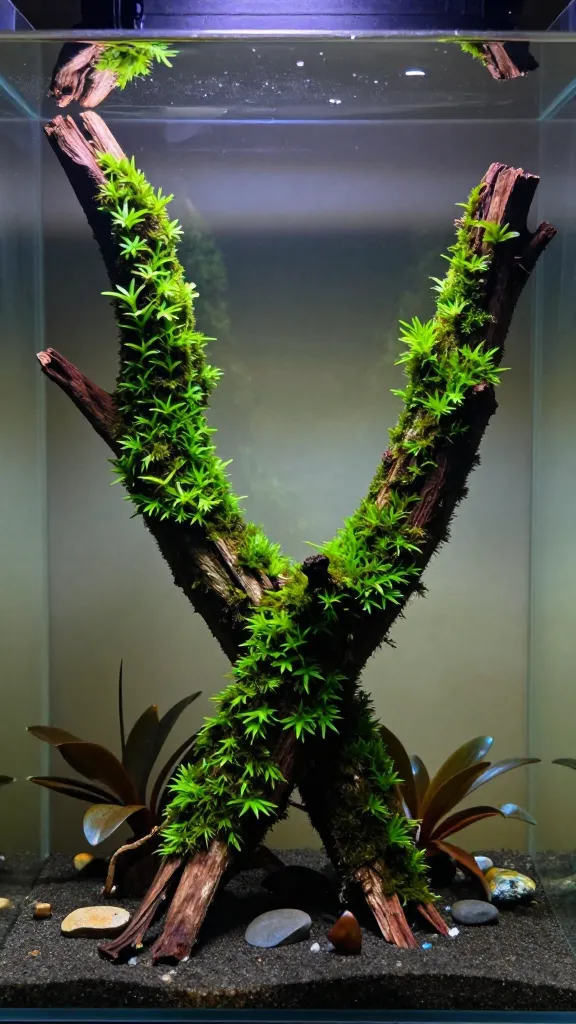
Without CO2, choose plants that earn their keep slowly and reliably so the wood’s silhouette remains the story. For a 10- to 15-gallon low light tank, set two to three cholla wood or small redmoor branches at varied angles, none reaching higher than 2/3 of the tank. Attach a single species thickly — Taxiphyllum ‘Christmas’ (Vesicularia montagnei) — to every branch with tight thread spacing, and add only a few Bucephalandra ‘Brownie Ghost’ near the base. Expect 6 to 8 weeks before the moss knits and 12 weeks before the lines blur prettily. The trap is mixing five slow epiphytes at once; maintenance becomes a tweezers chore and the forest loses its legibility.
9. The Island Root: Rule of Thirds, Open Water All Around

Isolated mass framed by emptiness pulls the eye cleanly and gives fish 360° of escape routes. In a 32-gallon long, mound substrate into a 2/3-high dome on the left third and pin a gnarled manzanita root into it so its primary branch leans toward the center. Wrap the crown with Hydrocotyle tripartita ‘Japan’ sparingly — just enough to break the silhouette — and ring the foot with Staurogyne repens so the island meets sand softly. Leave the remaining two thirds as open sand with no hardscape and only scattered Cryptocoryne lucens at the far right. If you break the perimeter with extra twigs or rocks, the island dissolves and you lose the clarity that makes this layout sing.
10. The Canopy and Roots: Two Layers, One Story

When a scape reads as both forest floor and canopy, it must be one organism, not a pile — the top feeds the bottom and the bottom frames the top. In a 75-gallon, invert a branching redmoor piece so its “crown” becomes a canopy at 1/2 tank height, with 4 to 6 dangling rootlets extended using thin twigs. Plant the canopy with a light hand — Microsorum pteropus ‘Windelov’ every 3 inches — and the rootlets with Bucephalandra ‘Green Wavy’, then carpet only under the canopy with Cryptocoryne parva so the edges fade to sand. Give it 8 weeks before your first full trim so the top and bottom establish in balance. When the whole canopy is smothered, light starves the floor and the piece becomes a ceiling rather than a forest.
Frequently Asked Questions
How do I keep driftwood from floating or shifting after I plant it?
Soak or boil pieces until fully waterlogged, then pin them with substrate and—if needed—stainless screws into inert slate buried under the soil. In smaller tanks, partially bury 1/3 of a branch to set the center of gravity low. Never rely on plants or thread to hold weight; stability comes first.
What plants actually attach to wood without CO2?
Use true epiphytes: Java fern (Microsorum pteropus), Anubias barteri varieties, Bucephalandra cultivars, and mosses like Taxiphyllum barbieri and Vesicularia montagnei. Tie them with cotton thread or gel superglue gel at the rhizome; they root to bark in 4 to 8 weeks under moderate light. Avoid burying rhizomes — rot is the usual reason attachment fails.
How long should I wait before adding fish to a new driftwood aquascape?
Wait until the tank is fully cycled and epiphytes have gripped — around 6 weeks for most setups. This gives bacterial films time to form on the wood and keeps early maintenance from uprooting anything. Test ammonia and nitrite at 0 ppm for a week before stocking.
How do I prevent tannins from turning the water tea-colored?
Pre-soak or boil the wood and run fresh activated carbon or Purigen for the first 2 to 4 weeks. Large, weekly 30-50% water changes during that period flush out the initial release. Some species like mopani are especially tannin-rich; plan for an extra week of soaking.
What size of wood works in a 10-gallon tank without crowding it?
A branch that reaches 1/2 to 2/3 of the tank length and no higher than 2/3 of the water column keeps scale believable. Choose finer manzanita or cholla with clean line and limit plants to small-leaved forms like Anubias ‘Petite’ and Bucephalandra mini. Leave at least 3 inches of open sand in front so the tank doesn’t read as packed.
Are driftwood aquascapes possible without pressurized CO2?
Yes — build around slow epiphytes and modest light, and choose patience over turnover. Mosses, Microsorum pteropus, and Anubias will attach and fill in over 6 to 12 weeks with weekly water changes and restrained fertilization. Faster stems belong behind the wood if used at all, trimmed to avoid shading.
Start With the Line Your Wood Already Has
You are composing with direction and shade, not with a catalog of species; the wood’s line decides the plant list and the open water decides what it feels like to live inside. Tonight, lay your best branch on a towel and turn it four ways — when the line clicks, mark the contact points, and plant only where water will flow across those marks in the tank.
Questions about your own scape? Leave them in the comments and I will answer them. — Julian