8 Seiryu Stone Layouts — Hard Lines and What They Do to Water
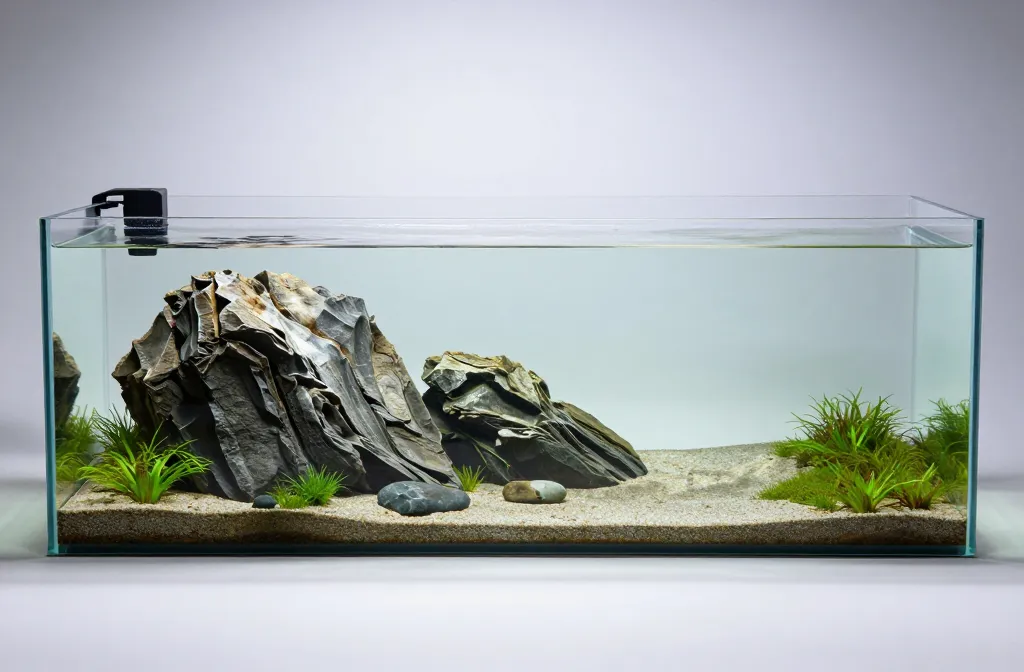
Seiryu stone layouts promise crisp lines and a living slope, but those edges also change the water that runs over them. Use the stone for structure and expect a steady upward nudge in hardness and pH as the weeks go by; design and husbandry have to meet in the same glass box. By the end you will have chosen a composition, a plant list that matches your tap and your patience, and a way to let the hardscape breathe without crowding the animals that live among it. I have spent two decades learning that a tank that reads clean at a glance is usually one with planned emptiness, not more rock.
1. Classic Seiryu Iwagumi: One Focal Ridge, Nothing Competing
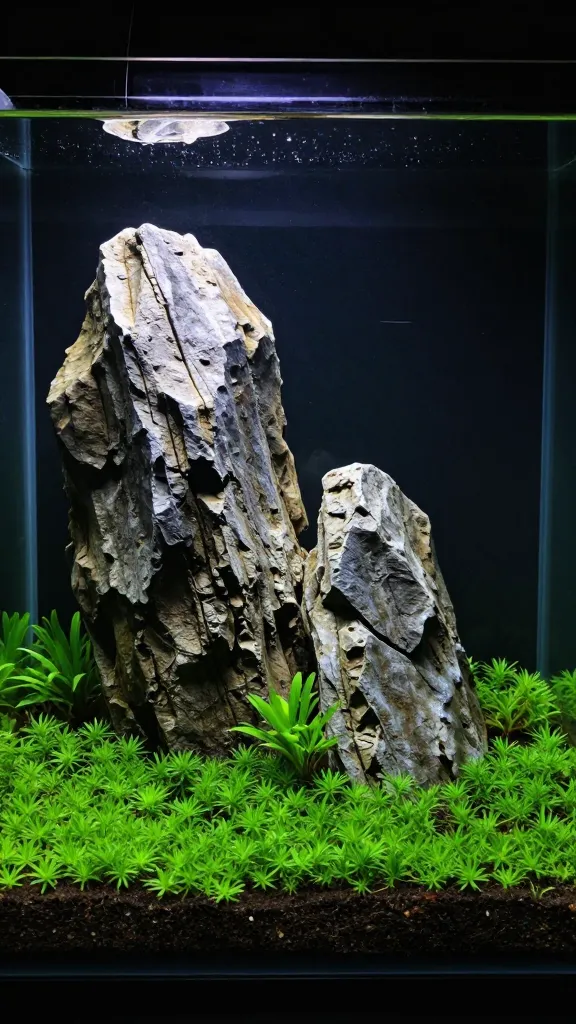
A single dominant line tells the eye where to rest, and everything else supports that choice. In a 20-gallon long, set one primary Seiryu stone at 2/3 tank height on the left third, then lean two subordinate stones into its stride so all seams point the same way. Plant a restrained carpet of Eleocharis acicularis ‘mini’ in the front 2/3 and tuck Micranthemum tweediei ‘Monte Carlo’ in the pockets around the bases. Give it 6 weeks to close under moderate light; with Seiryu’s buffering toward harder water, this plant set tolerates 72–78°F, no CO2, and weekly trims. When this fails, it is because the “supporting” stones are the same size as the main, and the scape reads as a quarry instead of a hillside.
2. Seiryu Riverbed: Negative Space as the Subject

Empty space is not a gap to be filled; it is the channel that makes the banks make sense. In a 29-gallon, shape a winding path 3–4 inches wide with Seiryu fragments, letting the pale substrate show as the “water,” and keep the path unbroken from front glass to rear corner. Plant the banks with Cryptocoryne parva and a light spray of Hydrocotyle tripartita ‘Japan’ to soften the edges; hold the center bare or dotted with Seiryu chips like exposed gravel bars. Give it 8 weeks for the crypts to root and spread; they accept the stony water and low-tech schedules. When this goes wrong, the path widens until it becomes a clearing, and the composition loses the sense of current.
3. Split Ridge Canyon: Asymmetry With Depth Cues

Depth comes from overlapping planes and a foreground-to-background scale shift that feels inevitable. In a 40-gallon breeder, create two low Seiryu ridges that converge toward the back right, leaving a 2-inch sand “canyon” between. Keep the front ridges lower than the rear ridges, and use smaller stones at the back to exaggerate distance. Plant Staurogyne repens on the outer toes of each ridge, Taxiphyllum barbieri (Java moss) sparse on the rear faces, and a background of Rotala rotundifolia kept at 2/3 tank height. Allow 6–8 weeks for moss to knit and stems to find their stair-step trim. Failure shows up as parallel, equal-height walls and stems trimmed flat, which flattens the perspective instantly.
4. Low-Tech Meadow Between Crags: Texture Over Speed

Slow groundcovers can carry a tank if the textures are chosen to read clearly against the stone. In a 10-gallon standard, keep Seiryu to three stones under 1/2 tank height arranged in a loose triangle, then plant Sagittaria subulata as a meadow with tufts of Helanthium tenellum ‘green’ and occasional clumps of Cryptocoryne wendtii ‘green’. Run room-temperature water in the 72–76°F band, no CO2, and expect 8–10 weeks before the meadow looks intentional. Trim runners to keep sightlines to the rock and leave 1–2 inches of foreglass unplanted for breathing room. This layout fails when every species is allowed to touch every stone, turning the crags into anonymous bumps.
5. High Slope Terraces: Stability as Design

Vertical ambition works only when gravity is part of the plan; a slope should lock itself in before the first plant goes in. In a 60P (24 gallons), terrace a back-left mound with Seiryu plates angled downward like shingles, capping each step with substrate so the face never exceeds 60°. Pin larger slabs with smaller keystones to prevent slumping. Plant the terraces with Bucephalandra sp. epiphytically on stone faces, lay Cryptocoryne pygmaea on the steps, and let Microsorum pteropus ‘Trident’ anchor the base. Give the scape 6 weeks without heavy trims so roots can stitch the soil. When it fails, it is because the first water change undermines the slope and you chase landslides for months.
6. Seiryu and Wood Confluence: Contrast as a Bridge

Hard contrast draws the eye, but it needs a reason to exist beyond novelty; use wood as the “stream” running through rock. In a 36-gallon bowfront, set a Seiryu cluster on the left like a headland, then arc Spider wood branches from the cluster across the midline, thinning toward the right third. Keep stone heights at or below 1/2 tank, and let the wood reach 2/3 so it reads as the lighter material. Plant Bolus of Anubias barteri var. nana ‘Petite’ on the wood forks and Hygrophila pinnatifida on stone seams; a front dusting of Hydrocotyle tripartita ‘Japan’ will stitch the two. Expect 6–8 weeks for the epiphytes to root to hardscape. This fails when the wood and rock are split into equal halves, and the eye ping-pongs without resting.
7. Sand-and-Seiryu Shoreline: Horizon and Restraint
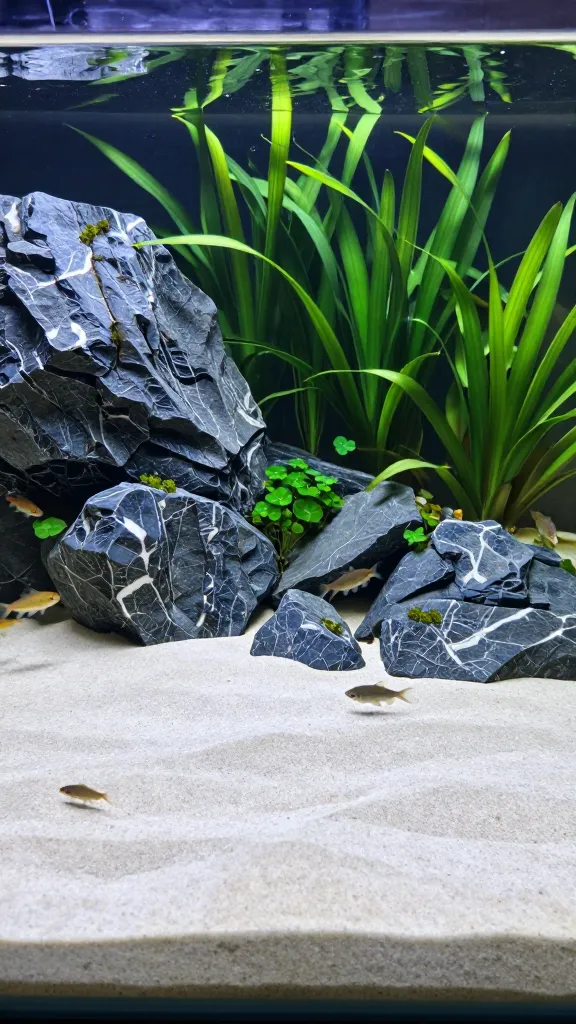
A clear horizon calms a busy foreground and gives fish room to show their behavior. In a 75-gallon, keep a 6–8 inch pale sand beach along the entire front, then stack a broken Seiryu shoreline that rises no more than 1/3 tank height, higher on one side and stepping down. Plant the landward side only: Cryptocoryne balansae for tall, ribboned leaves, and patches of Ranunculus inundatus for punctuated texture. Leave the beach completely unplanted; stock species that appreciate open sand and hard water, like a group of Poecilia reticulata (guppies) or hard-water livebearers, introduced only after cycling is complete. This fails when the beach narrows under sprawl and becomes a thin line rather than a place.
I hold one line stubbornly: Seiryu belongs in aquaria whose plants and livestock are chosen to enjoy harder, more alkaline water, not in softened systems forced to chase a number. If you love soft-water-only species, choose a different stone and let them thrive.
8. Hill-in-Hill Outcrop: Rhythm, Not Repetition
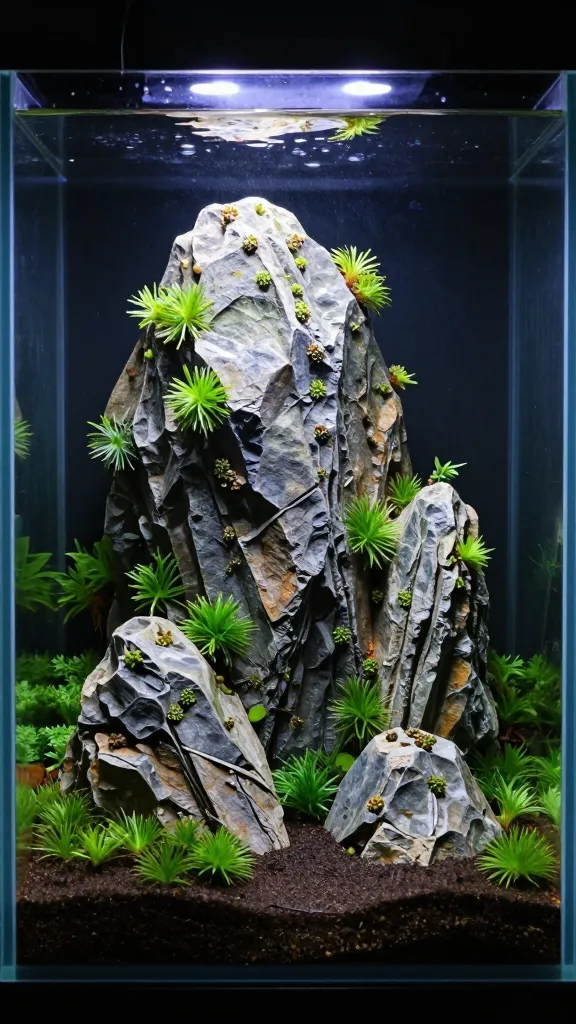
Repetition turns to rhythm when scale and tilt vary with purpose across the tank. In a 14-gallon cube, build a central Seiryu outcrop at 1/2 tank height and echo it with two smaller “children” stones of 1/3 and 1/4 height placed forward-left and rear-right. Keep all grains leaning one direction for coherence. Plant the base ring with Blyxa japonica and allow modest tufts of Riccardia chamedryfolia to catch on faces; in the gaps, tuck Pogostemon helferi to riff on the stone’s jagged edges. Give it 6 weeks to show the rhythm as the plants settle to their mature shape. It fails when every outcrop is the same size and distance apart, making a picket fence of boulders.
Frequently Asked Questions
Do Seiryu stone layouts raise pH and hardness?
Yes, Seiryu typically increases KH and nudges pH upward as it slowly dissolves, especially in low-CO2, frequent-change tanks. Plan a plant and livestock list that tolerates harder water, such as Cryptocoryne, Bucephalandra, and livebearers. Test weekly at the start and aim for a stable range rather than a single number.
How long should I give a new Seiryu hardscape to settle before trimming?
Give it 6 weeks before the first real assessment. By then, carpets have rooted, epiphytes have gripped the stone, and the initial buffering has flattened into a pattern you can plan around. Early heavy trims or rescapes destabilize slopes and slow the tank’s biological maturity.
What plants thrive in hard, alkaline water around Seiryu?
Choose hardy species that tolerate or prefer mineral-rich water: Cryptocoryne wendtii, Sagittaria subulata, Staurogyne repens, Pogostemon helferi, and most Anubias and Bucephalandra. For stems, Rotala rotundifolia and Ludwigia repens adapt well. Keep your expectations honest on color without CO2: greens and bronzes will carry the scape.
Can I use Seiryu in a low-tech tank without CO2?
Yes, if you choose plants that match the light and water and accept slower timelines. Stay with resilient species like Eleocharis acicularis ‘mini’, Cryptocoryne parva, and epiphytes, and plan on 6–10 weeks for the scape to read as finished. Keep light moderate and trims steady rather than drastic.
How do I keep Seiryu slopes from collapsing during water changes?
Build terraces that lock, not piles that hope, and protect exposed substrate. Angle plates like shingles, wedge keystones, and cap with a thin layer of gravel to resist scouring. When changing water, pour onto a plate or plastic bag on the sand so current never hits the slope face directly.
Start With the Stones on a Towel, Not in the Tank
Good Seiryu work is composition and water chemistry in quiet agreement: lines that lead, spaces that breathe, and species that like the world your rocks make. Tonight, lay your five best pieces on a towel, pick one to carry the story, and turn the others until their broken seams point the same way — then remove one and feel the space it leaves.
Questions about your own scape? Leave them in the comments and I will answer them. — Julian