8 Lava Rock Aquascape Layouts — Porous Stone, Planted Directly
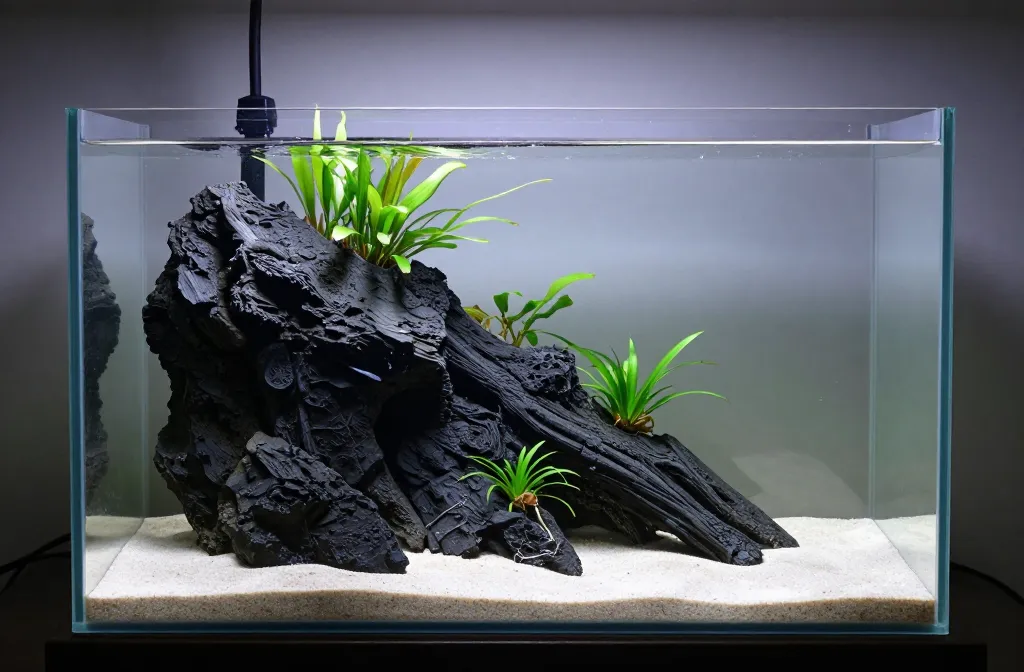
In these lava rock aquascape layouts, the stone is more than structure — its pores are planters, its edges catch the light, and its mass makes a landscape that holds. Lava rock lets you plant directly into the hardscape, so you can keep the substrate calm and the composition crisp while the roots anchor into stone. By the end, you will have chosen a layout, a plant list that suits tap water and restrained maintenance, and a timescale that tells you when to judge it. The glass stays simple; the life does the work.
1. The Ridge and Basin: Mass and Relief Create Rest
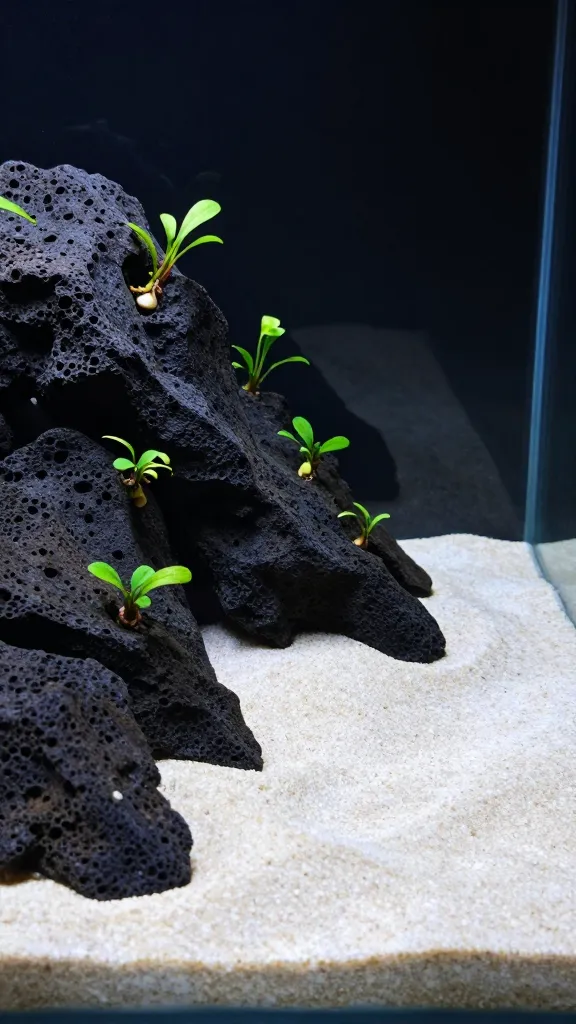
The eye needs a place to breathe, and the easiest way to grant it is to pair a single heavy ridge with an open basin. Stack black lava rock in a sloping spine that reaches 2/3 of the tank height on one side of a 20-gallon long, and let the opposite 1/3 remain open sand as the basin. Tuck Anubias barteri var. nana into the upper crevices and a few tufts of Microsorum pteropus (Java fern) midway down; both will root to stone in 6 weeks without CO2. Keep the basin clean with fine La Plata sand or similar, and resist the urge to pepper it with pebbles. When this fails, it’s because the basin fills with small bits — once the relief is gone, the scape reads flat and fussy.
2. Lava Rock Forest: Repetition and Rhythm Over Detail
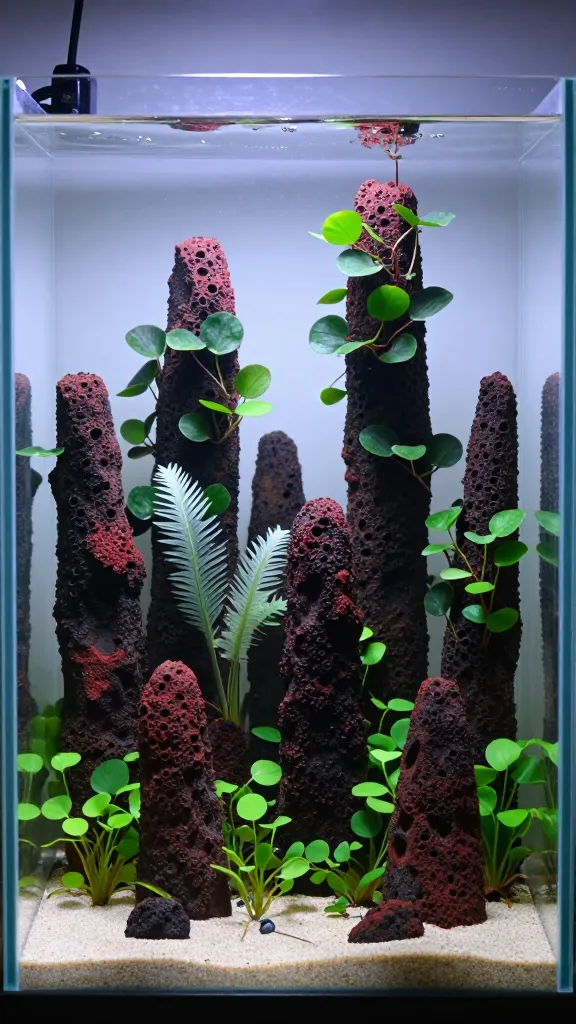
Repetition builds rhythm: many similar forms ask the eye to travel, not to stop and catalog. Choose 7 to 9 narrow lava pillars in a 29-gallon and set them in two staggered rows, tallest at 3/4 tank height and shortest at 1/3, all leaning 10° the same way to imply wind. Plant the “canopies” with Bucephalandra sp. clustered into the upper pockets and Bolbitis heudelotii on two mid pillars; let Hydrocotyle tripartita trail between trunks to soften. It settles in 8 weeks; trim the Hydrocotyle monthly to keep the trunks distinct. This goes wrong when pillar sizes vary wildly or lean at random — rhythm collapses into noise.
3. Lava Rock Iwagumi: One Focal Point, Supporting Stones Obedient
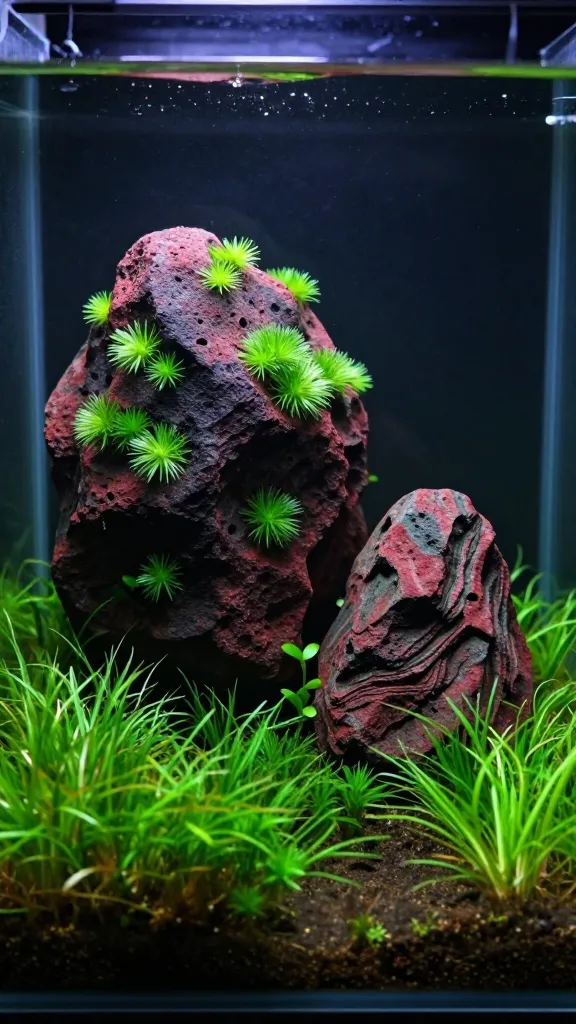
Hierarchy keeps a composition honest: one stone leads, the rest agree. In a 17-gallon, set a single dominant lava boulder at the golden ratio (roughly 0.62 of the length from one side), with two satellites that echo its angle and strata but stay 1/3 and 1/4 its mass. Plant pockets on the main stone with Riccardia chamedryfolia (mini pelia) and a few Anubias ‘Petite’, then carpet the floor with Eleocharis acicularis (dwarf hairgrass) if you use CO2, or Sagittaria subulata for low-tech. Give it 6 weeks before the first trim; the moss will mesh the pores by then. The failure is co-dominance — two similar boulders of equal height split the eye and exhaust the viewer.
4. The Lava Arch: Framing as a Path for the Gaze

Framing directs attention; a window inside the scape invites you to look through, not just at, the scene. Bridge two broad lava shelves into an arch in a 40-gallon breeder, leaving a 1/3-tank-width opening that reveals a pale sand run to the back glass. Weight the uprights with larger stones at the base so fish have secure caves; plant the arch underside with Taxiphyllum barbieri (Java moss) and the flanks with Crytocoryne wendtii ‘Green’ for rooted mass that doesn’t sprawl. In 8 weeks the moss will hang like lichen; keep it trimmed to keep the aperture clean. This fails when the arch is centered and symmetrical — symmetry deadens the invitation and turns the window into a gate.
5. Lava Island in Negative Space: Less Plant, More Water
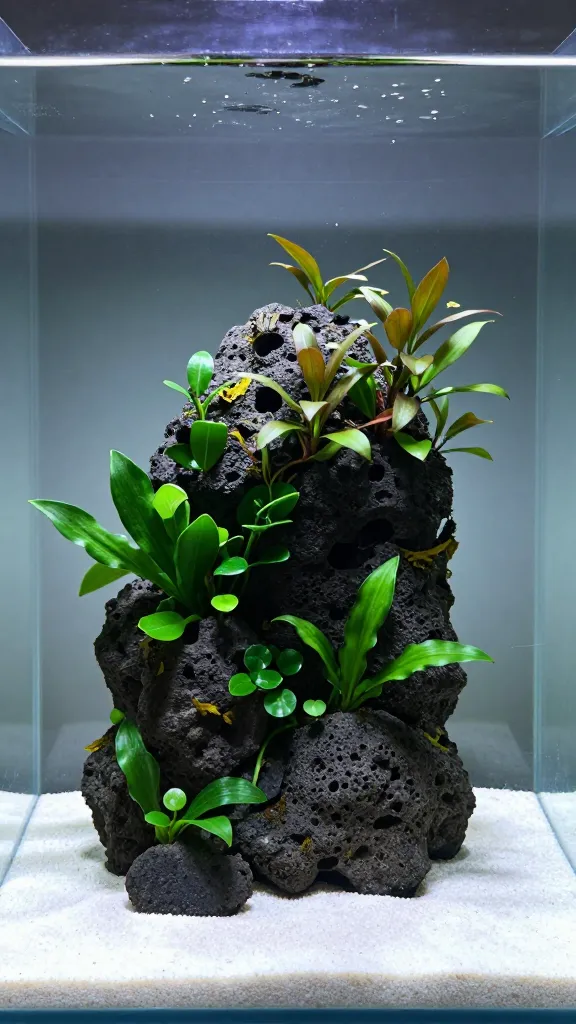
Negative space is not empty; it is the shape that makes the landform legible. Build a single compact island of lava rock no larger than 1/3 of the footprint in a 60P (24 inches long), lifting it 1/2 tank height at the peak. Plant the stone heavily with Bucephalandra ‘Green Wavy’, Anubias barteri var. nana ‘Petite’, and a few strands of Hygrophila pinnatifida in higher crevices, letting roots bind the rock. Leave the remaining sand bare and bright. It takes 6 to 8 weeks to balance; the island will darken as biofilm settles, which is the point. When this goes wrong, it’s because the island bleeds into the substrate with rubble — once the edge blurs, the space stops reading as water.
6. Lava Terrace River: Direction Through Gradient

Gradients tell the eye where the flow runs. In a 36-inch tank, build terraces of lava rock from back-left high to front-right low, stepping down in 3 distinct levels with a 1-inch drop between each. Fill the pockets along the “river” path with Staurogyne repens and the terraces themselves with Bucephalandra sp.; edge the riverbed with Seiryu chips only if they disappear under plants, not to mix stones visibly. A slow-growing path will clarify in 8 weeks; by 12, the direction is unmistakable. The miss is a flat staircase — if the drops aren’t obvious, the river reads like shelves, not current.
7. Shadowed Lava Cliff: Light as Structure

Contrast is a building material: bright substrate against a dark cliff makes depth without clutter. Stack black lava into a sheer face along the full back of a 20-gallon high, bringing the crest to 3/4 tank height and tilting a few stones forward to throw shadow. Plant only the upper ledges with Microsorum pteropus ‘Trident’ and anchor Cryptocoryne balansae at the cliff foot to send leaves into the gloom; leave the foreground open sand. Give it 6 weeks to take; the ferns will lace the lip and the crypts will rise into the half-light. The failure is bright plants plastered across the face — once the cliff glows everywhere, the light stops sculpting and the scape flattens.
8. Lava Rock Vivarium Edge: Emergent Green, Submerged Calm

Vertical layering settles a busy plant list by giving each layer a job. In a 45-gallon tall with a tight lid, let a main lava stack breach the surface by 2 inches and wick water to the air; plant submerged crevices with Anubias barteri and Bucephalandra sp., and tuck emergent roots of Epipremnum aureum (pothos) or Spathiphyllum wallisii (peace lily) into the top pockets to drink nitrates. Keep fish choices gentle and size-appropriate — small rasboras or shrimp that respect the calm. In 8 weeks the emergents will throw new leaves and stabilize the scape; trim them monthly to keep light to the water. This fails when the emergent crown shades the entire tank — once the surface closes, everything below strains.
Frequently Asked Questions
How do I attach plants to lava rock without glue?
Use cotton thread or fishing line to tie rhizomes snugly and wedge roots into natural pockets. In 6 weeks, Anubias, Bucephalandra, and Java fern will grip the pores and you can remove the ties. For mosses, press a thin layer into crevices and secure lightly; it will knit as biofilm forms.
Do lava rock aquascapes work without CO2?
Yes, if you choose slow epiphytes and moderate light. Rhizome plants like Anubias, Bucephalandra, Microsorum pteropus, and Bolbitis heudelotii are well suited, and they root directly to the rock in 6 to 8 weeks. Keep water changes regular and aim for steady, not explosive, growth.
Is lava rock safe for shrimp and soft-water fish?
Generally yes — inert lava rock doesn’t raise hardness, and its texture offers biofilm for grazing. Rinse and scrub it thoroughly before use to remove dust that can irritate gills. For delicate Caridina shrimp, let the tank mature for 6 weeks so microfauna establish on the rock first.
How do I keep the sand areas clean around a lava island layout?
Siphon lightly along the edges during weekly maintenance and direct flow so detritus settles where you can reach it. A small group of Corydoras pygmaeus or Malaysian trumpet snails can help stir, but don’t rely on them to replace husbandry. If waste collects, increase the open area rather than squeezing in more stone.
What plant goes in the pores if I want color but low maintenance?
Bucephalandra varieties bring subtle blues and reds under strong light without rapid sprawl. For a low-tech tank, stick to green forms and let the leaf sheen provide interest; coloring takes time and consistent conditions, not daily intervention. Trim spent leaves every 6 weeks to keep clumps tight.
Start With Stone That Decides the Space
One arrangement, one place to rest, and plants that want the same pace — that is how a lava rock layout outlives the first photograph. Tonight, choose three stones that agree with each other, scrub them, and set them in the tank dry until the negative space makes sense; only then pick two plants that can live on the rock and give them 6 weeks to prove it.
Questions about your own scape? Leave them in the comments and I will answer them. — Julian