7 Island Layout Aquascapes — One Mass, Open Water, Clear Edges
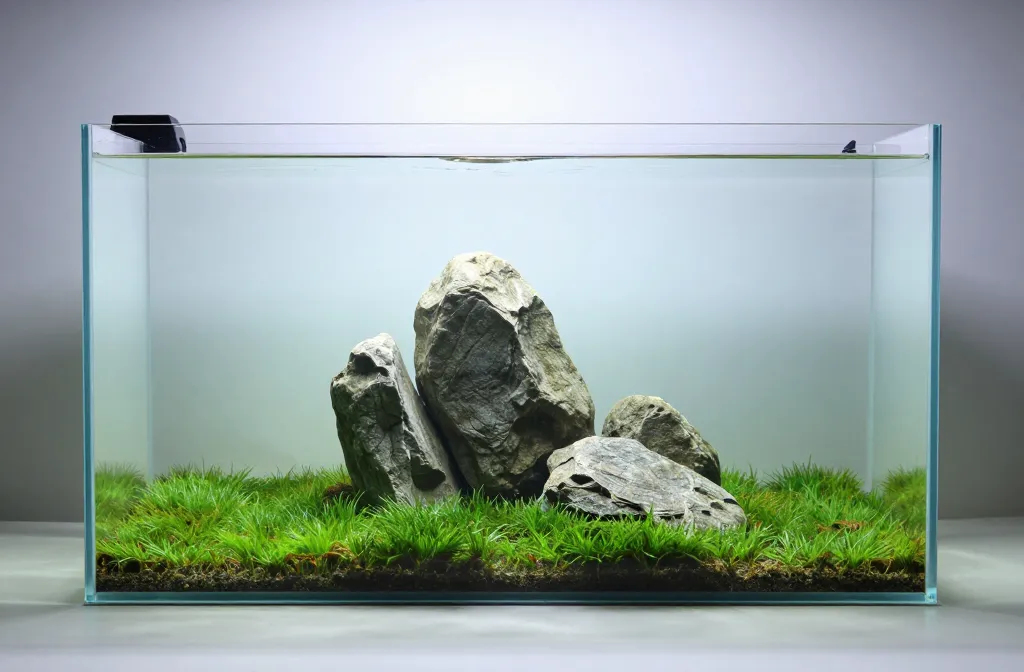
Most island layout aquascapes fail for the same quiet reason: the island is vague and the water around it is not truly open. An island scape is a single mass with negative space on all sides — clear edges, not a peninsula — and the open water is as designed as the rock. By the end of this list, you will have chosen a layout, a plant palette, and a proportion that fit your tank and your patience. Each entry names the stones, the plants, the footprint, and how many weeks until it looks like more than a sketch.
I’ve spent two decades building islands that held together and tearing down those that didn’t; the difference was never a product, only the structure and the restraint. What follows is craft you can stand in front of the glass and do.
1. Classic Island Iwagumi: A Triad of Stones, Negative Space That Breathes

The eye needs a single hierarchy, so the main stone leads and every other piece serves its lean, leaving water like sky on all sides. Build this in a 20-gallon long (30 inches) with seiryu stone: one taller keystone at 2/3 of the island’s height, a secondary at half that, and a tertiary that tucks the line. Keep the island’s footprint to 40% of the substrate, centered in the front-to-back depth but offset left or right by 1/3 for tension. Plant a tight carpet of Dwarf hairgrass (Eleocharis acicularis) and a rim of Staurogyne repens on the island’s lower slope; give it 6 weeks to knit. When this fails, it’s because the rock count creeps up and the negative water reads as leftover, not deliberate.
2. Wood-Crested Island: Vertical Rhythm, One Crown, One Shadow
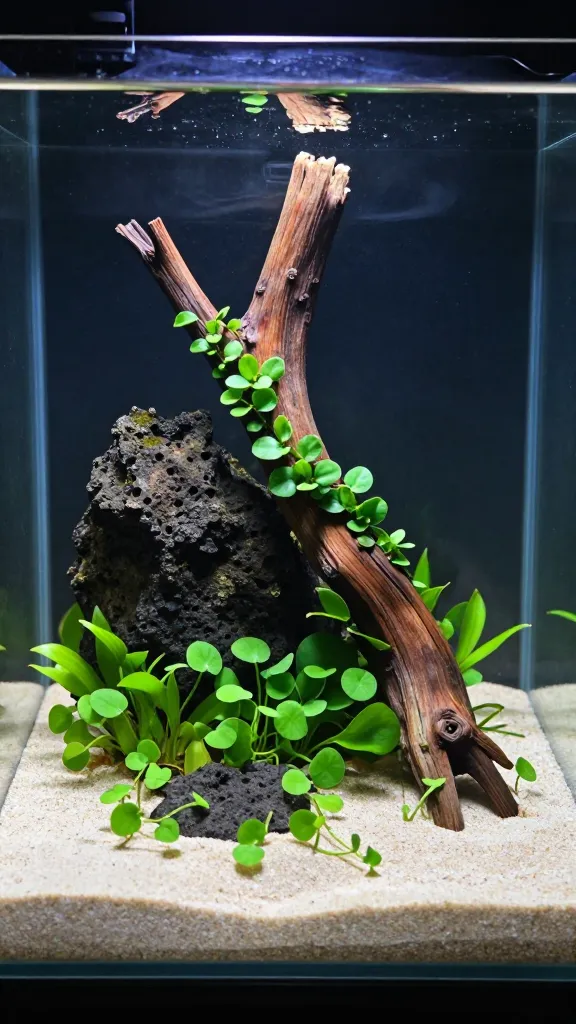
Set a single vertical rhythm so the crown pulls the gaze up and the waterline stays calm around it. In a 24-inch tank, anchor a low mound of lava rock and root one main branch of Spider wood (Azalea root) that leans 10–15 degrees toward the open water, with two thinner satellites echoing the direction. Skin the mound in Cryptocoryne wendtii ‘Green’ at the base, then Bucephalandra ‘Green Wavy’ epiphyted on the wood, and a light scatter of Hydrocotyle tripartita at the edge to soften the boundary; leave 2 inches of bare sand as a moat all around. Low to medium light, no CO2 is fine; let it settle 8 weeks for tannins to fade and roots to take. It goes wrong when the crown splits into two equal uprights and the island reads as a thicket instead of a single mass.
3. Sand Moat Island Layout: Edges You Can Read From Across the Room

Edges are an element, not an absence — a bright perimeter makes the island’s shape legible at a glance. In a 36-inch tank, pour a 2–3 inch band of pale pool filter sand or La Plata sand around a dark aquasoil core shaped into an oval; the sand is continuous, unbroken by hardscape. Stack Ohko (dragon) stone low and interlocked, no taller than 1/2 the tank height, with their fractures aligned. Plant the core densely with Helanthium tenellum ‘Green’ and a central tuft of Cryptocoryne flamingo for a controlled color accent; keep stems off the edges so the sand reads clean. Expect 6 weeks to close the soil-sand seam with runners. This fails when plants spill into the sand and the moat clogs, turning the edge into a fuzzy line.
4. Low-Tech Island Jungle: One Dense Community, Slow Water All Around

Diversity belongs inside the island, not spread across the tank — the water around it remains open for scale and for fish. In a 40-gallon breeder, mound aquasoil to 2/3 the tank height at the peak and terrace with flat gray mountain stone. Use forgiving species: a base of Java fern (Microsorum pteropus) and Anubias barteri var. nana on stone, a mid of Cryptocoryne undulata, and a single background of Hygrophila polysperma pruned into a dome; leave a 3-inch sand path all around. No CO2 needed; stable growth appears by week 8–10 under moderate light. It fails when you let Hygrophila pierce the horizon line and the island loses its single rounded silhouette.
5. High-Contrast Island: Light on Dark, Dark on Light, No Half Measures
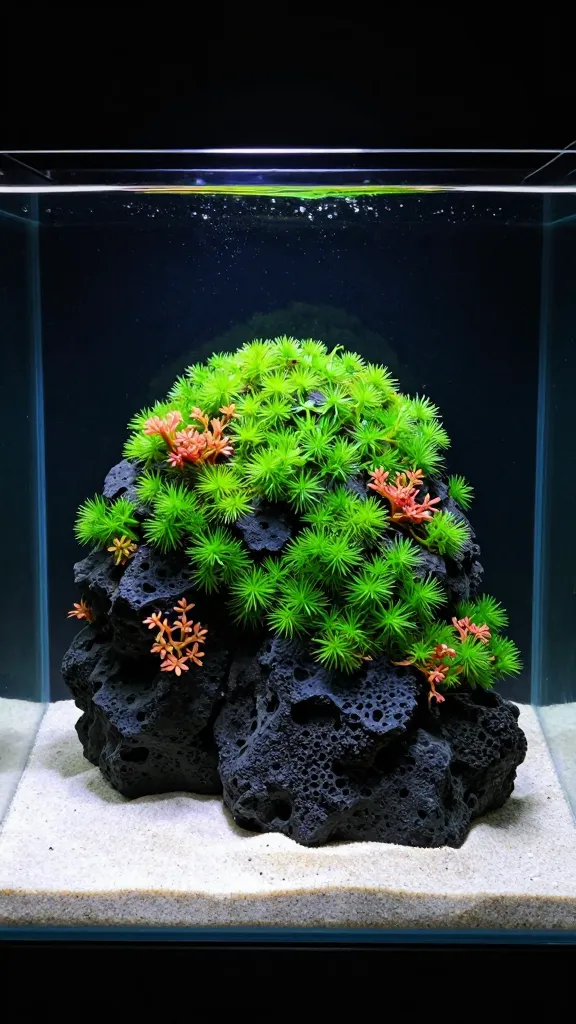
Contrast is a decision; pick one axis and push it until the mass and the water separate without effort. In a 60P (24 inches), use near-black lava rock and a pale aragonite sand band 2 inches wide, with the island no more than 45% of the footprint. Plant bright-toned species on the island: Micranthemum ‘Monte Carlo’ (M. tweediei) as the skin and small clumps of Rotala rotundifolia kept at or below 2/3 of the tank height to preserve the dome; run CO2 if you choose Rotala, or swap to Cryptocoryne parva for low-tech. Give 6 weeks before the contrast reads clean through new growth. The miss here is muddy mid-tones everywhere — beige sand with beige rock and mid-green plants leave the island dissolving into the water.
6. Shallow Tank Island: Broad Footprint, Low Canopy, Horizon Intact
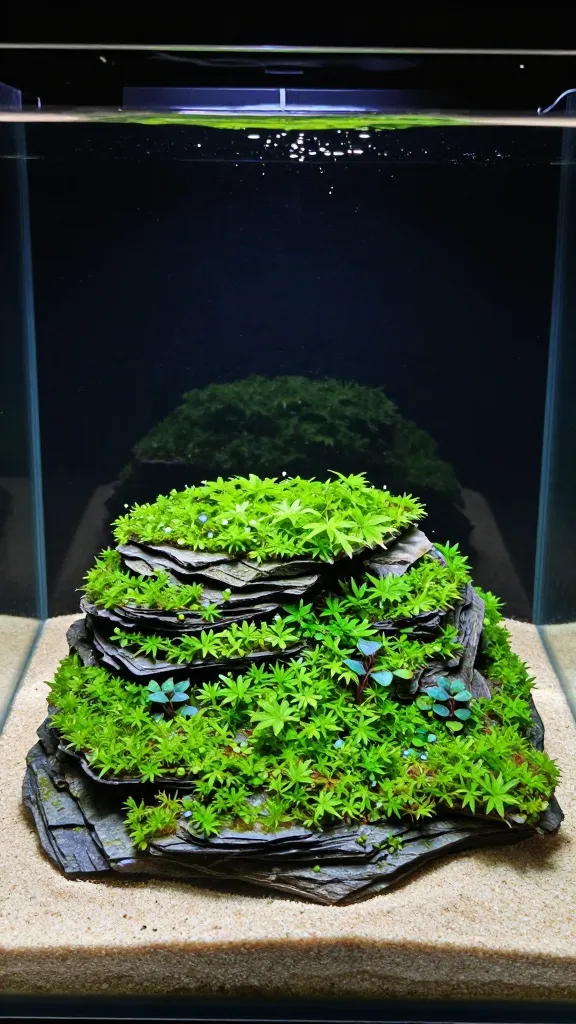
In shallow water, height becomes loud, so keep the canopy low and let width do the talking. In a 12-inch-high bookshelf tank, build an island only 1/3 of the tank height at the peak, with a broad base that occupies 50% of the footprint; use thin Maple leaf stone plates to stack shallow angles. Plant exclusively low growers: a skin of Glossostigma elatinoides if CO2 is available, or Marseille hairgrass (Eleocharis pusilla) without CO2, plus tiny clumps of Bucephalandra ‘Kedagang Mini’ for texture. Keep 1.5 inches of clean sand around the island and let the surface shimmer be your “sky”; 6–8 weeks to close. It fails when a single tall stem or wood spike breaks the horizon and the shallow tank looks pinched.
7. Two-Island Dialogue: Unequal Partners, One Silent Channel

Asymmetry needs distance; two masses read as a pair only if one clearly leads and the water between them is wide and empty. In a 90 cm tank, shape a large island occupying 35% of the footprint and a smaller one at 15%, with a 6-inch open channel of sand between them; keep both below 2/3 tank height. Use matching materials — Manten stone and one plant palette — but vary density: the larger planted with Cryptocoryne lucens and Bucephalandra ‘Red’, the smaller with just Buce and a skim of Riccardia chamedryfolia on stone. CO2 optional; allow 8 weeks for the channel to feel intentional, not bare. This goes wrong when the smaller island grows into parity and the pair becomes a wall across the tank.
Frequently Asked Questions
How wide should the sand moat be in an island layout aquascape?
Keep the moat 2–3 inches wide in tanks 24–36 inches long. That’s enough distance to read as open water while still being maintainable with a siphon. If your tank is shorter than 20 inches, scale the moat to roughly 1/6 of the front-to-back depth.
Do I need CO2 for an island layout to work?
No; build the composition first and choose plants that match your light and patience. Low-tech palettes like Java fern, Anubias nana, Cryptocoryne wendtii, and Eleocharis acicularis will settle in 6–10 weeks with regular trims. If you want fine carpets or tight stems (Monte Carlo, Rotala), CO2 gives you control, but it’s a choice with daily attention and weekly trims.
What fish suit the open water around the island?
Choose species that enjoy uninterrupted swimming lanes and won’t uproot the edges. Small schooling fish like Ember tetra (Hyphessobrycon amandae), Green neon tetra (Paracheirodon simulans), or Harlequin rasbora (Trigonostigma heteromorpha) thrive in groups of 10–20, depending on tank size. Always cycle first and keep the sand band clear of dense plants so they have space.
How long until the island looks finished?
Expect 6 weeks before it reads as a single mass rather than a pile of parts. Carpets and crypts need that time to root, close seams, and soften stone edges. Wood-based islands with epiphytes often take 8 weeks as tannins leach and new leaves replace nursery growth.
How do I keep plants from invading the moat?
Set a physical boundary and maintain it on a schedule. Build a low retaining line of flat stones at the soil-sand seam and trim runners every 2 weeks until growth stabilizes; use long tweezers to pluck stray Eleocharis or Monte Carlo from the sand. During water changes, lightly rake the sand with your fingers and siphon detritus.
Let the Water Be Water
An island works when the mass is singular and the water around it is deliberate; the edges are a design choice, not leftovers. Tonight, pour the sand first and sketch the island’s footprint at 40–50% of the base, then place one keystone that leans — everything else will answer to that line.
Questions about your own scape? Leave them in the comments and I will answer them. — Julian