10 Jungle Aquascape Ideas — Controlled Overgrowth That Still Reads
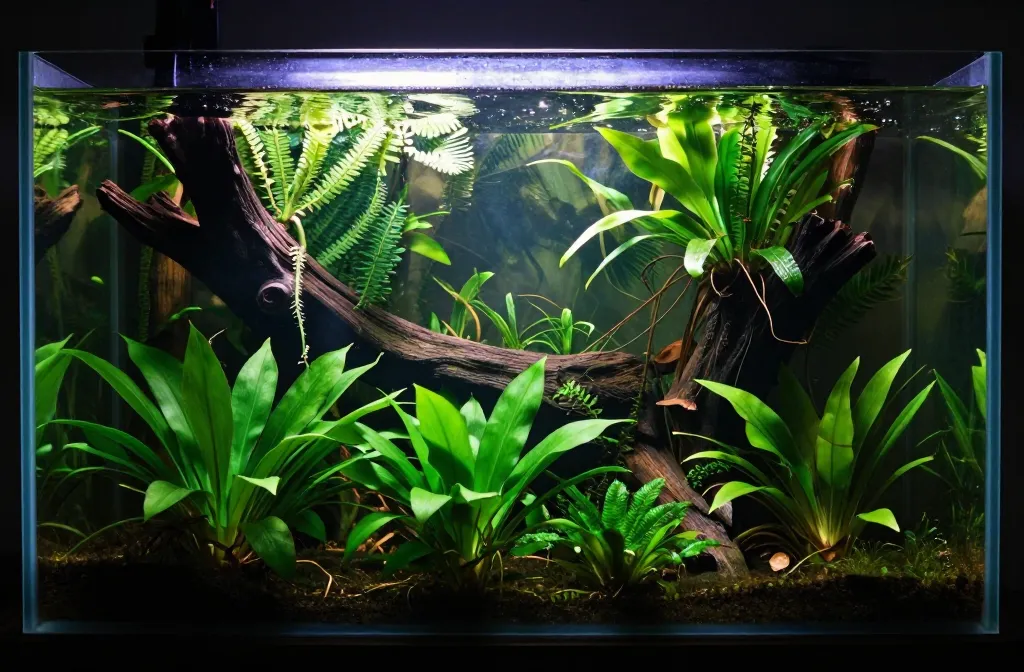
Light falling through a thicket is the promise of jungle aquascape ideas: foliage layered so richly that the water feels humid, yet the eye knows where to land. A jungle aquascape is not chaos; it’s a dense community arranged for flow, maintenance, and the fish that live among it. By the end of this list, you’ll have chosen a layout, a plant palette that shares the same care needs, and a way to let it grow in while keeping it legible. Each entry names a tank size, proportions, plants by their true names, and how long to wait before judging it. What you keep out matters as much as what you add.
1. Riverbank Sweep: One Direction of Growth, Everything Leaning
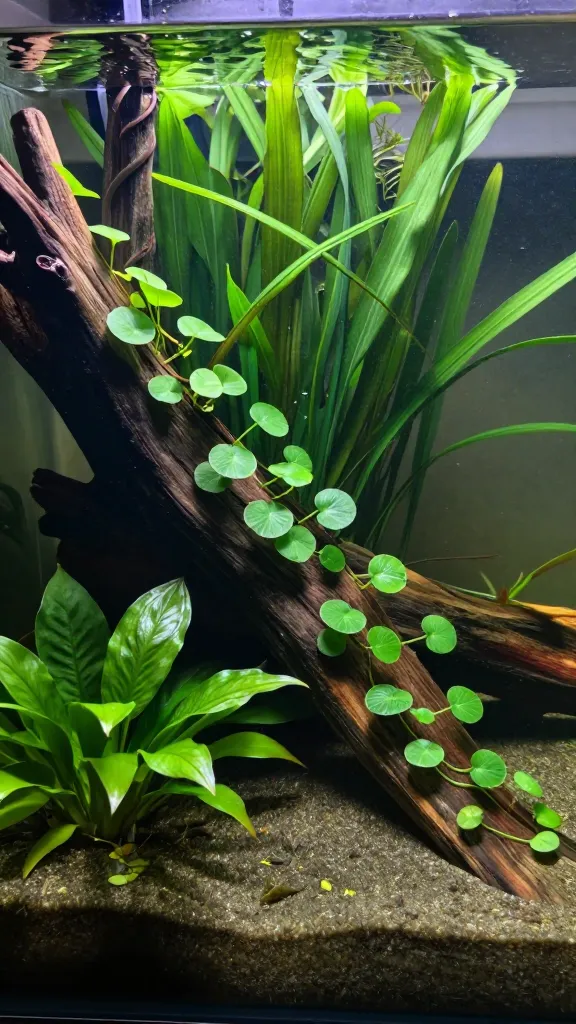
Movement unifies density; when all leaves tilt the same way, the eye reads a current instead of clutter. Set a 20-gallon long (30 inches) with wood arcing from back left to front right at a 30° sweep, all higher mass planted on the up-current side. Use Brazilian pennywort (Hydrocotyle leucocephala), Hygrophila siamensis, and Java fern (Microsorum pteropus) rhizomes on the wood, with Cryptocoryne wendtii ‘Green’ tucked on the lee side. Let stems grow to 2/3 of tank height, then top and replant tips in 3-4 weeks to reinforce flow. When this fails, it’s because pieces lean every which way; re-angle wood until fronds and stems echo the same line.
2. Canopy and Floor: A Two-Layer Jungle With Nothing Midwater
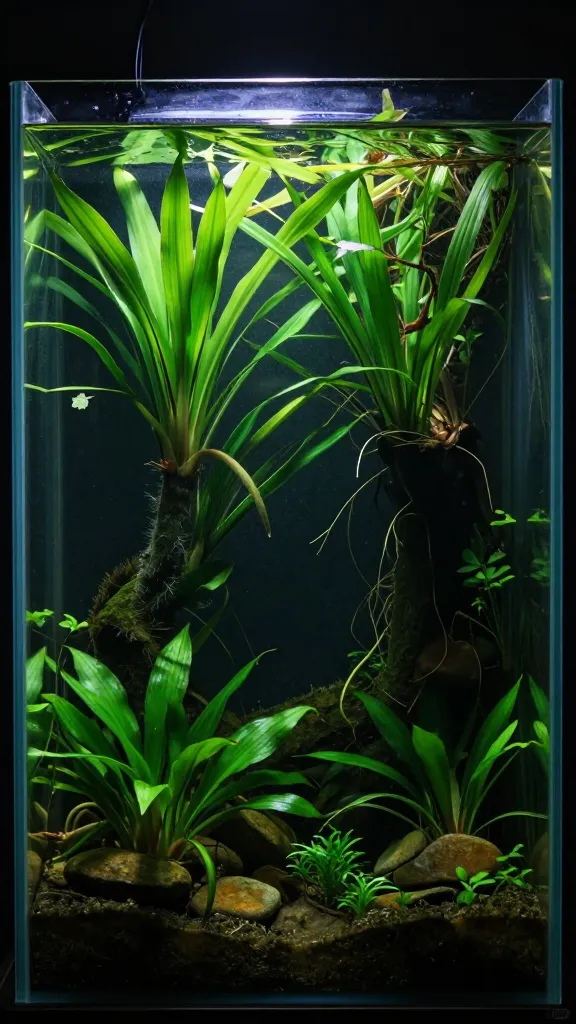
Legibility comes from gaps; leaving the middle open makes busy foliage read as a forest rather than a hedge. In a 29-gallon (18 inches tall), commit to a high canopy and a dark floor: Amazon sword (Echinodorus grisebachii) and Vallisneria americana for height, with a carpet of Cryptocoryne parva and Anubias barteri var. nana on stones. Keep the midwater at 1/2 the tank height clear except for roots and the occasional sword leaf. It takes 6 weeks for the crypts to settle and push steady growth; feed the swords with root tabs if you skip CO2. The mistake here is filling the middle with random stems; resist and the fish will own that space.
3. Jungle Aquascape Island: Mass in the Center, Water All Around

An island composes itself if you keep the margins honest; the negative water band is what makes the thicket read. In a 40 breeder, mound substrate to a central dome reaching 2/3 of the height, leaving a 3-4 inch bare perimeter of sand. Plant the crown with Ludwigia repens and Hygrophila polysperma, the flanks with Bucephalandra clumps on wood, and the base with Cryptocoryne undulata. The sand ring is inviolate: re-edge it every water change for 6 weeks while roots anchor. When it goes wrong, it’s because the island bleeds into the shore; re-trim the stems to the dome line and pull creepers that cross the sand.
4. Shaded Undergrowth: Low Light on Purpose, Texture Over Color

Shadow is structure; if you dim the scene, textures separate where colors would have blended. In a 20-gallon high with moderate light, build a lattice of spider wood to create real shade, then pack the dark with Bolbitis heudelotii, Java fern ‘Trident’ (Microsorum pteropus), and Anubias barteri tied to branches. At the base, run a ribbon of Helanthium tenellum ‘Green’ as the only fine texture. Expect 8 weeks before the bolbitis really knits; trim only browned fronds and let the ferns drape. The failure state is algae on slow leaves under harsh light; if in doubt, reduce intensity and extend duration rather than blasting growth.
5. Root Cathedral: Vertical Lines That Pull the Eye Up

Repetition of one gesture builds calm; repeating upright roots creates a nave for the fish to travel. In a 55-gallon, stand multiple straight manzanita branches or mangrove roots in a staggered 2/3 grid, all rising to within 1 inch of the surface. Sleeve them in Subwassertang (Lomariopsis lineata) and sprigs of Vesicularia dubyana (Java moss) to soften joints, then plant Cryptocoryne crispatula var. balansae at the base to lace the verticals. Give it 6 weeks for the crypts to send ribbon leaves up the aisles. This falls apart when the roots tilt randomly; reset until 80% of uprights are truly vertical so the choir of lines holds.
6. Tangled Bank Color Story: One Warm Accent Against Greens

Color reads best as an accent; one warm species says more than five competing reds. In a 32-gallon (24 inches long), assign 80% of biomass to greens and browns: Hygrophila corymbosa, Microsorum pteropus, and Cryptocoryne wendtii ‘Brown’. Reserve one wedge for Alternanthera reineckii grown to a tight bush at 1/2 height; top and replant tips every 3 weeks to keep it compact under moderate light with CO2 optional but helpful. The fish will shelter in the green and pass the red, which is the point. When this fails, it’s because three red stems dilute the message; remove extras and let the single accent own the page.
7. Edge-of-Swamp Emersed Rim: Letting Plants Break the Surface

Breaking the water line adds scale; a few emersed crowns make a small tank feel like a shoreline. On a 10-gallon shallow (12 inches tall), mount cholla or spider wood so it breaches, then plant Bucephalandra on the damp zones and wedge Hygrophila difformis (water wisteria) to root submerged and throw emersed leaves in 6-8 weeks. Add Salvinia minima to dapple light over the back 1/3, leaving the front 2/3 open for viewing. Keep humidity around the rim by lowering filter ripple; mist the wood during the first fortnight until roots grip. This goes wrong when floaters smother the surface; thin them weekly so gas exchange stays safe for the fish.
8. Substrate Story: Tall Roots, Short Tops, Heavy on the Bottom
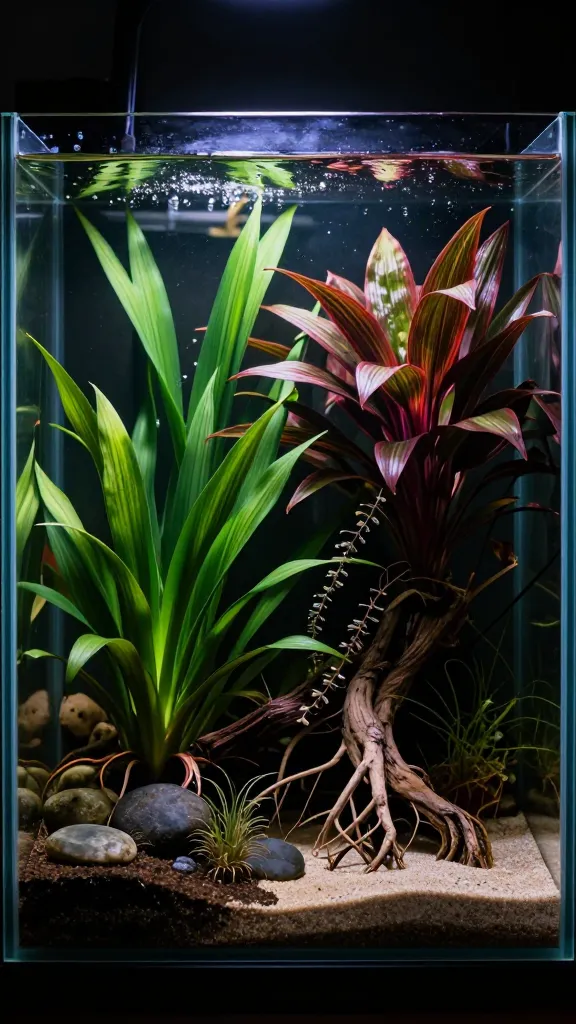
Weight belongs low; when the base is darker and denser, the thicket looks anchored instead of top-heavy. In a 75-gallon, use a 2-3 inch nutrient-rich substrate sloped 1 inch higher in back, cap with a thin layer of sand only in the front 1/4 for contrast. Choose root-feeders that bulk the lower half: Cryptocoryne usteriana, Barclaya longifolia, and a colony of Echinodorus ‘Ozelot’, letting leaves reach 1/2 to 2/3 of the height. Thread Pogostemon stellatus ‘Octopus’ sparingly for motion. In 6 weeks the crypts will lock the slope; do not uproot them once settled—divide by side shoots instead. The failure here is a skyline of lanky stems and a bare base; if you see stems showing knees, add rosettes.
9. Fish-Led Paths: Sightlines Sized to the Inhabitants
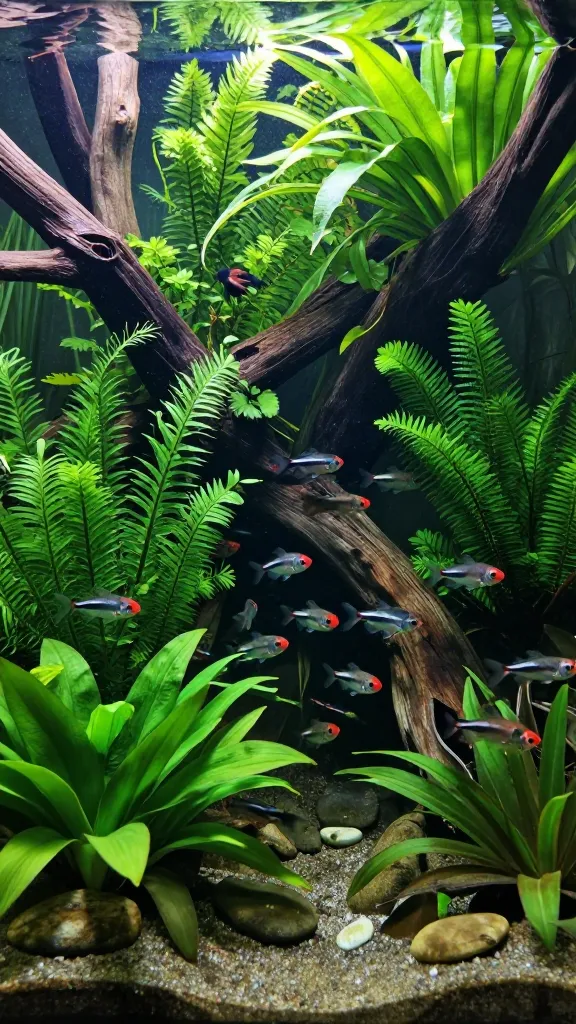
Design is for the animals; if you scale alleys to your fish, the layout composes itself as behavior. For a group of rummynose tetras (Hemigrammus bleheri) in a 36-gallon bowfront, leave two lanes 3 inches wide that run from front to back, weaving around wood. Plant dense flanks with Limnophila sessiliflora and Cryptocoryne pontederiifolia, plus Java fern on the wood for mid-level cover. Trim every 2-3 weeks to keep lanes open at eye level; the school will reward you by using them, and you’ll read rhythm rather than blur. This fails when hedges close the paths; if the fish hesitate, you planted over their doorway—cut it back that day.
10. Patina, Not Pruning: Letting the Jungle Earn Its Age
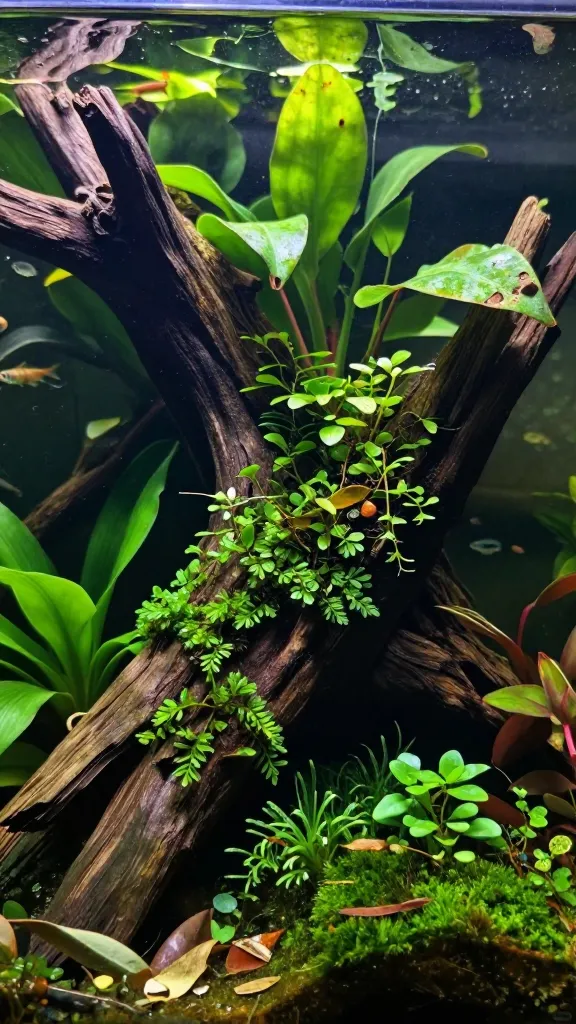
Age is a layer; letting epiphytes beard the wood and allowing leaf margins to show maturity creates a believable forest. In a 60-gallon, overplant slow growers—Buces, Anubias petite, Bucephalandra ‘Green Wavy’—and give them 10-12 weeks under moderate light. Trim only to remove full leaves, never tip-prune epiphytes; let Taxiphyllum barbieri ramble to 1-2 inches before thinning by hand. My firm view: a jungle that looks perfect on day one is over-designed—start loose, plant heavy, and edit after the first 6 weeks once the plants show you their lines. The failure mode is impatience; fussy weekly cuts make the tank read as groomed hedges, not a living thicket.
Frequently Asked Questions
How long does a jungle aquascape take to look “grown in”?
Give it 6 weeks before you judge structure, and 10-12 weeks for slow epiphytes to add depth. Fast stems like Hygrophila and Limnophila will fill space in 2-3 weeks, but wait for crypts, ferns, and buces to establish. At that point, edit with whole-leaf removals instead of wholesale replanting.
Can I build this style without CO2 injection?
Yes, if you choose plants accordingly and accept slower timelines. Use Java fern, Anubias, Bucephalandra, Cryptocoryne, and Vallisneria, and keep light moderate to prevent algae on slow leaves. Root tabs beneath heavy feeders help; the 6-week settle still applies.
What fish are comfortable in a dense layout like this?
Schooling fish that appreciate cover do well: Harlequin rasboras (Trigonostigma heteromorpha), rummynose tetras, and small Corydoras for the floor. Size the tank to the species—no large fish in small volumes—and cycle before stocking. Keep open lanes at 2-3 inches wide so they can school visibly.
How do I keep a jungle aquascape from turning into an untrimmed mess?
Define non-negotiables and enforce them: an open band of sand, a midwater gap, or two clear sightlines. Trim on a schedule—every 2-3 weeks for stems, every 6 weeks for crypts and swords—removing whole leaves and resetting lines. Consistency is calmer than big seasonal overhauls.
What substrate works best for this kind of layout?
A nutrient-rich soil helps rosette plants and swords drive the base, capped with cosmetic sand only where you want contrast. Aim for 2-3 inches overall with a 1 inch back-to-front slope to add depth. If you use inert gravel, supplement with root tabs under heavy feeders every 4-6 weeks.
How many species should I use in a jungle aquascape without it feeling busy?
Choose 5-7 species and plant them in large groups rather than one pot of everything. Repetition creates harmony: three or four big colonies read as intentional mass. Add one accent at most, then give it 6 weeks before deciding if you need more.
Let the Water Decide the Thicket
A jungle layout is density arranged by rules: one direction of growth, a kept void, or a single accent that tells the story. Tonight, stand at the glass and choose one boundary—clear the midwater band to 1/2 height or redraw the sand margin to a clean arc—and hold it for 6 weeks while the plants speak.
Questions about your own scape? Leave them in the comments and I will answer them. — Julian