12 Aquascape Aquarium Showcase Layouts — What Each One Teaches
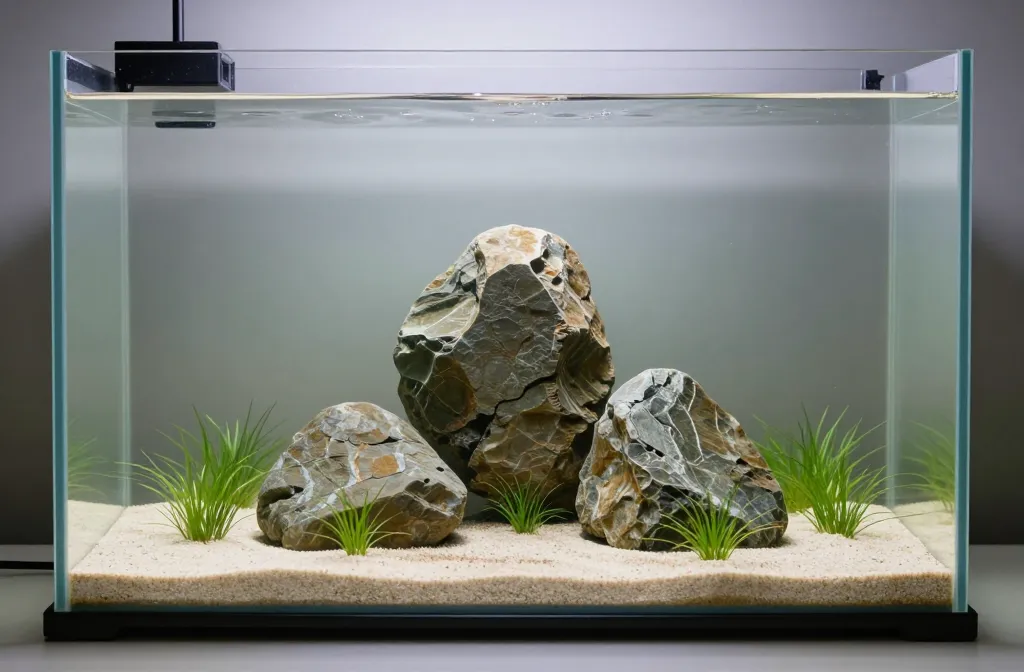
Light spills across a bare sand lane; three stones lean into it and the glass waits for your hand. These aquascape aquarium showcase layouts are the ones you can build and live with, and each teaches a rule you can reuse in any tank you own. By the end you will have chosen a direction, a plant list you can source, and a rhythm for how the next 6 weeks will look while the scape settles. Every idea names the proportions, the species, and the time; none asks for gear you don’t have. Your fish and shrimp remain the reason the layout exists.
1. Classic Iwagumi Triangle: One Peak, Two Supporters
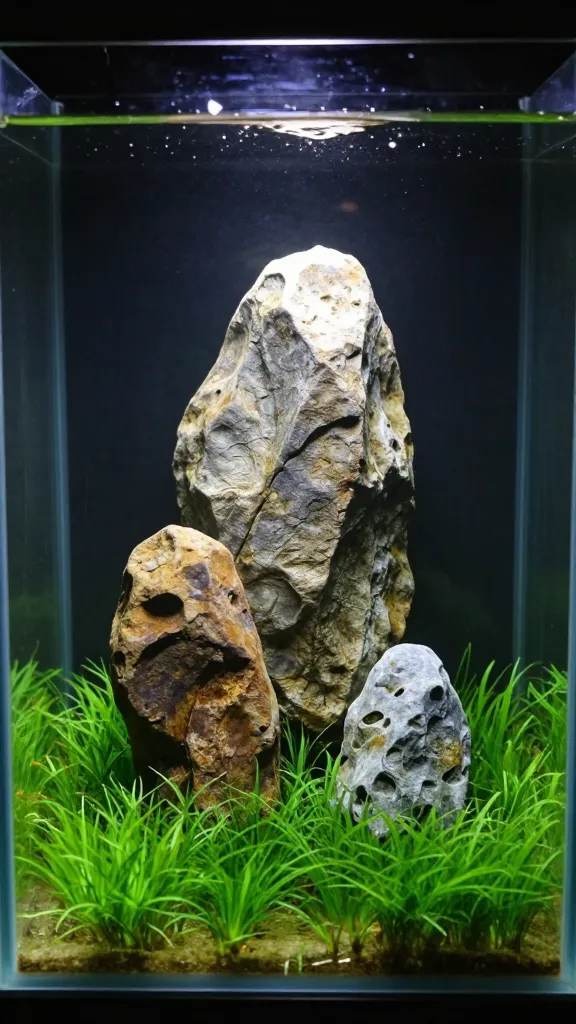
A layout reads cleanly when a single height wins and every other line yields to it. Set a triangle with three Seiryu stone or Ohko (dragon stone) pieces in a 20-gallon long: the tallest at 2/3 of tank height, set off-center at the rule-of-thirds, one secondary stone at half that height echoing its face, and a tertiary stone at 1/3. Plant a low carpet of Dwarf hairgrass (Eleocharis acicularis) around the feet and keep the rear open. Give it 6 weeks to knit; trim runners, not tips. When this fails it is because the stones are similar in size, which flattens the hierarchy into rubble.
2. Island on Sand: Negative Space Does the Heavy Lifting
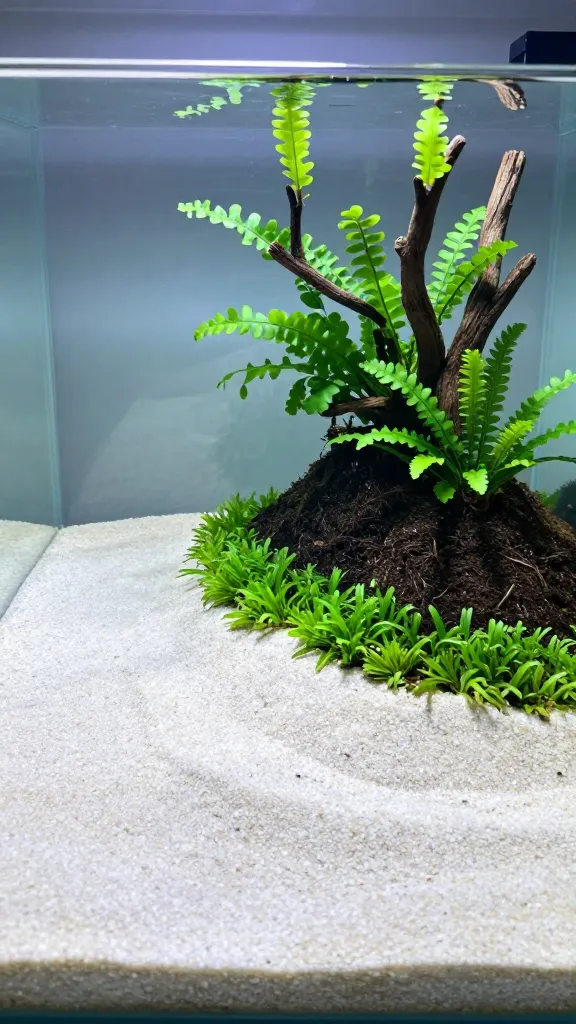
Empty water is a design element; letting the eye rest across an open forecourt makes a small tank feel large. In a 10-gallon, pour a 6-inch-wide crescent of pale cosmetic sand from front-left to mid-right, and raise a mound of aquasoil on the back-right to form a single “island.” Anchor with Manzanita wood and plant the mound with Cryptocoryne wendtii ‘Green’ at mid and Staurogyne repens at the front edge; tuck Microsorum pteropus (Java fern) on the wood. Keep the sand scrupulously clean and unplanted. If the mound spreads into the sand, the negative space collapses and the composition loses its breath.
3. Dutch-Style Bands: Rhythm Through Height and Color
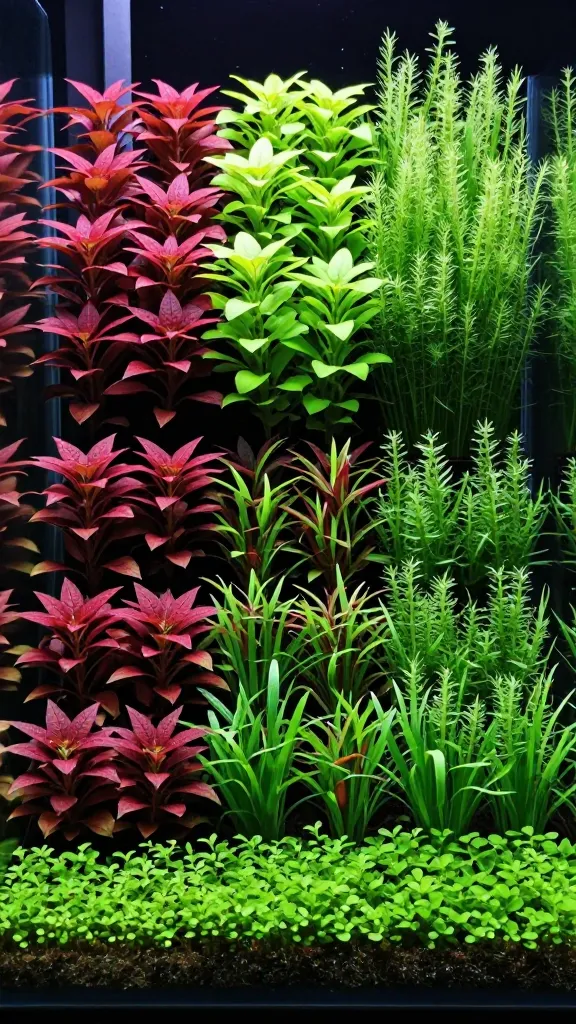
Order comes from distinct groups with deliberate height steps rather than a mixed border. In a 29-gallon, plant five to seven contrasting stem “streets” in 4-inch-wide bands: rear-left Ludwigia repens, center-rear Hygrophila polysperma, rear-right Limnophila sessiliflora; mid rows of Alternanthera reineckii ‘Mini’ and Pogostemon erectus; front with Cryptocoryne parva. Trim weekly for 6 weeks to set the steps, then every 2 weeks. Failure looks like checkerboard chaos: too many species under 10 and no clear height difference between neighbors.
4. Blackwater Roots: Light as Mood, Not Spotlight
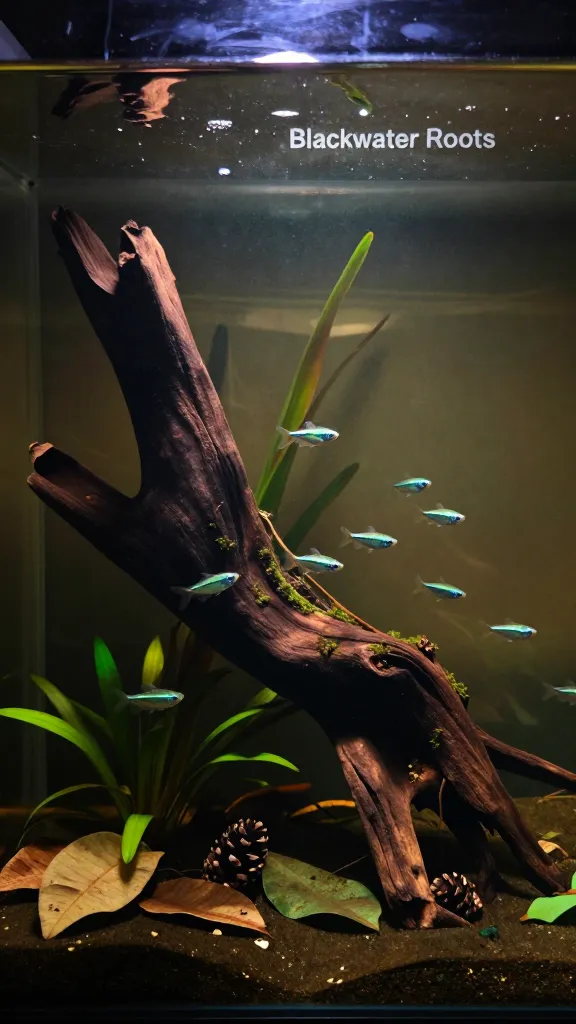
Low light and tannins calm fish and soften edges so silhouette replaces color. In a 20-gallon high, lay Malaysian driftwood roots diagonally from back-left to front-right at 30–40°; leaf-litter with catappa leaves and alder cones. Plant shade lovers: Bucephalandra sp. on wood, Anubias barteri var. nana low, and sparse clumps of Cryptocoryne usteriana rear. Keep light modest and water tea-colored; give 6 weeks for biofilm to settle before adding sensitive species like Paracheirodon simulans. When it fails, the wood floats above a flat substrate or the leaves are cleaned away, stripping the scene of its softness and cover.
5. The River Bend: Flow Lines Unite the Tank
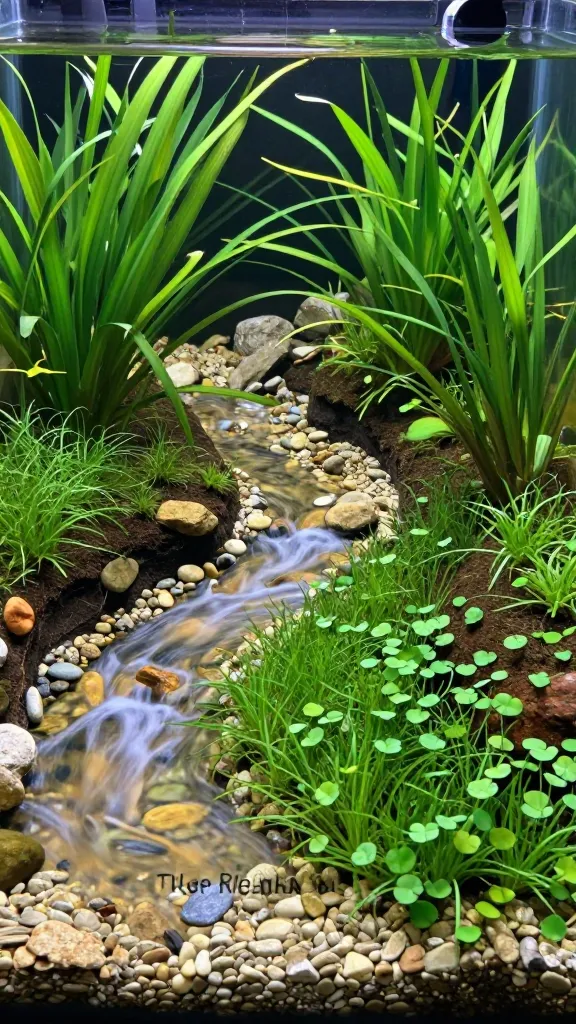
When every element points in the same direction, the eye follows without being told. In a 40-gallon breeder, cut a sinuous gravel “river” 4–6 inches wide from back-left to front-center using small rounded stones; raise banks with aquasoil and terrace with river cobbles. Plant upstream banks with Vallisneria spiralis and Cryptocoryne balansae; downstream shallows with Helanthium tenellum and patches of Marsilea hirsuta. Run gentle laminar flow along the river’s arc. If the cobbles are the same size and scattered evenly, the bend reads as a toy train track instead of a current-cut channel.
6. Moss-Covered Branchwork: Repetition Builds Credibility
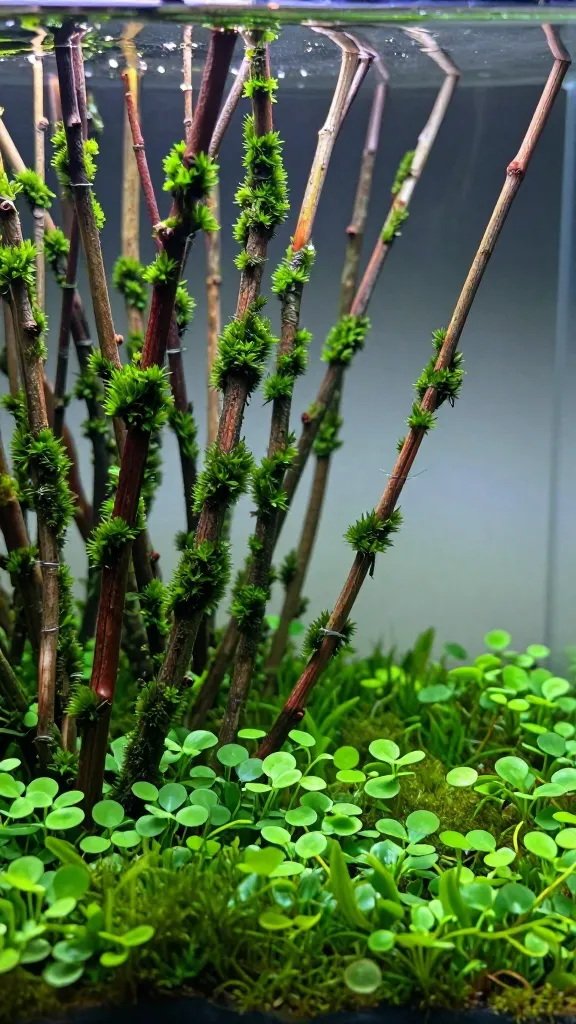
A forest convinces when many small gestures echo one another rather than one big statement shouting. In a 17-gallon, assemble a thicket of thin Manzanita twigs all leaning to the same vanishing point. Wrap each sparingly with Taxiphyllum barbieri (Java moss) tied with cotton thread; keep moss on 1/3 of the branch length so wood still reads. Plant a simple base of Micranthemum ‘Monte Carlo’ (M. tweediei); give 6 weeks for moss to root before your first tight trim. Overwrapping or mixing three mosses turns it into shag carpet and erases the branch rhythm.
7. Rocky Scree Slope: Texture Scales the Scene Down
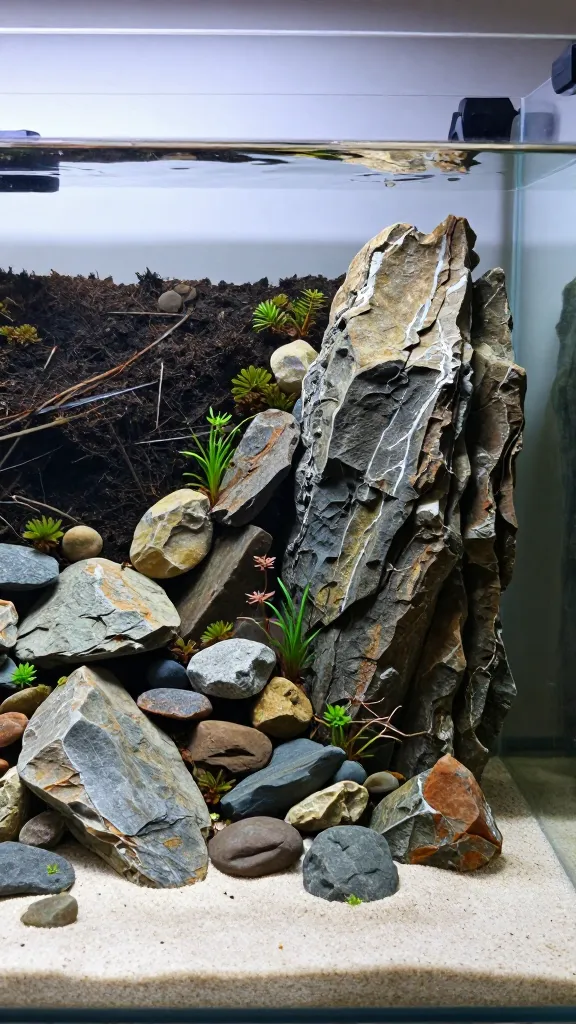
Fine texture suggests distance; a slope that graduates stone size sells depth better than forced perspective alone. In a 20-gallon long, stack Seiryu stone fragments from pea-sized scree at the back down to thumb-sized at the front, with a main spur at mid-right rising to 1/2 tank height. Backfill with aquasoil; plant Riccardia chamedryfolia (mini pellia) in the back scree and Sagittaria subulata sparingly at mid-slope. Keep front open sand. Failure is mixing too many bold, flat faces—your scree becomes a rock pile and the gradient vanishes.
8. Jungle Midground: Overlap Creates Depth Without Hard Rules
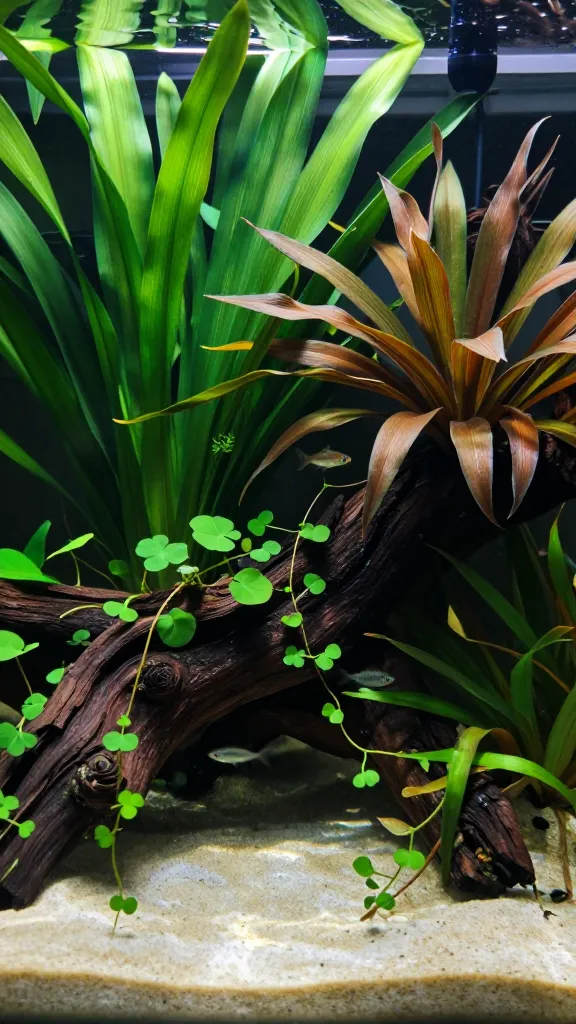
Depth in a relaxed scape comes from overlapping leaves that hide edges and let fish disappear, not from perfect geometry. In a 55-gallon, group broad-leaved Echinodorus bleheri rear-left, a mid swath of Bolbitis heudelotii on wood, and multiple clumps of Cryptocoryne wendtii ‘Brown’ across mid-right. Thread runners of Hydrocotyle tripartita along wood to stitch zones; leave a 6–8-inch swimming lane at the front. Give 6 weeks before a hard cut so the overlaps establish. The miss is spacing every plant equidistant like houseplants on a shelf—no overlap, no mystery.
9. The Single-Stone Shrine: Discipline Around One Focal
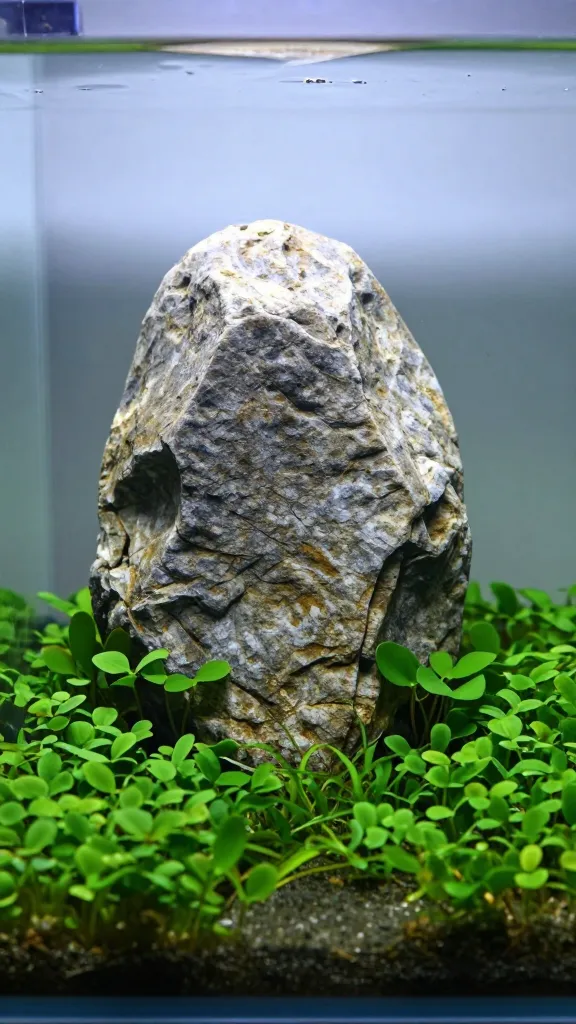
Respect grows when you give one element the room to matter and deny yourself the urge to add a second hero. In a 7.5-gallon cube, place one Yamaya stone or weathered granite chunk 60–70% of tank height, set 1/3 from either side with its grain facing inward. Plant a restrained carpet of Hydrocotyle verticillata or a thin sward of Lilaeopsis brasiliensis; two small tufts of Anubias nana ‘Petite’ tucked into the stone’s base. Wait 6 weeks for the carpet to close. This fails when you add a second large rock “for balance,” which splits the eye and turns a shrine into a yard sale.
10. Low-Tech Meadow: Lightness from Air-Gapped Plants
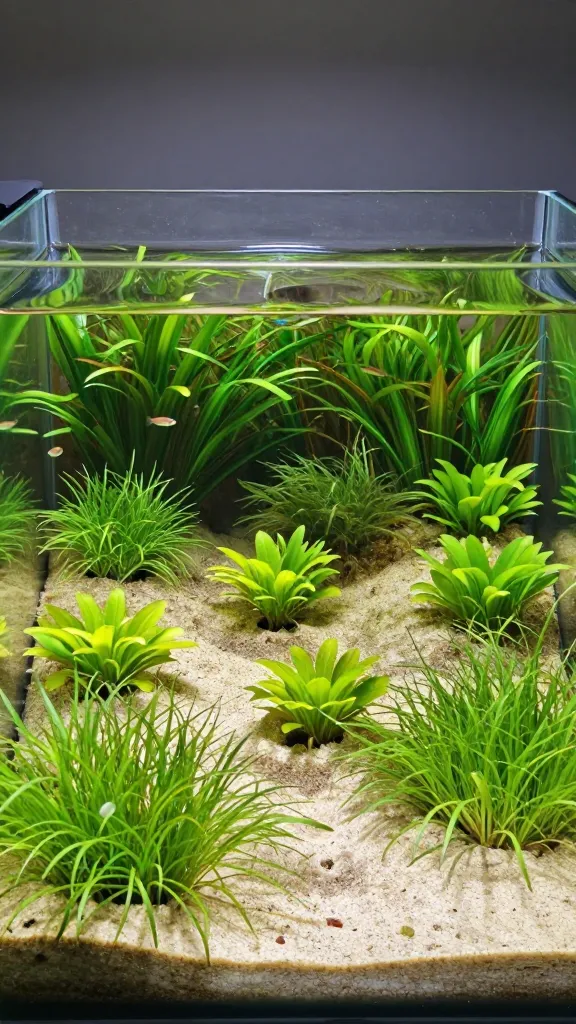
Air between stems is as important as the stems themselves; leaving intentional gaps keeps a no-CO2 scape from reading heavy. In a 15-gallon, plant small clumps of Cryptocoryne lutea 3 inches apart across the mid, intersperse with tufts of Blyxa japonica, and rim the rear with Hygrophila corymbosa ‘Siamensis 53B’ kept at 2/3 height by monthly trims. Front with patches of Eleocharis pusilla and bare sand in between. Overplanting or letting every clump touch smothers flow and the meadow turns to thicket; give it 6 weeks to find its spacing, and trim to preserve the gaps.
11. Roots Over Stone: Contrast Carries the Story
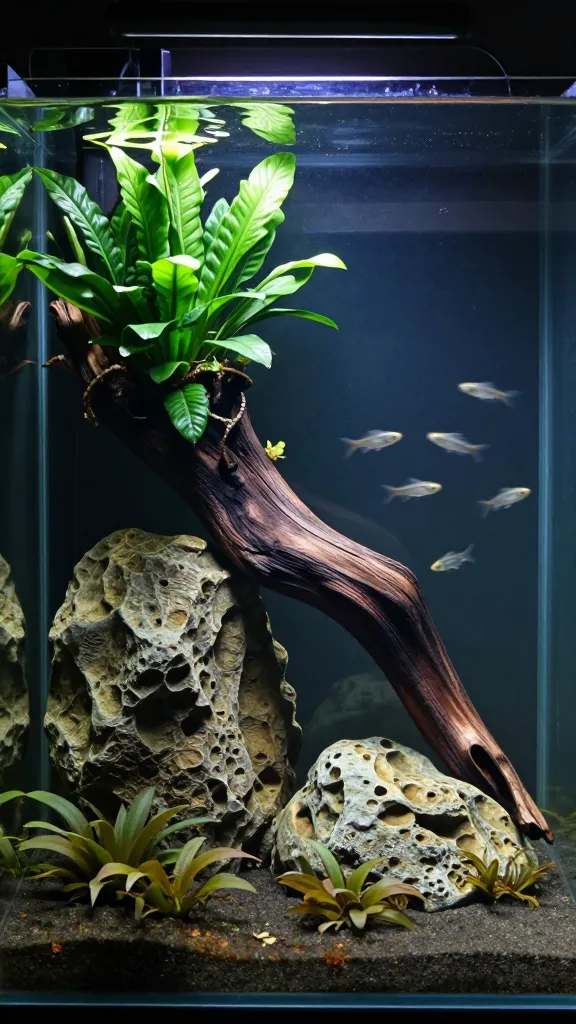
Hard meets soft is a conversation you can read from across the room; contrast of line and texture animates a quiet layout. In a 36-gallon bowfront, seat two Dragon stones low, then pin an arching Spider wood root over them so wood crosses stone at 45°. Epiphyte the wood with Anubias barteri var. coffeefolia and Bucephalandra ‘Green Wavy’; plant a subdued base of Cryptocoryne beckettii. Keep the rear water column open for schooling fish. If the wood and stone are the same visual weight or parallel, the contrast dies and the scape goes static.
12. High Canopy, Low Floor: Light Direction Guides Behavior
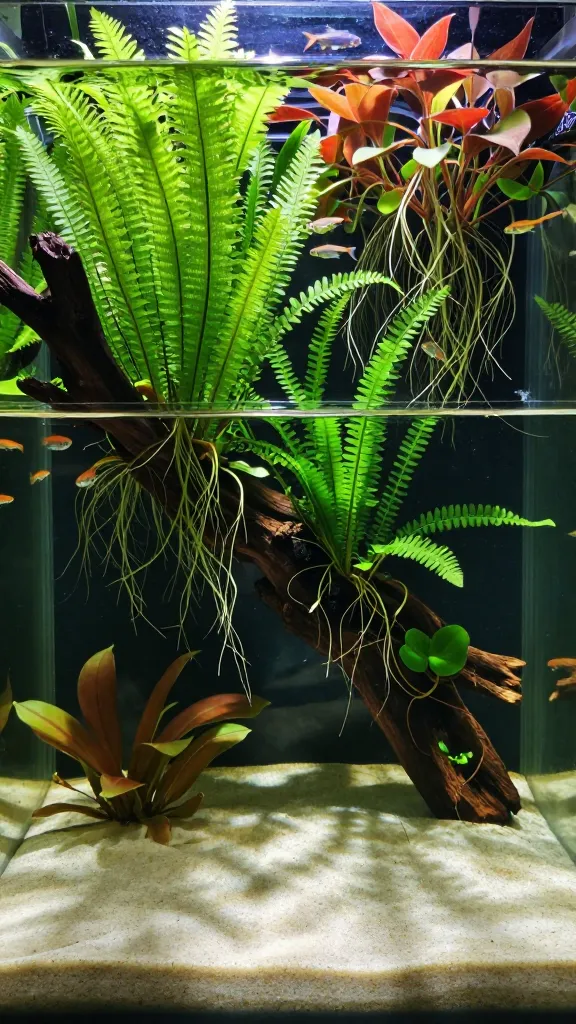
Fish behave differently when cover is above and the floor is open; design the ceiling first, then the ground. In a 24-inch-tall 30-gallon, build a crown of Ceratopteris thalictroides (water sprite) and Phyllanthus fluitans (red root floater); mount Microsorum pteropus ‘Trident’ on mid-height wood, and keep the substrate mostly bare with a 3-inch ribbon of Cryptocoryne nurii. Angle light slightly forward so the foreground gleams under dappled shade. Give 6 weeks for roots to curtain down; trim floaters to 60–70% coverage. Failure is letting the floor fill—once the carpet closes, the ceiling–floor dialogue is lost.
Frequently Asked Questions
How long should I give a new aquascape aquarium layout before judging it?
Give it 6 weeks. That’s enough time for roots to anchor, for initial melt to pass on species like Cryptocoryne, and for your first shaping trims to take effect without destabilizing the plants.
Which layouts work best without CO2?
Island on sand, low-tech meadow, blackwater roots, and the single-stone shrine all live comfortably without CO2. Choose hardy plants like Anubias, Java fern, Cryptocoryne wendtii, Hydrocotyle verticillata, and Eleocharis pusilla, keep light moderate, and plan trims every 2 to 3 weeks after the first 6.
What tank size is best for trying an aquascape aquarium showcase with rocks as the focus?
A 20-gallon long is a forgiving start for rock-led layouts like iwagumi or a scree slope. Its footprint gives you room for 2/3–1/3 asymmetry and negative space while keeping stone sizes manageable to source and place.
Can I stock fish right after finishing the layout?
No. Cycle the tank fully and let the scape settle at least 6 weeks before adding sensitive fish, even if your filter seed shortens nitrogen cycling. Shrimp and small clean-up crews also benefit from the biofilm that develops in those 6 weeks.
How do I keep sand lanes clean in the layout long term?
Physically separate sand and soil with a buried barrier of thin plastic or small stones, and siphon the lane lightly at water changes. Reestablish the edge with a card if needed, and resist planting runners near the seam so the negative space holds.
Choose One Gesture and Let It Breathe
Aquascapes fail more from adding than from holding back; decide what matters, then give it room while the living parts make it theirs. Tonight, place your main stone or branch at 1/3, step back 6 feet, and remove anything that competes with it; write the plant list to support that one line, not to fill the catalog.
Questions about your own scape? Leave them in the comments and I will answer them. — Julian